Université Paris Cité, INSERM, INRAE, CRESS, Paris, France.
Faculty of Public Health and Policy, Department of Global Health and Development, London School of Hygiene and Tropical Medicine, London, UK.
Obes Rev. 2023 Jan;24(1):e13524. doi: 10.1111/obr.13524. Epub 2022 Nov 17.
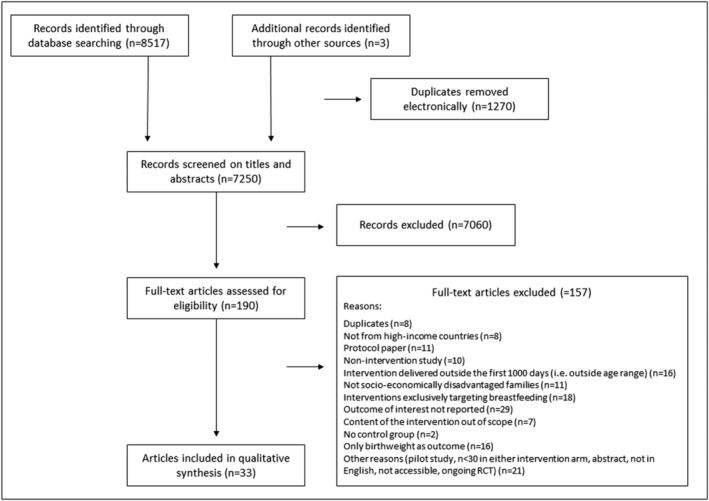
This narrative systematic review examined effectiveness of interventions during pregnancy and up to 2 years of age in improving energy balance-related behaviors or prevent overweight/obesity in children from families experiencing socio-economic disadvantage. We identified 24 interventions, from 33 articles, since 1990. Overall, despite their heterogeneity and variability in internal and external validity, there was some evidence of beneficial impact of interventions on obesity risk (4/15), and associated behaviors, e.g.: breastfeeding (9/18), responsive feeding (11/16), diet (7/8), sedentary (1/3) and movement (4/7) behaviors, and sleep (1/2). The most effective interventions aimed at promoting breastfeeding commenced antenatally; this was similar for the prevention of obesity, provided the intervention continued for at least 2 years postnatally and was multi-behavioral. Effective interventions were more likely to target first-time mothers and involve professional delivery agents, multidisciplinary teams and peer groups. Among ethnic/racial minorities, interventions delivered by lay agents had some impact on dietary behavior but not weight outcomes. Co-creation with stakeholders, including parents, and adherence to theoretical frameworks were additional ingredients for more pragmatic, inclusive, non-judgmental, and effective programs. The growing body of evidence on obesity prevention interventions targeting families experiencing socio-economic disadvantage is promising for reducing early inequalities in obesity risk.
本叙述性系统评价考察了在妊娠期间及 2 岁以下阶段实施干预措施,以改善来自社会经济弱势群体家庭的儿童与能量平衡相关的行为或预防超重/肥胖的效果。自 1990 年以来,我们从 33 篇文章中确定了 24 项干预措施。尽管这些干预措施在内部和外部有效性方面存在异质性和可变性,但仍有一些证据表明干预措施对肥胖风险(4/15)和相关行为,如母乳喂养(9/18)、反应性喂养(11/16)、饮食(7/8)、久坐(1/3)和运动(4/7)行为和睡眠(1/2)具有有益影响。最有效的干预措施旨在促进母乳喂养,起始于产前;对于预防肥胖也是如此,前提是干预措施至少持续到产后 2 年以上,并且是多行为的。有效的干预措施更有可能针对初产妇,并涉及专业的分娩代理、多学科团队和同伴群体。在少数族裔/种族群体中,由非专业人士提供的干预措施对饮食行为有一定影响,但对体重结果没有影响。与利益相关者共同创造,包括父母,并遵循理论框架,是更务实、包容、非评判和有效的计划的其他要素。针对社会经济弱势群体家庭的肥胖预防干预措施的证据不断增加,这为减少肥胖风险的早期不平等带来了希望。