Frenoy Pauline, Vandentorren Stéphanie, Arnaud Amandine, Vuillermoz Cécile, Rico Berrocal Raquel, Martin-Fernandez Judith, Azria Elie, de Lauzon-Guillain Blandine, Bernard Jonathan Y, Lioret Sandrine
Université de Paris, CRESS, INSERM, INRAE, Paris, France.
Santé Publique France, French National Public Health Agency, Saint-Maurice, France.
Matern Child Nutr. 2021 Jul;17(3):e13167. doi: 10.1111/mcn.13167. Epub 2021 Mar 29.
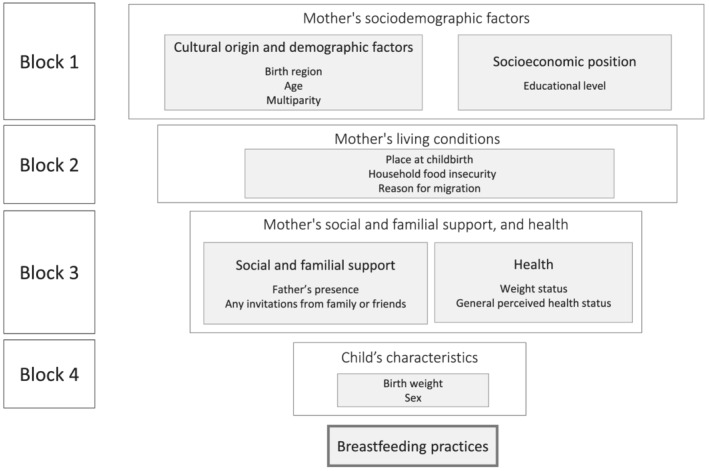
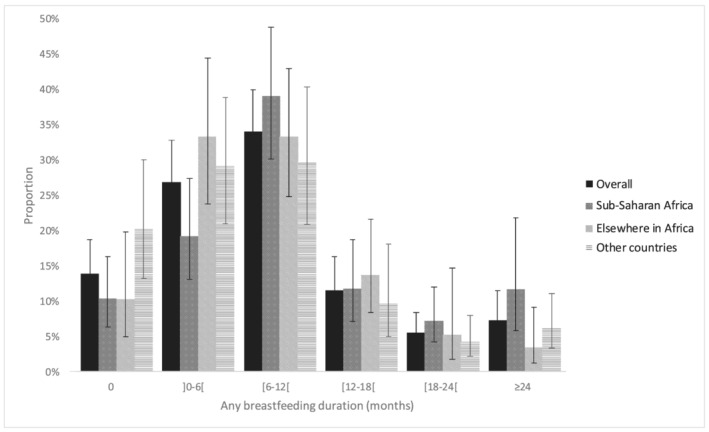
In high-income countries, breastfeeding has been shown to be positively associated with socioeconomic position. However, less is known about breastfeeding practices and their associated factors among extremely disadvantaged populations. We aimed to assess the associations of cultural origins and socioeconomic factors with any breastfeeding initiation and duration in homeless families. We analyzed data from 456 children aged 6 months to 5 years from the cross-sectional ENFAMS survey, conducted in 2013 among a random sample of homeless families in shelters in the Greater Paris area. Data were collected by bilingual interviewers in 17 languages. Four nested multivariable robust Poisson regression models were run in a hierarchical framework to determine the factors associated with breastfeeding initiation and with any breastfeeding for 6 months or more. Most of the children (86.0%) had previously been or were currently being breastfed at the time of the survey; 58.9% were fed with breast milk ≥6 months. A higher maternal age and African origin were positively associated with breastfeeding ≥6 months, although the relation to the region of origin was moderated by education level. Migration to escape war, unrest or other violence and the child's birth in France were inversely associated with breastfeeding ≥6 months. Any breastfeeding by these homeless mothers seems influenced predominantly by their cultural origin and complicated by a difficult migration trajectory. The possible influence of poor material circumstances and cumulative hardship should encourage interventions targeted at homeless mothers that emphasize social/family support with a commitment to improving the family's living conditions.
在高收入国家,母乳喂养已被证明与社会经济地位呈正相关。然而,对于极度弱势人群的母乳喂养行为及其相关因素,我们了解得较少。我们旨在评估文化背景和社会经济因素与无家可归家庭中母乳喂养的开始及持续时间之间的关联。我们分析了来自横断面ENFAMS调查的456名6个月至5岁儿童的数据,该调查于2013年在大巴黎地区收容所中的无家可归家庭随机样本中进行。数据由会说17种语言的双语访员收集。在分层框架中运行了四个嵌套的多变量稳健泊松回归模型,以确定与母乳喂养开始以及持续6个月或更长时间的母乳喂养相关的因素。在调查时,大多数儿童(86.0%)曾经或正在接受母乳喂养;58.9%的儿童接受母乳喂养≥6个月。较高的母亲年龄和非洲裔与母乳喂养≥6个月呈正相关,尽管与原籍地区的关系受到教育水平的调节。为逃避战争、动荡或其他暴力而移民以及孩子在法国出生与母乳喂养≥6个月呈负相关。这些无家可归母亲的任何母乳喂养行为似乎主要受其文化背景影响,并因艰难的移民轨迹而变得复杂。物质条件差和累积困难可能产生的影响应促使针对无家可归母亲的干预措施,强调社会/家庭支持,并致力于改善家庭生活条件。