Bukhary Fouzia A, Obeid Amal M, Alsayyad Hanan M, Okmi Ezzuddin A
Health Affairs Directorate, Ministry of Health, Makkah, KSA.
Yousef Abdulatif Jameel Scientific Chair of Prophetic Medicine Application, King Abdulaziz University Hospital, King Abdulaziz University, Jeddah, KSA.
J Taibah Univ Med Sci. 2022 Aug 14;18(1):74-83. doi: 10.1016/j.jtumed.2022.07.012. eCollection 2023 Feb.
The aim of this study was to explore the potential effect of Hijama in promoting oral health by analyzing its effects in modulating saliva flow and pH.
An open-label, non-randomized controlled trial design was conducted at the Hijama clinic of Y.A. Jameel Scientific Chair of Prophetic Medical Applications at King Abdul Aziz University Hospital (KAUH), Jeddah, KSA. Forty-one healthy volunteers were divided into two groups: Hijama (intervention, = 21) and control ( = 20). Saliva volume and pH were measured in salivary samples collected in a standardized fashion, 1 h before admission to the Hijama room (pre-Hijama) and 30 min after the procedure (post-Hijama) in both groups. The Hijama group underwent an additional salivary collection 7 days after Hijama.
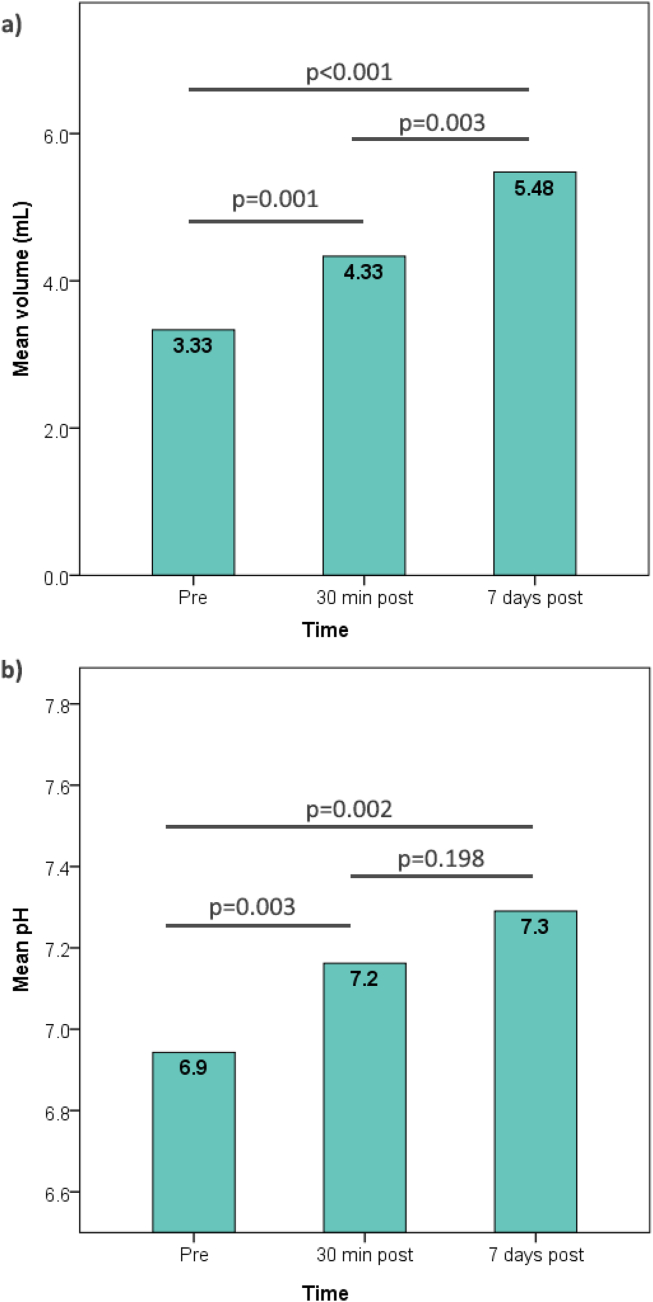
Early post-Hijama assessment showed an increase in saliva volume by an average of 1 mL in the Hijama group, whereas that in the control group decreased by 0.6 mL ( < 0.001; large effect size, Cohen's = 1.24). Saliva pH also increased in the Hijama group by an average 0.22 but decreased by 0.08 in controls ( < 0.001; large effect size, Cohen's = 1.22). The multivariate model demonstrated that Hijama explained 48.8% of the variability of both pH and volume together (group × time effect, eta squared = 0.488, < 0.001), whereas time and sex had no effect. At 7 days post-Hijama, both the volume and pH of saliva had increased in the Hijama group with respect to the early post-Hijama time point; however, only the volume increase was statistically significant.
Hijama enhanced salivary function and induced a significant increase in saliva volume and pH, which was maintained 7 days after the intervention. Further studies are warranted to identify other effects of Hijama on salivary glands and explore its long-term efficacy and clinical applications.
本研究旨在通过分析拔罐疗法调节唾液流量和pH值的作用,探讨其对促进口腔健康的潜在影响。
在沙特阿拉伯吉达阿卜杜勒阿齐兹国王大学医院(KAUH)的先知医学应用Y.A.贾米尔科学主席拔罐诊所进行了一项开放标签、非随机对照试验设计。41名健康志愿者被分为两组:拔罐组(干预组,n = 21)和对照组(n = 20)。两组均在进入拔罐室前1小时(拔罐前)和拔罐操作后30分钟(拔罐后)以标准化方式收集唾液样本,测量唾液体积和pH值。拔罐组在拔罐7天后进行了额外的唾液采集。
拔罐后早期评估显示,拔罐组唾液体积平均增加1 mL,而对照组减少0.6 mL(P < 0.001;效应量较大,科恩d值 = 1.24)。拔罐组唾液pH值也平均增加0.22,而对照组下降0.08(P < 0.001;效应量较大,科恩d值 = 1.22)。多变量模型表明,拔罐疗法共同解释了pH值和体积变异性的48.8%(组×时间效应,η² = 0.488,P < 0.001),而时间和性别没有影响。在拔罐后7天,拔罐组唾液的体积和pH值相对于拔罐后早期时间点均有所增加;然而,只有体积增加具有统计学意义。
拔罐疗法增强了唾液功能,使唾液体积和pH值显著增加,且在干预后7天仍保持这一效果。有必要进一步研究以确定拔罐疗法对唾液腺的其他影响,并探索其长期疗效和临床应用。