Department of Thyroid Surgery, People's Hospital of Ganzhou, Ganzhou, China.
Department of Oncology, Ganxian People's Hospital of Ganzhou, Ganxian, China.
Medicine (Baltimore). 2022 Nov 18;101(46):e31911. doi: 10.1097/MD.0000000000031911.
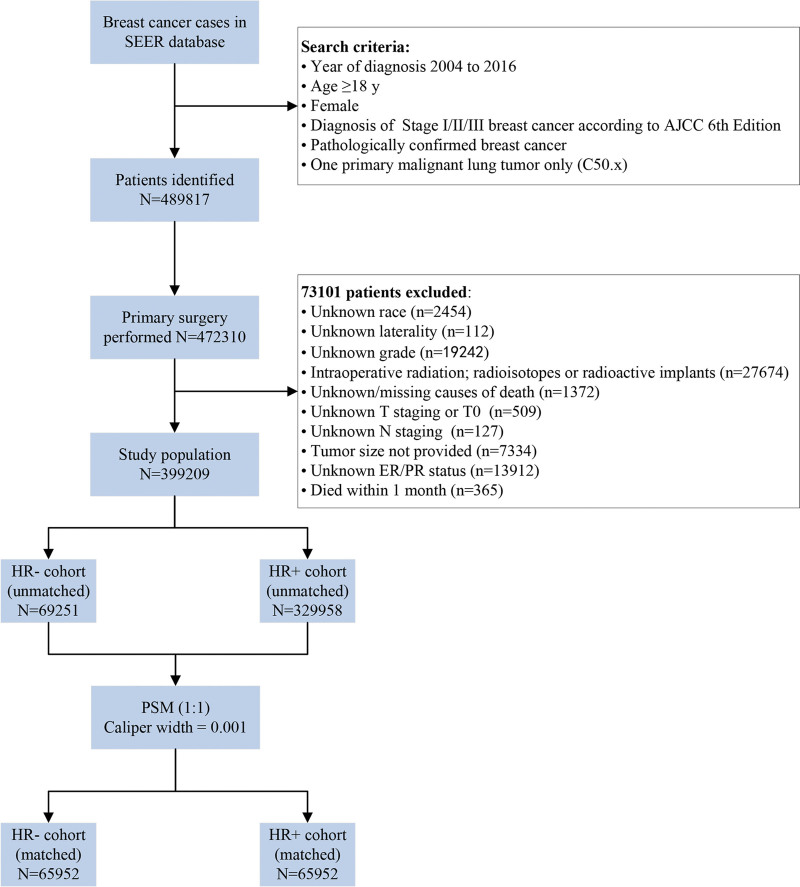
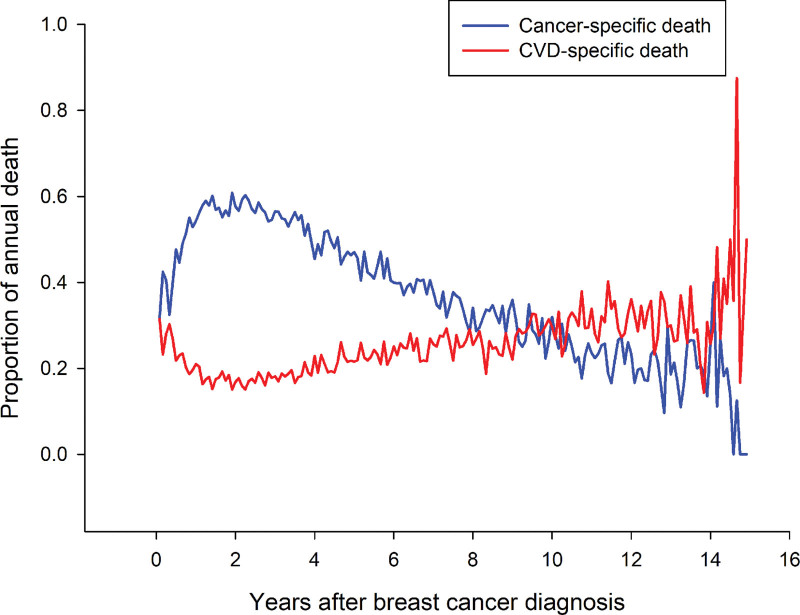
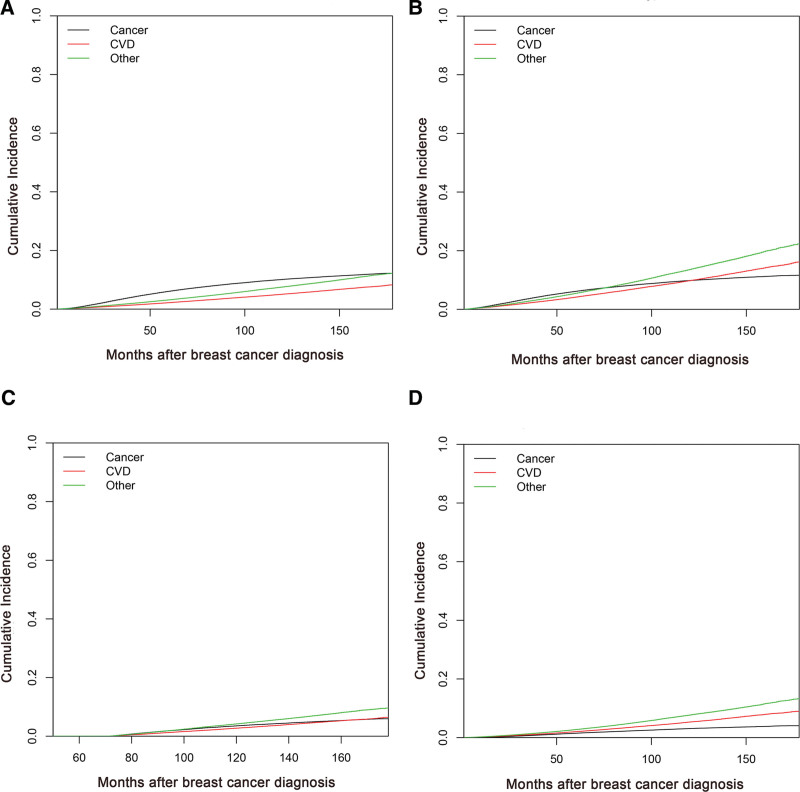
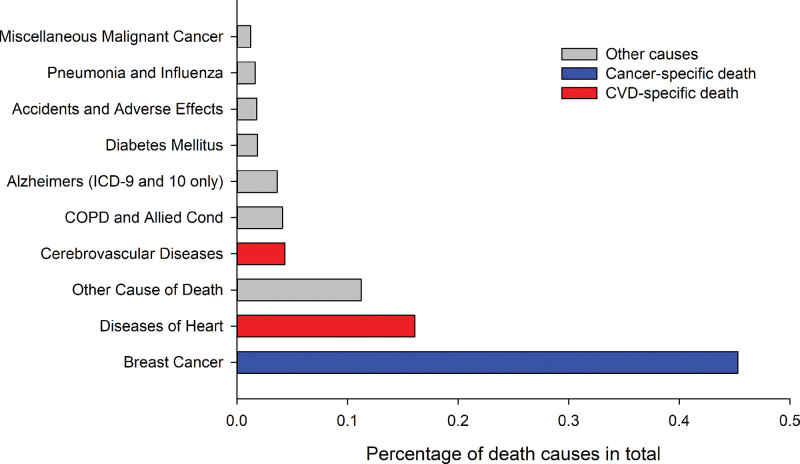
Adjuvant endocrine therapy (AET) is known to reduce the risk of hormone receptor-positive (HR+) breast cancer (BC) recurrence and mortality rates, but its impact on cardiovascular disease (CVD) events is unclear. The primary objective of this study was to analyze the association of HR status with CVD mortality in patients with stage I to III BC. A retrospective study of patients with stage I to III BC was conducted using the 2004 to 2016 Surveillance, Epidemiology, and End Results (SEER) database, and patients were grouped according to their HR status. Propensity score matching (PSM) was used to adjust for heterogeneity between the groups. The cumulative incidence rate of CVD mortality was evaluated via a cumulative incidence curve. Univariate and multivariate Fine and Gray's competing risk regression models were used to identify risk factors associated with CVD mortality. In total, 399,209 patients with BC were included in this study, and 329,958 patients (82.65%) were HR-positive. The cumulative incidence of CVD death was 8.28% in stage I to III BC patients. In the constituent ratio analysis, primary BC was the leading cause of death (45.29%, N = 31,465), followed by heart disease (16.07%, N = 11,166). Compared to the second year following BC diagnosis, the risk of CVD-specific death gradually increased. After PSM, 65,952 pairs of patients were matched, which led to the equilibrium of all variables between the HR-negative cohort and HR+ cohort. Multivariate analysis indicated that HR status was not significantly associated with the risk of CVD mortality, with a hazard ratio of 1.01 (P = .895). This study highlights the importance of understanding the associations between risk factors and CVD for BC patients. HR status was not associated with the risk of CVD mortality in this study.
辅助内分泌治疗(AET)已知可降低激素受体阳性(HR+)乳腺癌(BC)复发和死亡率,但对心血管疾病(CVD)事件的影响尚不清楚。本研究的主要目的是分析 HR 状态与 I 期至 III 期 BC 患者 CVD 死亡率的关系。使用 2004 年至 2016 年的监测、流行病学和最终结果(SEER)数据库对 I 期至 III 期 BC 患者进行回顾性研究,并根据 HR 状态对患者进行分组。采用倾向评分匹配(PSM)调整组间异质性。通过累积发生率曲线评估 CVD 死亡率的累积发生率。采用单变量和多变量 Fine 和 Gray 竞争风险回归模型确定与 CVD 死亡率相关的危险因素。本研究共纳入 399209 例 BC 患者,其中 329958 例(82.65%)为 HR+。I 期至 III 期 BC 患者 CVD 死亡的累积发生率为 8.28%。在构成比分析中,原发性 BC 是主要死亡原因(45.29%,N=31465),其次是心脏病(16.07%,N=11166)。与 BC 诊断后第二年相比,CVD 特异性死亡的风险逐渐增加。PSM 后,匹配了 65952 对患者,使 HR-阴性队列和 HR+队列之间的所有变量达到平衡。多变量分析表明,HR 状态与 CVD 死亡风险无显著相关性,风险比为 1.01(P=0.895)。本研究强调了了解 BC 患者危险因素与 CVD 之间关系的重要性。在本研究中,HR 状态与 CVD 死亡率的风险无关。