Institute of Medical Biometry and Epidemiology, University Medical Center Hamburg-Eppendorf, Martinistraße 52, 20246, Hamburg, Germany.
Division of Cancer Epidemiology, German Cancer Research Centre, Im Neuenheimer Feld 280, 69120, Heidelberg, Germany.
Breast Cancer Res. 2023 Jul 27;25(1):89. doi: 10.1186/s13058-023-01680-x.
Cardiovascular disease (CVD) is the leading cause of death worldwide. The aim of this study was to examine if CVD affects the mortality of women after a breast cancer diagnosis and population controls differently.
The analysis included a total of 3,555 women, diagnosed with primary stage 1-3 breast cancer or in situ carcinoma between 2002 and 2005 and 7,334 controls breast cancer-free at recruitment, all aged 50-74 years, who were followed-up in a German breast cancer case-control study until June, 30 2020. Kaplan-Meier and cumulative incidence function were calculated for all-cause mortality and mortality from any cancer, stratified for case-control status and CVD, separately for women aged < 65 and ≥ 65 years. Cox regression and Fine-Gray subdistribution hazard models were used to estimate hazard ratios (HR) and 95% confidence intervals (95% CI) for the association between case-control-status, CVD and mortality from all causes/any cancer.
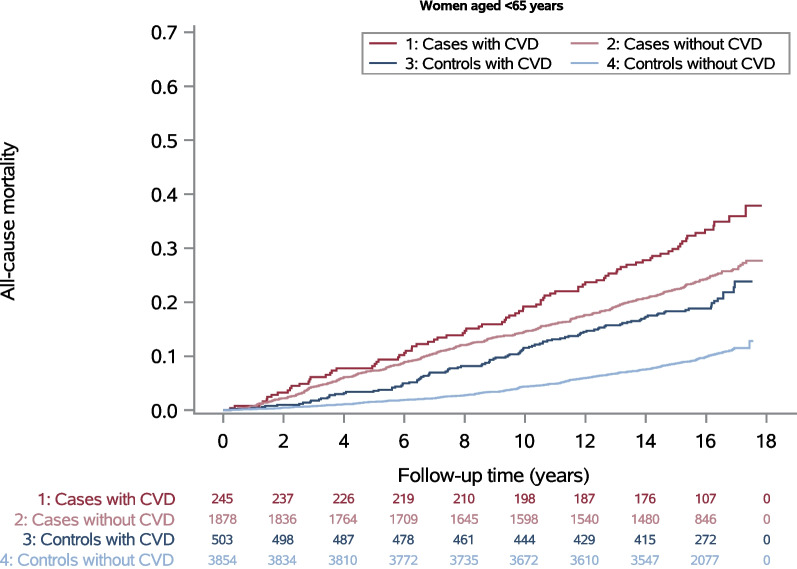
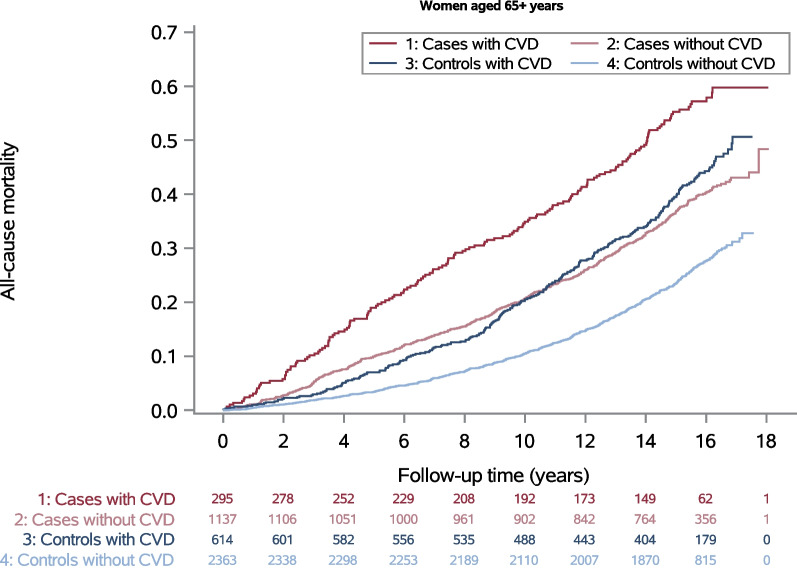
The median follow-up was 16.1 years. In total, 1,172 cases (33.0%) and 1,401 initial controls (19.1%) died. CVD prevalence at recruitment was 15.2% in cases and controls. Cases with CVD had the highest and controls without CVD the lowest mortality during the entire observation period in both age groups (< 65 and ≥ 65 years). CVD was identified as a risk factor for all-cause mortality in both cases and controls aged < 65 years (HR 1.22, 95%CI 0.96-1.55 and HR 1.79, 95%CI 1.43-2.24) as well as at ages of ≥ 65 years (HR 1.44, 95%CI 1.20-1.73 and HR 1.59, 95%CI 1.37-1.83). A significant association of CVD and cancer mortality was found only for cases aged ≥ 65 years.
CVD was significantly associated with all-cause mortality of both cases and controls and CVD was identified as a risk factor for cancer mortality of cases aged ≥ 65 years at recruitment. Therefore, attention should be paid on monitoring and preventing CVD in breast cancer patients, especially in those diagnosed at older ages.
心血管疾病(CVD)是全球范围内的主要死亡原因。本研究旨在探讨 CVD 是否会对女性乳腺癌诊断后的死亡率产生不同的影响,并与人群对照进行比较。
本分析共纳入了 3555 名女性,她们在 2002 年至 2005 年间被诊断为原发性 1-3 期乳腺癌或原位癌,以及 7334 名无乳腺癌的对照人群,年龄均在 50-74 岁之间。所有参与者均参与了一项德国乳腺癌病例对照研究,随访至 2020 年 6 月 30 日。对所有原因死亡率和任何癌症死亡率进行 Kaplan-Meier 和累积发病率函数分析,并根据病例对照状态和 CVD 进行分层,分别针对年龄<65 岁和≥65 岁的女性。使用 Cox 回归和 Fine-Gray 亚分布风险模型来估计病例对照状态、CVD 与所有原因/任何癌症死亡率之间的关联的风险比(HR)和 95%置信区间(95%CI)。
中位随访时间为 16.1 年。共有 1172 例病例(33.0%)和 1401 名初始对照(19.1%)死亡。病例和对照在招募时的 CVD 患病率分别为 15.2%和 15.2%。在两个年龄组(<65 岁和≥65 岁)中,CVD 患者的死亡率最高,而无 CVD 的对照人群的死亡率最低。CVD 被确定为年龄<65 岁的病例和对照人群全因死亡率的一个危险因素(HR 1.22,95%CI 0.96-1.55 和 HR 1.79,95%CI 1.43-2.24),以及年龄≥65 岁的病例和对照人群全因死亡率的一个危险因素(HR 1.44,95%CI 1.20-1.73 和 HR 1.59,95%CI 1.37-1.83)。仅在≥65 岁的病例中发现 CVD 与癌症死亡率之间存在显著关联。
CVD 与病例和对照的全因死亡率显著相关,并且 CVD 被确定为招募时年龄≥65 岁的病例癌症死亡率的一个危险因素。因此,应注意监测和预防乳腺癌患者的 CVD,特别是在年龄较大的患者中。