Key Laboratory of Mountain Surface Processes and Ecological Regulation, Institute of Mountain Hazards and Environment, Chinese Academy of Sciences, #9, Block 4, Renminnanlu Road, Chengdu, 610041, Sichuan, China.
University of Chinese Academy of Sciences, Beijing, 100049, China.
Sci Rep. 2022 Nov 19;12(1):19928. doi: 10.1038/s41598-022-23084-1.
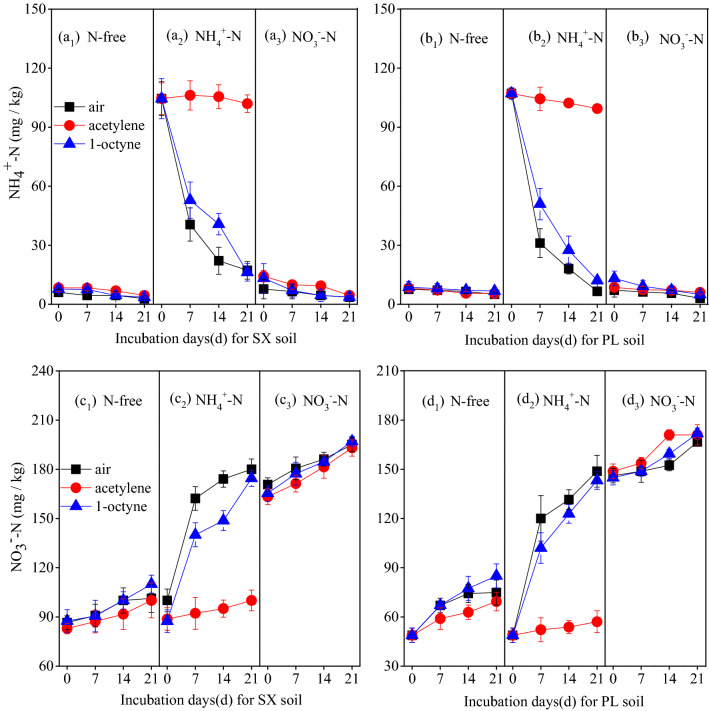
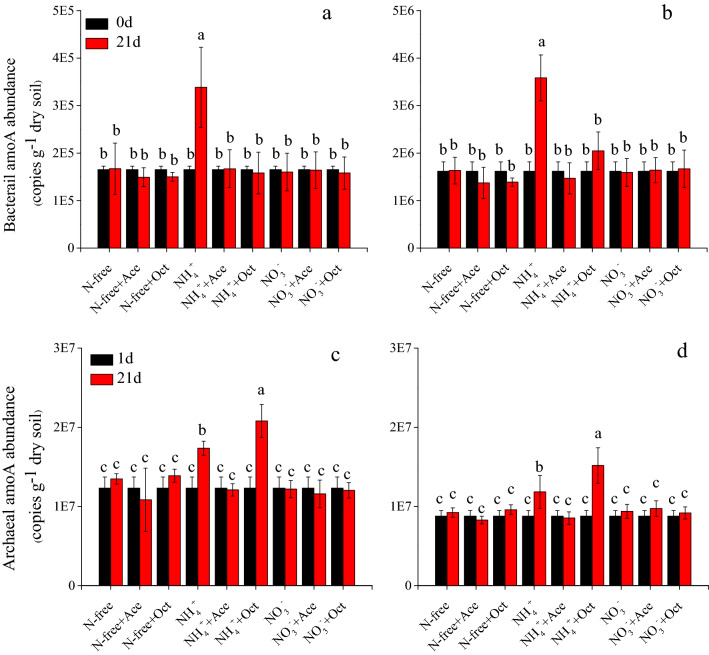
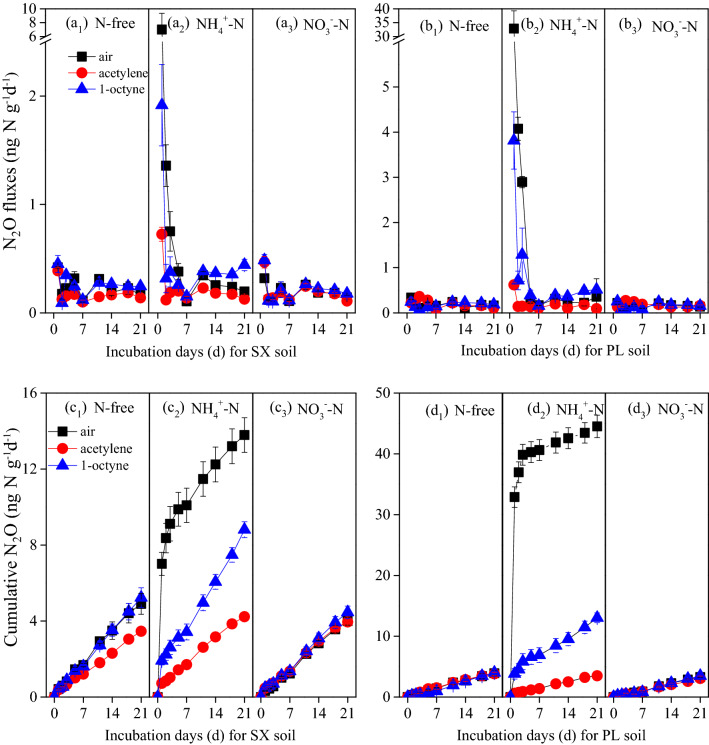
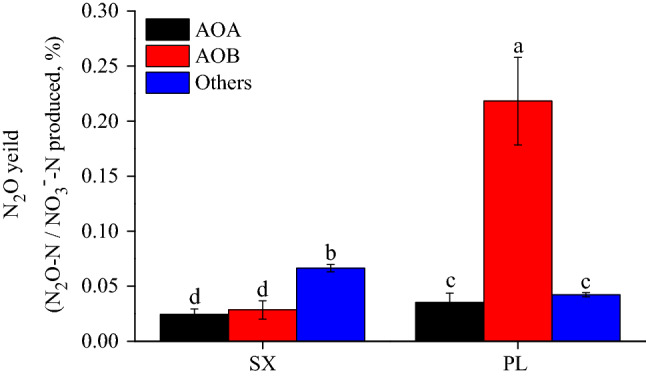
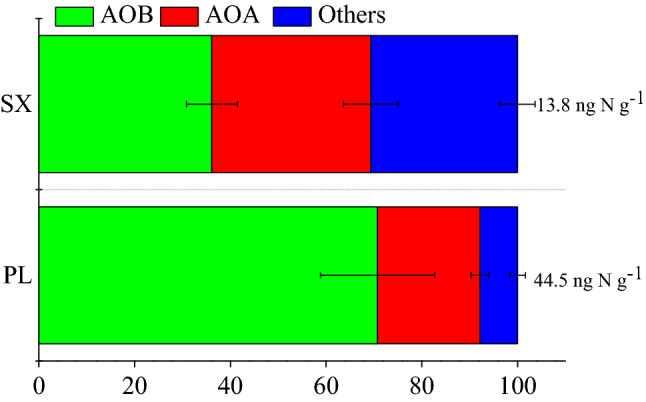
Nitrification is believed to be one of the primary processes of NO emission in the agroecological system, which is controlled by soil microbes and mainly regulated by soil pH, oxygen content and NH availability. Previous studies have proved that the relative contributions of ammonia oxidizing bacteria (AOB) and archaea (AOA) to NO production were varied with soil pH, however, there is still no consensus on the regulating mechanism of nitrification-derived NO production by soil pH. In this study, 1-octyne (a selective inhibitor of AOB) and acetylene (an inhibitor of AOB and AOA) were used in a microcosm incubation experiment to differentiate the relative contribution of AOA and AOB to NO emissions in a neutral (pH = 6.75) and an alkaline (pH = 8.35) soils. We found that the amendment of ammonium (NH) observably stimulated the production of both AOA and AOB-related NO and increased the ammonia monooxygenase (AMO) gene abundances of AOA and AOB in the two test soils. Among which, AOB dominated the process of ammonia oxidation in the alkaline soil, contributing 70.8% of NO production derived from nitrification. By contrast, the contribution of AOA and AOB accounted for about one-third of nitrification-related NO in acidic soil, respectively. The results indicated that pH was a key factor to change abundance and activity of AOA and AOB, which led to the differentiation of derivation of NO production in purple soils. We speculate that both NH content and soil pH mediated specialization of ammonia-oxidizing microorganisms together; and both specialization results and NO yield led to the different NO emission characteristics in purple soils. These results may help inform the development of NO reduction strategies in the future.
硝化作用被认为是农业生态系统中 NO 排放的主要过程之一,它受土壤微生物控制,主要受土壤 pH、氧含量和 NH 供应的调节。先前的研究已经证明,氨氧化细菌(AOB)和古菌(AOA)对 NO 生成的相对贡献随土壤 pH 而变化,然而,关于土壤 pH 对硝化衍生的 NO 生成的调节机制仍没有共识。在本研究中,1-辛炔(AOB 的选择性抑制剂)和乙炔(AOB 和 AOA 的抑制剂)在微宇宙培养实验中被用来区分 AOA 和 AOB 对中性(pH=6.75)和碱性(pH=8.35)土壤中 NO 排放的相对贡献。我们发现,铵(NH)的添加显著刺激了 AOA 和 AOB 相关的 NO 的产生,并增加了两个测试土壤中 AOA 和 AOB 的氨单加氧酶(AMO)基因丰度。其中,AOB 在碱性土壤中主导了氨氧化过程,对硝化衍生的 NO 生成的贡献为 70.8%。相比之下,AOA 和 AOB 的贡献分别占酸性土壤中硝化相关 NO 的约三分之一。结果表明,pH 是改变 AOA 和 AOB 丰度和活性的关键因素,这导致了紫色土壤中 NO 生成来源的分化。我们推测,NH 含量和土壤 pH 共同调节氨氧化微生物的特化;并且特化结果和 NO 产量导致了紫色土壤中不同的 NO 排放特征。这些结果可能有助于为未来制定 NO 减排策略提供信息。