Romero-Ferreiro Verónica, Susi Rosario, Sánchez-Morla Eva M, Marí-Beffa Paloma, Rodríguez-Gómez Pablo, Amador Julia, Moreno Eva M, Romero Carmen, Martínez-García Natalia, Rodriguez-Jimenez Roberto
Department of Psychology, Universidad Europea de Madrid, Madrid, Spain.
Instituto de Investigación Sanitaria Hospital 12 de Octubre (imas12), Madrid, Spain.
Front Psychol. 2022 Nov 3;13:827037. doi: 10.3389/fpsyg.2022.827037. eCollection 2022.
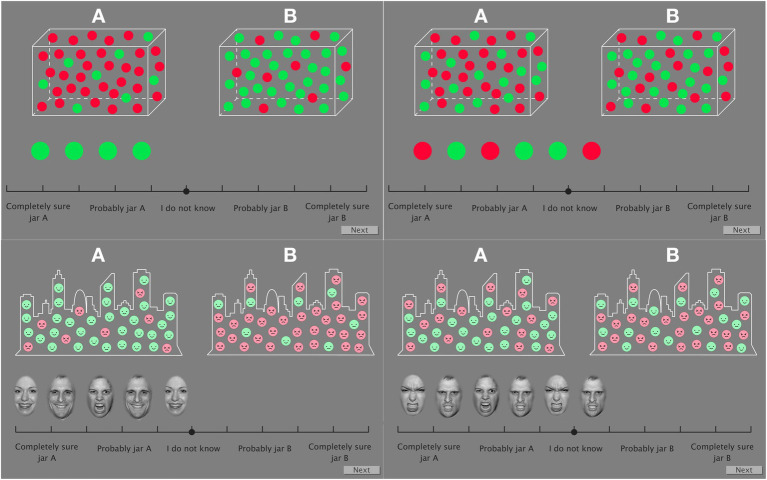
Delusions are one of the most classical symptoms described in schizophrenia. However, despite delusions are often emotionally charged, they have been investigated using tasks involving non-affective material, such as the Beads task. In this study we compared 30 patients with schizophrenia experiencing delusions with 32 matched controls in their pattern of responses to two versions of the Beads task within a Bayesian framework. The two versions of the Beads task consisted of one emotional and one neutral, both with ratios of beads of 60:40 and 80:20, considered, respectively, as the "difficult" and "easy" variants of the task. Results indicate that patients showed a greater deviation from the normative model, especially in the 60:40 ratio, suggesting that more inaccurate probability estimations are more likely to occur under uncertainty conditions. Additionally, both patients and controls showed a greater deviation in the emotional version of the task, providing evidence of a reasoning bias modulated by the content of the stimuli. Finally, a positive correlation between patients' deviation and delusional symptomatology was found. Impairments in the 60:40 ratio with emotional content was related to the amount of disruption in life caused by delusions. These results contribute to the understanding of how cognitive mechanisms interact with characteristics of the task (i.e., ambiguity and content) in the context of delusional thinking. These findings might be used to inform improved intervention programs in the domain of inferential reasoning.
妄想是精神分裂症中描述的最典型症状之一。然而,尽管妄想往往带有强烈的情感色彩,但人们一直使用涉及非情感材料的任务(如珠子任务)对其进行研究。在本研究中,我们在贝叶斯框架内,比较了30名患有妄想的精神分裂症患者与32名匹配的对照组在对两种版本珠子任务的反应模式上的差异。珠子任务的两个版本分别包含一个情感版本和一个中性版本,两种版本中珠子的比例均为60:40和80:20,分别被视为该任务的“困难”和“简单”变体。结果表明,患者与规范模型的偏差更大,尤其是在60:40的比例下,这表明在不确定条件下更可能出现更不准确的概率估计。此外,患者和对照组在任务的情感版本中都表现出更大的偏差,这为受刺激内容调节的推理偏差提供了证据。最后,发现患者的偏差与妄想症状之间存在正相关。情感内容的60:40比例下的损伤与妄想对生活造成的干扰程度有关。这些结果有助于理解在妄想思维的背景下认知机制如何与任务特征(即模糊性和内容)相互作用。这些发现可能用于为推理领域改进干预方案提供信息。