Luo Xia-Yan, Zhang Ya-Min, Zhu Run-Qiu, Yang Shan-Shan, Zhou Lu-Fang, Zhu Hui-Yong
Department of Oral and Maxillofacial Surgery, The First Affiliated Hospital of Zhejiang University School of Medicine, Hangzhou 310003, Zhejiang Province, China.
Department of Stomatology, Sanmen People's Hospital, Taizhou 317100, Zhejiang Province, China.
World J Clin Cases. 2022 Nov 16;10(32):11726-11742. doi: 10.12998/wjcc.v10.i32.11726.
There is no unified standard to predict postoperative survival in patients with tongue squamous cell carcinoma (TSCC), hence the urgency to develop a model to accurately predict the prognosis of these patients.
To develop and validate nomograms for predicting overall survival (OS) and cancer-specific survival (CSS) of patients with TSCC.
A cohort of 3454 patients with TSCC from the Surveillance, Epidemiology, and End Results (SEER) database was used to develop nomograms; another independent cohort of 203 patients with TSCC from the Department of Oral and Maxillofacial Surgery, First Affiliated Hospital of Zhejiang University School of Medicine, was used for external validation. Univariate and multivariate analyses were performed to identify useful variables for the development of nomograms. The calibration curve, area under the receiver operating characteristic curve (AUC) analysis, concordance index (C-index), net reclassification index (NRI), and decision curve analysis (DCA) were used to assess the calibration, discrimination ability, and clinical utility of the nomograms.
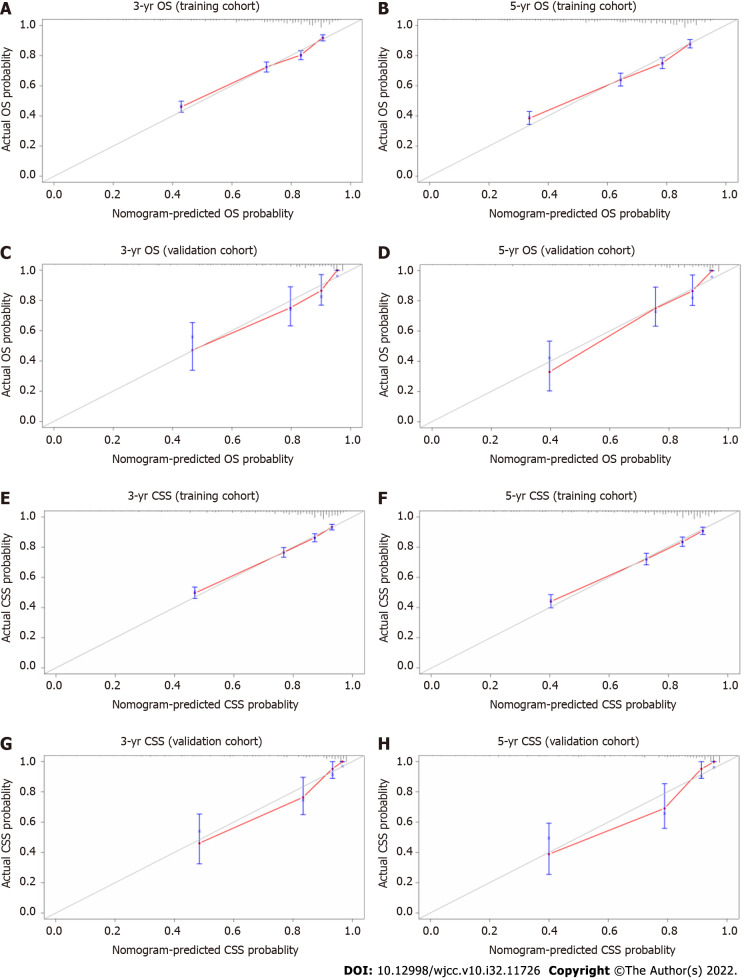
Eight variables were selected and used to develop nomograms for patients with TSCC. The C-index (0.741 and 0.757 for OS and CSS in the training cohort and 0.800 and 0.830 in the validation cohort, respectively) and AUC indicated that the discrimination abilities of these nomograms were acceptable. The calibration curves of OS and CSS indicated that the predicted and actual values were consistent in both the training and validation cohorts. The NRI values (training cohort: 0.493 and 0.482 for 3- and 5-year OS and 0.424 and 0.402 for 3- and 5-year CSS; validation cohort: 0.635 and 0.750 for 3- and 5-year OS and 0.354 and 0.608 for 3- and 5-year CSS, respectively) and DCA results indicated that the nomograms were significantly better than the tumor-node-metastasis staging system in predicting the prognosis of patients with TSCC.
Our nomograms can accurately predict patient prognoses and assist clinicians in improving decision-making concerning patients with TSCC in clinical practice.
舌鳞状细胞癌(TSCC)患者术后生存情况的预测尚无统一标准,因此迫切需要建立一个模型来准确预测这些患者的预后。
建立并验证预测TSCC患者总生存期(OS)和癌症特异性生存期(CSS)的列线图。
使用来自监测、流行病学和最终结果(SEER)数据库的3454例TSCC患者队列来建立列线图;另一个独立队列由浙江大学医学院附属第一医院口腔颌面外科的203例TSCC患者组成,用于外部验证。进行单因素和多因素分析以确定用于建立列线图的有用变量。采用校准曲线、受试者工作特征曲线下面积(AUC)分析、一致性指数(C指数)、净重新分类指数(NRI)和决策曲线分析(DCA)来评估列线图的校准、区分能力和临床实用性。
选择了8个变量用于建立TSCC患者的列线图。C指数(训练队列中OS和CSS的C指数分别为0.741和0.757,验证队列中分别为0.800和0.830)和AUC表明这些列线图的区分能力是可接受的。OS和CSS的校准曲线表明,预测值与实际值在训练队列和验证队列中均一致。NRI值(训练队列:3年和5年OS分别为0.493和0.482,3年和5年CSS分别为0.424和0.402;验证队列:3年和5年OS分别为0.635和0.750,3年和5年CSS分别为0.354和0.608)和DCA结果表明,列线图在预测TSCC患者预后方面明显优于肿瘤-淋巴结-转移分期系统。
我们的列线图可以准确预测患者预后,并有助于临床医生在临床实践中改善对TSCC患者的决策。