Zhou Yan, Yu Jing, Zhou Haiying
Department of Respiratory and Critical Care Medicine, Zhuji People's Hospital, Zhuji, Zhejiang Province 311800, China.
Emerg Med Int. 2022 Nov 10;2022:4313394. doi: 10.1155/2022/4313394. eCollection 2022.
To analyze the changes in thrombelastography (TEG) in patients with acute exacerbation of chronic obstructive pulmonary disease (AECOPD) and the relationship with indicators related to lung function.
100 patients with AECOPD admitted to our hospital from May 2021 to May 2022 were selected as the AE group, and another 80 patients with a stable phase of COPD in the same period were selected as the SP group. Fresh blood specimens were collected from both groups, and TEG-related indicators ( value, value, -angle, MA value) were measured using the TEG technique, and lung function-related indicators (FEV1, FVC, FEV1/FVC, FEV1%) were measured using a lung function meter, and the correlation between TEG-related indicators and lung function-related indicators was analyzed.
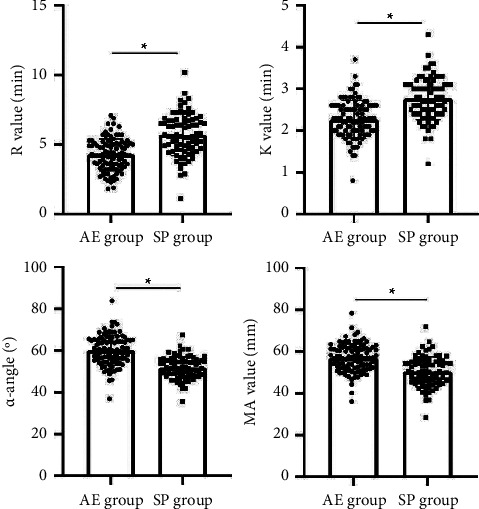
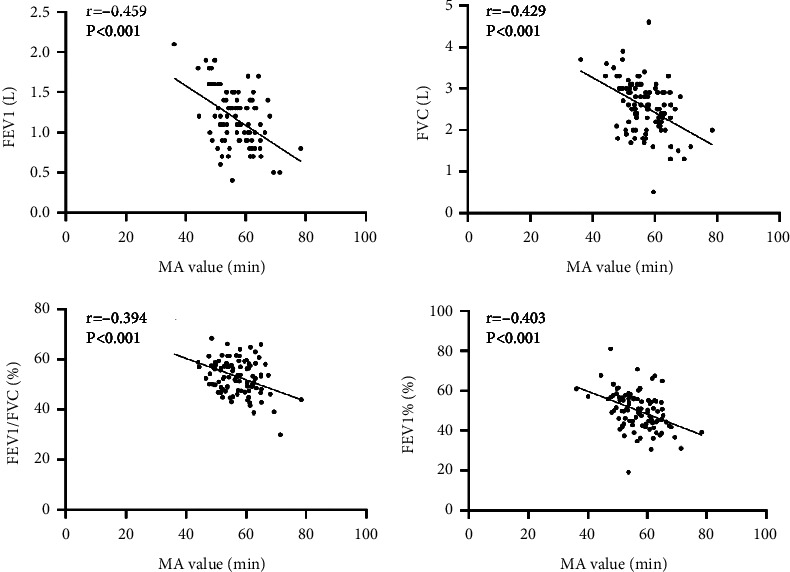
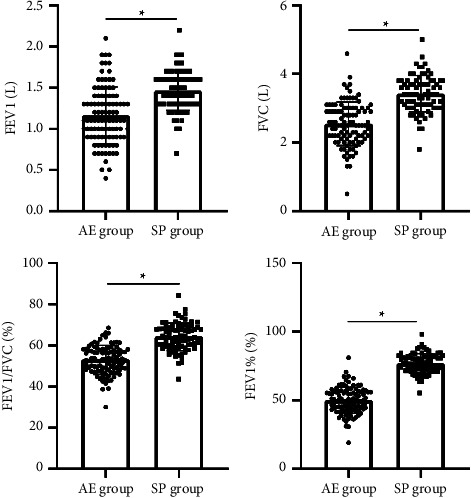
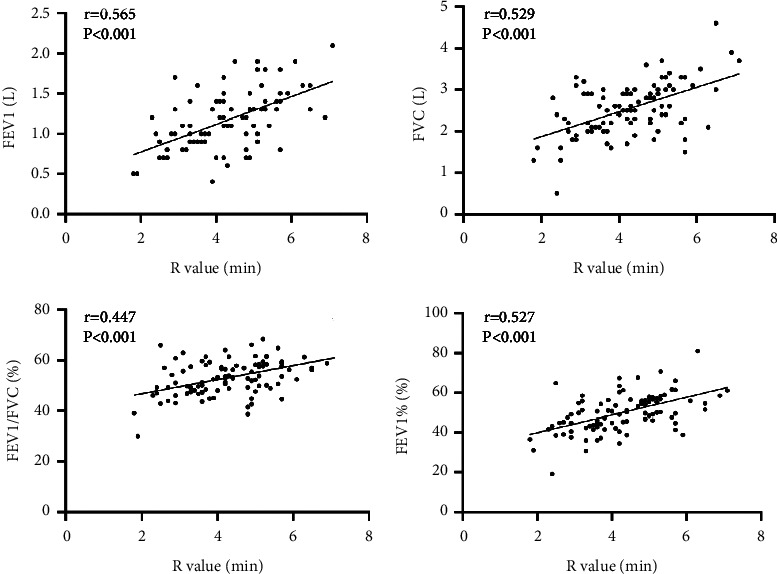
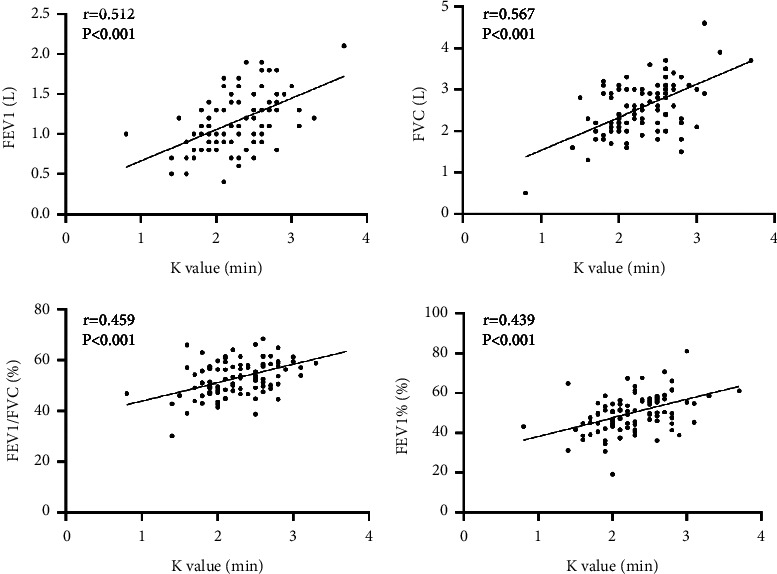
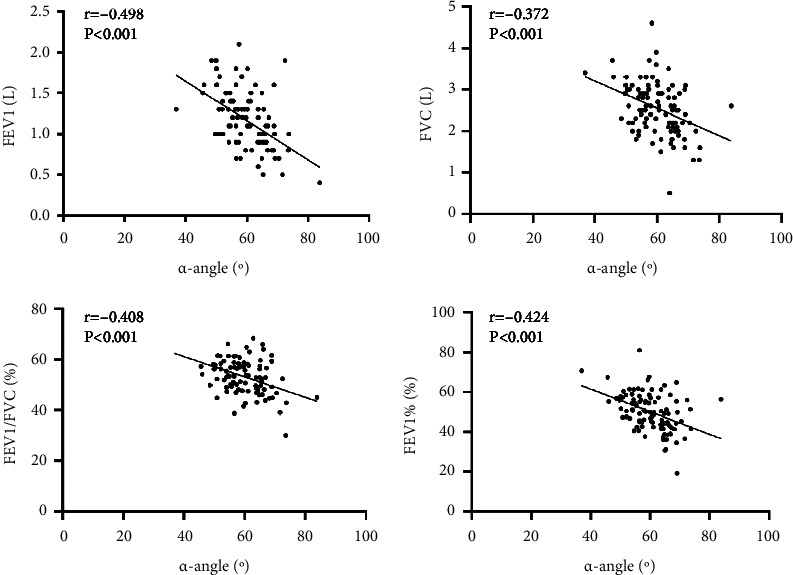
Patients in the AE group had lower and values and higher -angle and MA values than those in the SP group, all with statistically significant differences ( < 0.05). Patients in the AE group had lower FEV1, FVC, FEV1/FVC, and FEV1% levels than those in the SP group, all with statistically significant differences ( < 0.05). Correlation analysis showed that the value in TEG of AECOPD patients was positively correlated with pulmonary function-related indicators (FEV1, FVC, FEV1/FVC, FEV1%) ( = 0.565, 0.529, 0.447, 0.527, all < 0.001); value was positively correlated with pulmonary function-related indicators (FEV1, FVC, FEV1/FVC, FEV1%) ( = 0.512, 0.567, 0.459, 0.439, all < 0.001); -angle was inversely correlated with pulmonary function-related indicators (FEV1, FVC, FEV1/FVC, FEV1%) ( = -0.498, -0.372, -0.408, -0.424, all < 0.001); MA value was inversely correlated with lung function-related indicators (FEV1, FVC, FEV1/FVC, FEV1%) ( = -0.459, -0.429, -0.394, -0.403, all < 0.001).
There is a correlation between TEG-related indicators and lung function-related indicators in AECOPD patients, both of which can guide the diagnosis and treatment process of the disease and are worthy of clinical promotion. The clinical registration number is EA2021086.
分析慢性阻塞性肺疾病急性加重期(AECOPD)患者血栓弹力图(TEG)的变化及其与肺功能相关指标的关系。
选取2021年5月至2022年5月我院收治的100例AECOPD患者作为AE组,同期选取80例COPD稳定期患者作为SP组。采集两组患者的新鲜血液标本,采用TEG技术测定TEG相关指标(R值、K值、α角、MA值),采用肺功能仪测定肺功能相关指标(FEV1、FVC、FEV1/FVC、FEV1%),并分析TEG相关指标与肺功能相关指标的相关性。
AE组患者的R值和K值低于SP组,α角和MA值高于SP组,差异均有统计学意义(P<0.05)。AE组患者的FEV1、FVC、FEV1/FVC和FEV1%水平低于SP组,差异均有统计学意义(P<0.05)。相关性分析显示,AECOPD患者TEG的R值与肺功能相关指标(FEV1、FVC、FEV1/FVC、FEV1%)呈正相关(r=0.565、0.529、0.447、0.527,均P<0.001);K值与肺功能相关指标(FEV1、FVC、FEV1/FVC、FEV1%)呈正相关(r=0.512、0.567、0.459、0.439,均P<0.001);α角与肺功能相关指标(FEV1、FVC、FEV1/FVC、FEV1%)呈负相关(r=-0.498、-0.372、-0.408、-0.424,均P<0.001);MA值与肺功能相关指标(FEV1、FVC、FEV1/FVC、FEV1%)呈负相关(r=-0.459、-0.429、-0.394、-0.403,均P<0.001)。
AECOPD患者TEG相关指标与肺功能相关指标存在相关性,二者均可指导疾病的诊断和治疗过程,值得临床推广。临床注册号为EA2021086。