Pan Liang, Lu Wenjie, Han Zhanying, Pan Sancong, Wang Xi, Shan Yingguang, Peng Meng, Qin Xiaofei, Sun Guoju, Zhang Peisheng, Dong Jianzeng, Qiu Chunguang
Department of Cardiovascular Medicine, The First Affiliated Hospital of Zhengzhou University, Zhengzhou, China.
Department of Cardiology, Jincheng People's Hospital, Jincheng, China.
Front Cardiovasc Med. 2022 Nov 3;9:1028007. doi: 10.3389/fcvm.2022.1028007. eCollection 2022.
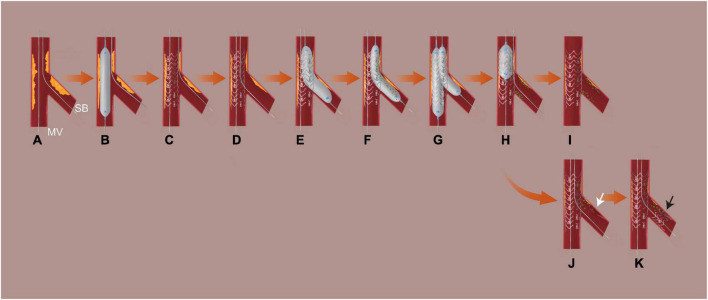
An increasing body of evidence suggests that drug-coated balloon (DCB) angioplasty represents a valuable option for revascularization in selected patients with coronary bifurcation disease. However, there remains a paucity of real-world observational evidence on the efficacy of DCB in left main (LM) true bifurcation lesion. We compared clinical and angiographic outcomes of hybrid [DCB + drug-eluting stent (DES)] versus DES-only strategy (provisional stenting or two-stent strategies) in LM true bifurcated lesions.
The primary endpoint was the 2-year composite rate of target lesion failure (TLF): cardiac death, target vessel myocardial infarction (TVMI), or clinically driven target lesion revascularization (CD-TLR). A routine 1-year angiographic follow-up was scheduled. Propensity-score matching was utilized to assemble a cohort of patients with similar baseline characteristics.
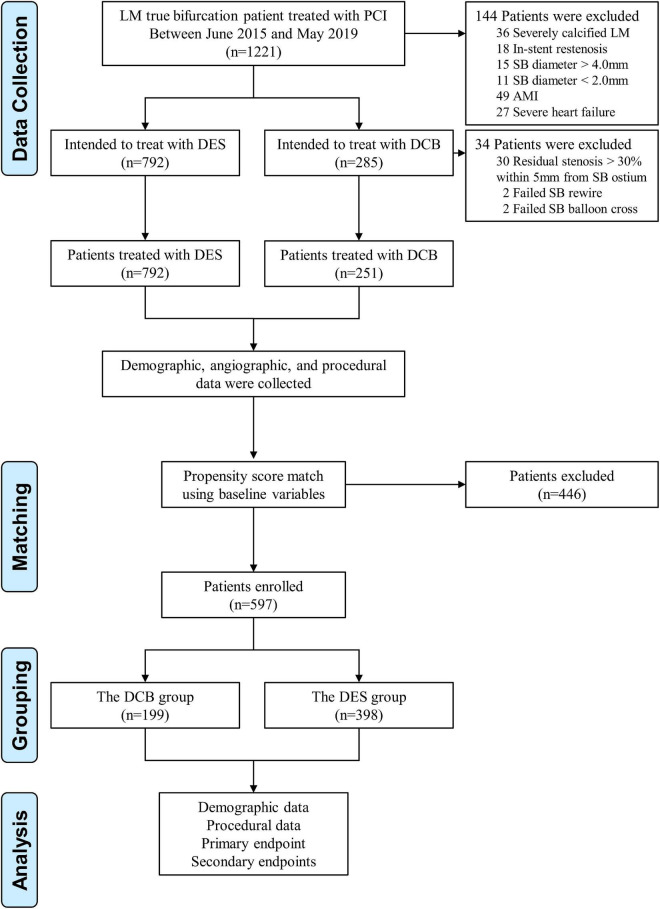
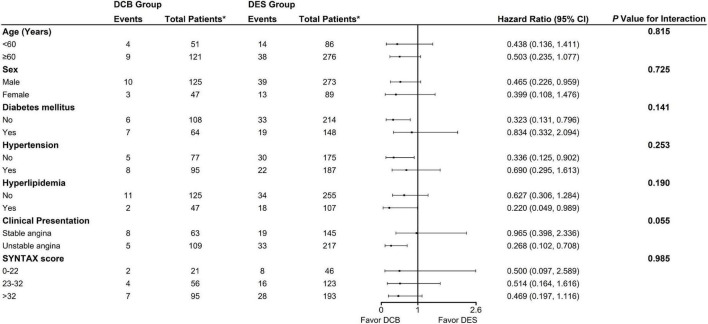
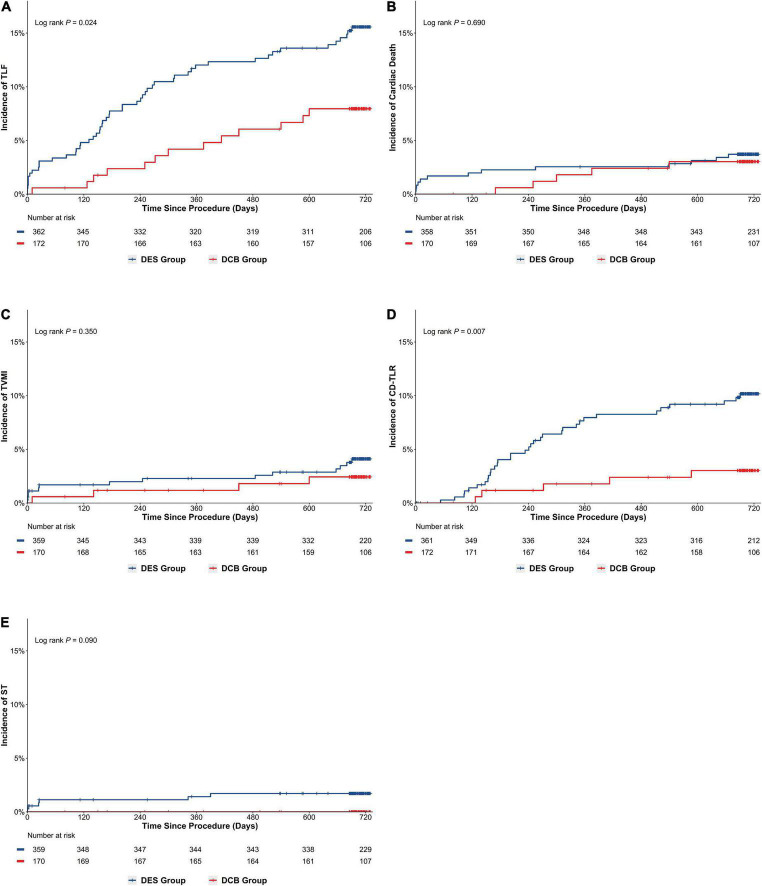
Among 1077 eligible patients, 199 who received DCB treatment and 398 who were assigned to DES therapy had similar propensity scores and were included in the analysis. TLF within 2 years occurred in 13 patients (7.56%) assigned to DCB group, and 52 patients (14.36%) assigned to DES group (odds ratio: 0.487; 95% confidence interval: 0.258-0.922; = 0.025; Log-rank = 0.024). Compared with the DES group, the DCB group resulted in a lower rate of CD-TLR (2.91% 9.42%; = 0.007). Cardiac death, TVMI, all-cause mortality, and stent thrombosis were comparable between both groups. Patients treated with DES-only were associated with a higher late lumen loss (0.42 ± 0.62 mm . 0.13 ± 0.42 mm, < 0.001) compared with the DCB group at 1 year. In sensitivity analysis, the DCB group also presented a lower incidence of TLF, CD-TLR and stent thrombosis both compared to the two-stent strategy and compared to provisional stenting (s < 0.05).
The 2-year results of PCI utilizing DCB for LM true bifurcation lesions are superior to employing DES alone in terms of safety and effectiveness.
越来越多的证据表明,药物涂层球囊(DCB)血管成形术是特定冠状动脉分叉病变患者血运重建的一种有价值的选择。然而,关于DCB治疗左主干(LM)真性分叉病变疗效的真实世界观察性证据仍然匮乏。我们比较了混合治疗(DCB+药物洗脱支架[DES])与单纯DES策略(临时支架置入或双支架策略)治疗LM真性分叉病变的临床和血管造影结果。
主要终点是2年靶病变失败(TLF)的复合率:心源性死亡、靶血管心肌梗死(TVMI)或临床驱动的靶病变血运重建(CD-TLR)。计划进行常规的1年血管造影随访。采用倾向评分匹配法来组建一组具有相似基线特征的患者队列。
在1077例符合条件的患者中,199例接受DCB治疗的患者和398例接受DES治疗的患者具有相似的倾向评分,并被纳入分析。DCB组2年内有13例患者(7.56%)发生TLF,DES组有52例患者(14.36%)发生TLF(优势比:0.487;95%置信区间:0.258 - 0.922;P = 0.025;对数秩检验P = 0.024)。与DES组相比,DCB组的CD-TLR发生率较低(2.91%对9.42%;P = 0.007)。两组的心源性死亡、TVMI、全因死亡率和支架血栓形成情况相当。与DCB组相比,单纯DES治疗的患者在1年时晚期管腔丢失更高(0.42±0.62mm对0.13±0.42mm,P < 0.001)。在敏感性分析中,与双支架策略和临时支架置入相比,DCB组的TLF、CD-TLR和支架血栓形成发生率也较低(P < 0.05)。
就安全性和有效性而言,利用DCB治疗LM真性分叉病变的PCI 2年结果优于单独使用DES。