Sivertsen Marianne, Arntzen Ellen Christin, Alstadhaug Karl Bjørnar, Normann Britt
Department of Health and Care Sciences, UiT The Arctic University of Norway, Tromsoe, Norway.
Department of Medicine, Nordland Hospital Trust, Bodoe, Norway.
Front Rehabil Sci. 2022 Sep 19;3:987601. doi: 10.3389/fresc.2022.987601. eCollection 2022.
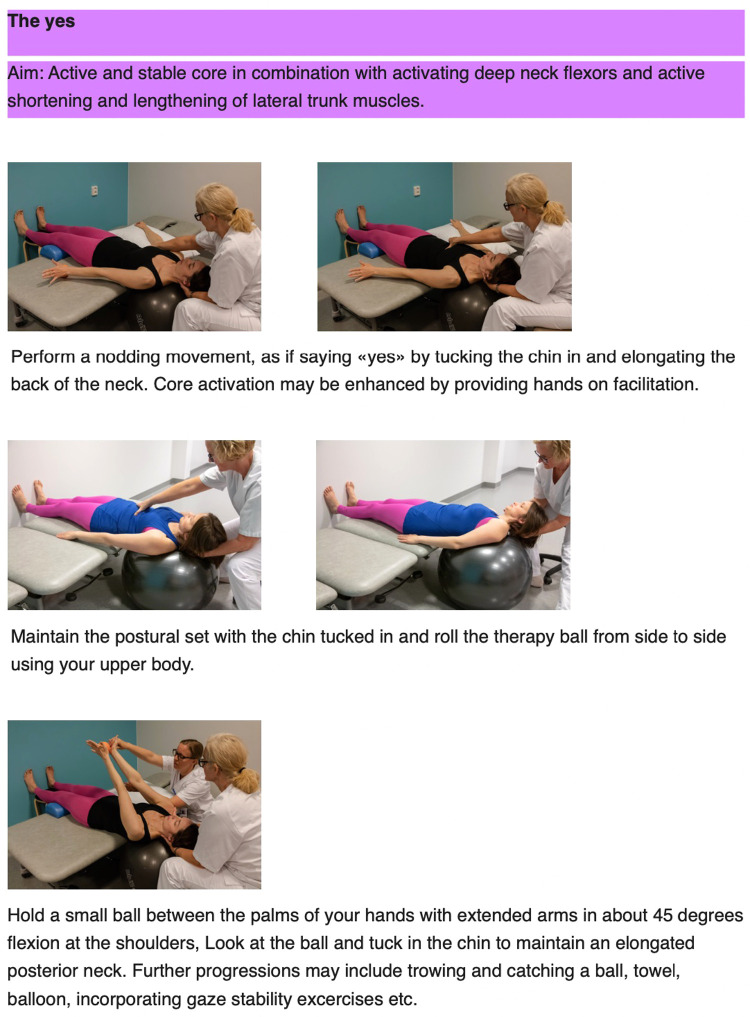
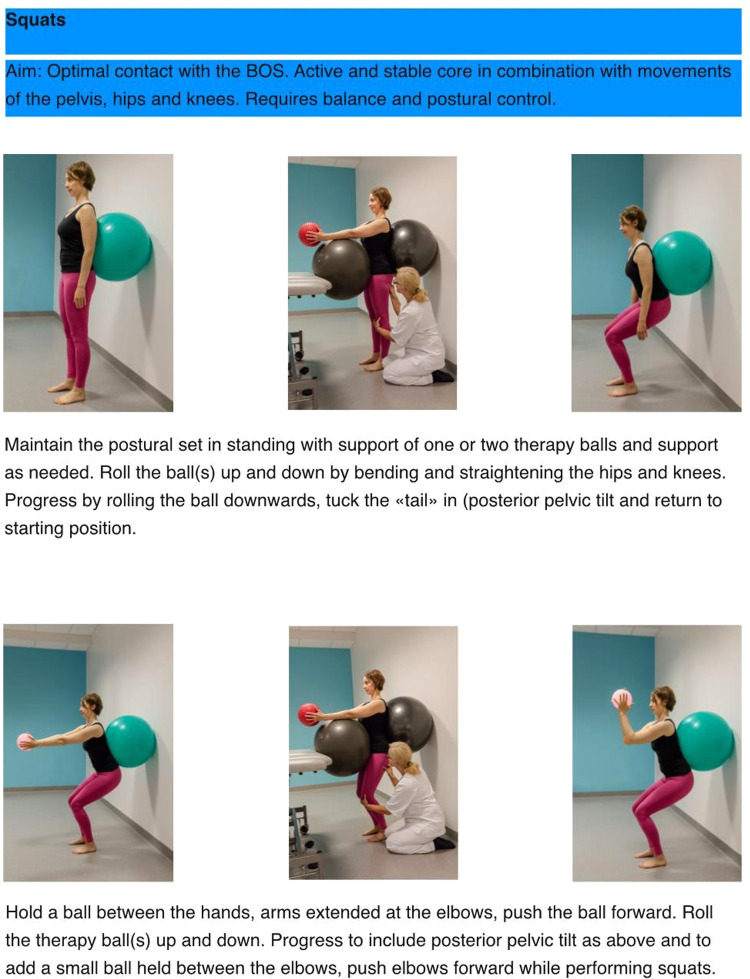
Research on stroke rehabilitation often addresses common difficulties such as gait, balance or physical activity separately, a fragmentation contrasting the complexity in clinical practice. Interventions aiming for recovery are needed. The purpose of this study was to investigate effects of a comprehensive low-cost physical therapy intervention, I-CoreDIST, vs. usual care on postural control, balance, physical activity, gait and health related quality of life during the first 12 weeks post-stroke.
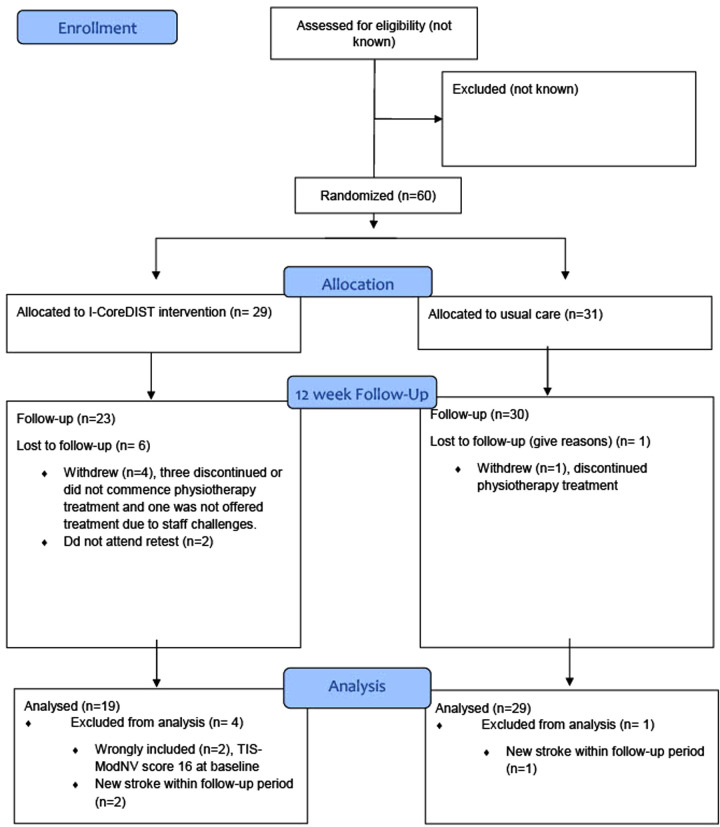
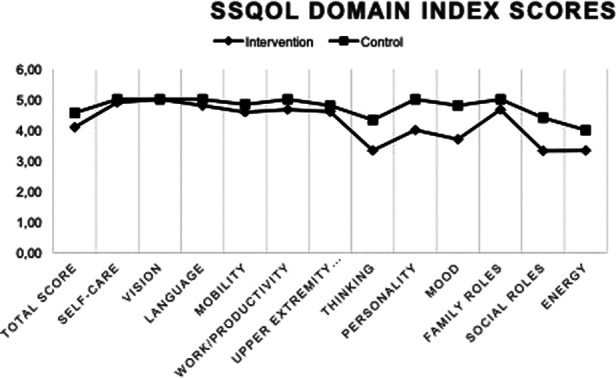
This prospective, assessor-masked randomized controlled trial included 60 participants from two stroke units in Norway. Participants, who were randomized to I-CoreDIST ( = 29) or usual care physical therapy ( = 31), received 5 sessions/week when in-patients or 3 sessions/week as out-patients. Primary outcomes were the Trunk Impairment Scale-modified Norwegian version (TISmodNV) and activity monitoring (ActiGraphsWgt3X-BT). Secondary outcomes were the Postural Assessment Scale for Stroke, MiniBesTEST, 10-meter walk test, 2-minute walk test, force-platform measurements and EQ5D-3L. Stroke specific quality of life scale was administered at 12 weeks. Linear regression and non-parametric tests were used for statistical analysis.
Five participants were excluded and seven lost to follow-up, leaving 48 participants in the intention-to-treat analysis. There were no significant between-group effects for primary outcomes: TIS-modNV ( = 0,857); daily average minutes of sedative ( = 0.662), light ( = 0.544) or moderate activity ( = 0.239) and steps ( = 0.288), or secondary outcomes at 12 weeks except for significant improvements on EQ5D-3L in the usual care group. Within-group changes were significant for all outcomes in both groups except for activity levels that were low, EQ5D-3L favoring the usual care group, and force-platform data favoring the intervention group.
Physical therapy treatment with I-CoreDIST improved postural control, balance, physical activity and gait during the first 12 weeks after a stroke but is not superior to usual care.
中风康复研究通常分别探讨诸如步态、平衡或身体活动等常见难题,这种碎片化情况与临床实践中的复杂性形成对比。需要旨在促进恢复的干预措施。本研究的目的是调查一种全面的低成本物理治疗干预措施I-CoreDIST与常规护理相比,对中风后前12周的姿势控制、平衡、身体活动、步态及健康相关生活质量的影响。
这项前瞻性、评估者盲法随机对照试验纳入了挪威两个中风单元的60名参与者。随机分为I-CoreDIST组(n = 29)或常规护理物理治疗组(n = 31)的参与者,住院时每周接受5次治疗,门诊时每周接受3次治疗。主要结局指标为改良挪威版躯干功能障碍量表(TISmodNV)和活动监测(ActiGraphsWgt3X-BT)。次要结局指标为中风姿势评估量表、MiniBesTEST、10米步行试验、2分钟步行试验、测力平台测量以及EQ5D-3L。在12周时进行中风特异性生活质量量表评估。采用线性回归和非参数检验进行统计分析。
5名参与者被排除,7名失访,意向性分析中剩余48名参与者。主要结局指标在组间无显著差异:TIS-modNV(P = 0.857);每日平均静息分钟数(P = 0.662)、轻度活动分钟数(P = 0.544)或中度活动分钟数(P = 0.239)以及步数(P = 0.288),12周时的次要结局指标除常规护理组EQ5D-3L有显著改善外,其他均无显著差异。两组内所有结局指标均有显著变化,但活动水平较低,EQ5D-3L有利于常规护理组,测力平台数据有利于干预组。
I-CoreDIST物理治疗在中风后的前12周改善了姿势控制、平衡、身体活动和步态,但并不优于常规护理。