Institute of Neuroscience and Physiology, Rehabilitation Medicine, Sahlgrenska Academy, University of Gothenburg, and the Sahlgrenska University Hospital, Per Dubbsgatan 14, 3rd Floor, PO Box 430, 405 30, Gothenburg, Sweden.
Department of Neuroscience, Neurology, Uppsala University, Uppsala, Sweden.
Sci Rep. 2021 Apr 27;11(1):9078. doi: 10.1038/s41598-021-88606-9.
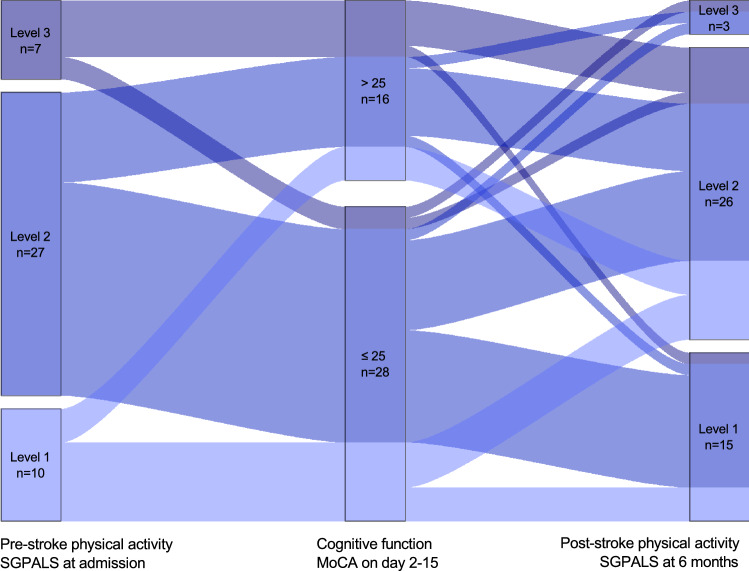
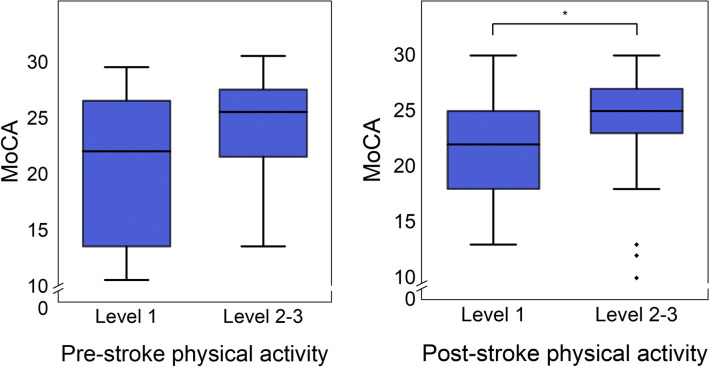
Regular physical activity is widely recommended in the primary and secondary prevention of stroke. Physical activity may enhance cognitive performance after stroke, but cognitive impairments could also hinder a person to take part in physical activity. However, a majority of previous studies have not found any association between post-stroke cognitive impairments and a person's subsequent level of activity. In this explorative, longitudinal study, we describe the intraindividual change in physical activity from before to 6 months after stroke, in relation to early screening of post-stroke cognitive impairments. Participants were recruited at 2 to 15 days after stroke, and screened for cognitive impairments using the Montreal Cognitive Assessment tool. Information on pre-stroke physical activity was retrospectively collected at hospital admittance by physiotherapists. Post-stroke physical activity was evaluated after 6 months. Of 49 participants included, 44 were followed up. The level of physical activity changed in more than half of all participants after stroke. Participants who were physically active 6 months after stroke presented with significantly less cognitive impairments. These results highlight that many stroke survivors experience a change in their physical activity level following stroke, and that unimpaired cognition may be important for a stroke survivors' ability to be physically active.
经常进行身体活动被广泛推荐用于中风的一级和二级预防。身体活动可能会增强中风后的认知表现,但认知障碍也可能阻碍人们参与身体活动。然而,大多数先前的研究并未发现中风后认知障碍与患者随后的活动水平之间存在任何关联。在这项探索性的纵向研究中,我们描述了中风前至中风后 6 个月期间身体活动的个体内变化,这与中风后认知障碍的早期筛查有关。参与者在中风后 2 至 15 天内被招募,并使用蒙特利尔认知评估工具筛查认知障碍。在入院时,由物理治疗师回顾性收集中风前身体活动的信息。中风后 6 个月评估身体活动情况。在 49 名入组患者中,有 44 名进行了随访。超过一半的参与者在中风后身体活动水平发生了变化。在中风后 6 个月仍积极进行身体活动的患者认知障碍明显减少。这些结果强调了许多中风幸存者在中风后经历身体活动水平的变化,并且认知无障碍可能对中风幸存者的身体活动能力很重要。