Department of Epidemiology and Biostatistics, School of Public Health, Saint Paul's Hospital Millennium Medical College, Addis Ababa, Ethiopia.
Front Public Health. 2022 Nov 3;10:998055. doi: 10.3389/fpubh.2022.998055. eCollection 2022.
Adequate maternal health care could prevent 54% of maternal deaths in low- and middle-income countries. In Ethiopia, the maternal mortality rate was reduced from 817 to 412 deaths per 100,000 live births between 2000 and 2016. Thus, the current study focuses on the adequacy of prenatal care (PNC) services rather than the mere prenatal contacts available to assess compliance with the WHO recommended standard guidelines.
A nationally representative cross-sectional dataset from the Ethiopian Mini Demographic and Health Survey 2019 was analyzed. Risk factors for prenatal care adequacy were assessed using a multilevel ordinal logistic regression model.
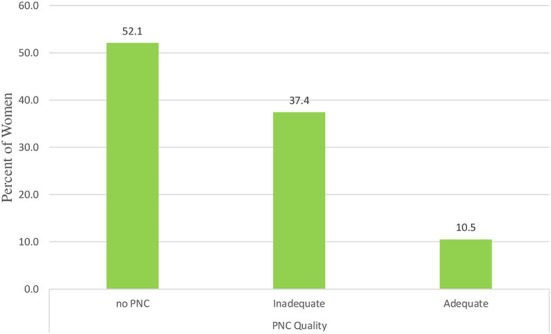
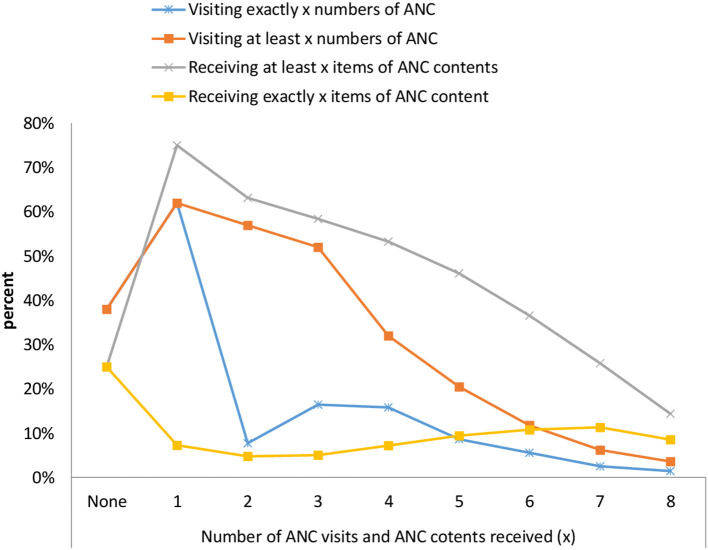
About 43% of women met the old WHO recommendation of at least four prenatal contacts, while only 3.5% of women met the new WHO recommended minimum of eight prenatal contacts. The overall adequacy of prenatal care based on the four prenatal care utilization indicators was 52.1% no PNC, 37.4% received inadequate PNC and 10.5% received adequate PNC. Being a rural resident [AOR = 0.694 (95% CI: 0.557, 0.865)] and wanting no more children [AOR = 0.687 (95% CI: 0.544, 0.868)] are associated with inadequate prenatal care. Higher educational attainment of women and spouses, exposure to the media, upper wealth quintile, and a perceived shorter distance to a health facility were significantly associated with adequate prenatal care.
The prevalence of adequate prenatal care was lower. Multi-sectoral efforts are needed to improve maternal health targets by reducing maternal mortality through improved health care services.
在中低收入国家,充分的孕产妇保健可以预防 54%的孕产妇死亡。在埃塞俄比亚,2000 年至 2016 年期间,孕产妇死亡率从每 10 万例活产 817 例降至 412 例。因此,本研究侧重于产前保健(PNC)服务的充分性,而不是仅仅关注可用于评估遵守世界卫生组织(WHO)建议标准指南的产前接触。
分析了来自埃塞俄比亚 2019 年迷你人口与健康调查的全国代表性横断面数据集。使用多水平有序逻辑回归模型评估了产前保健充分性的风险因素。
约 43%的妇女符合旧的世卫组织建议,即至少进行 4 次产前检查,而只有 3.5%的妇女符合新的世卫组织建议的最低 8 次产前检查。根据四个产前保健利用指标,产前保健的总体充分性为 52.1%无 PNC、37.4%接受不足的 PNC 和 10.5%接受充分的 PNC。居住在农村地区[优势比(AOR)=0.694(95%置信区间:0.557,0.865)]和希望不再生育[AOR=0.687(95%置信区间:0.544,0.868)]与产前保健不足有关。妇女和配偶受教育程度较高、接触媒体、上一个财富五分位数以及感知到距离医疗机构更近,与充分的产前保健显著相关。
充分的产前保健的比例较低。需要多部门努力,通过改善医疗保健服务来降低孕产妇死亡率,从而实现改善孕产妇健康的目标。