Section for Cell Biology and Physiology, Department of Biology, Faculty of Science, University of Copenhagen, Copenhagen, Denmark.
Section for Computational and RNA Biology, Department of Biology, Faculty of Science, University of Copenhagen, Copenhagen, Denmark.
Int J Cancer. 2023 Mar 15;152(6):1210-1225. doi: 10.1002/ijc.34367. Epub 2022 Dec 1.
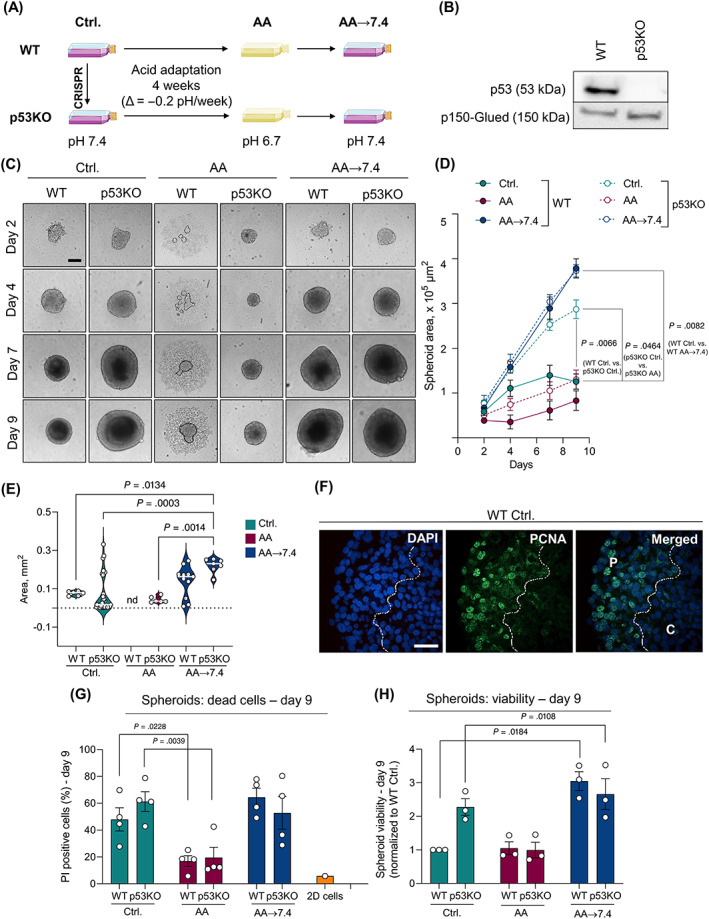
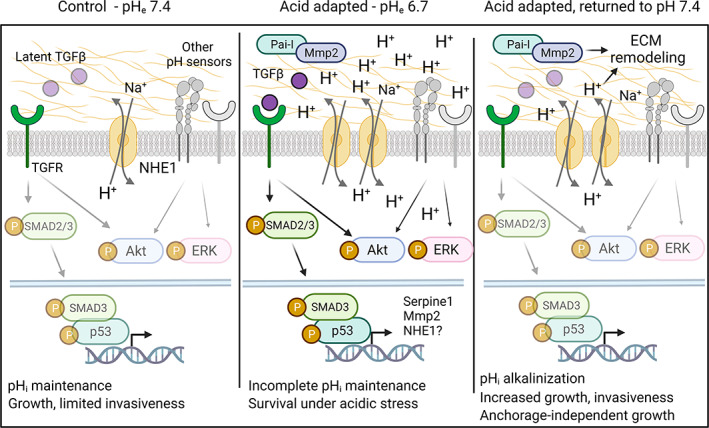
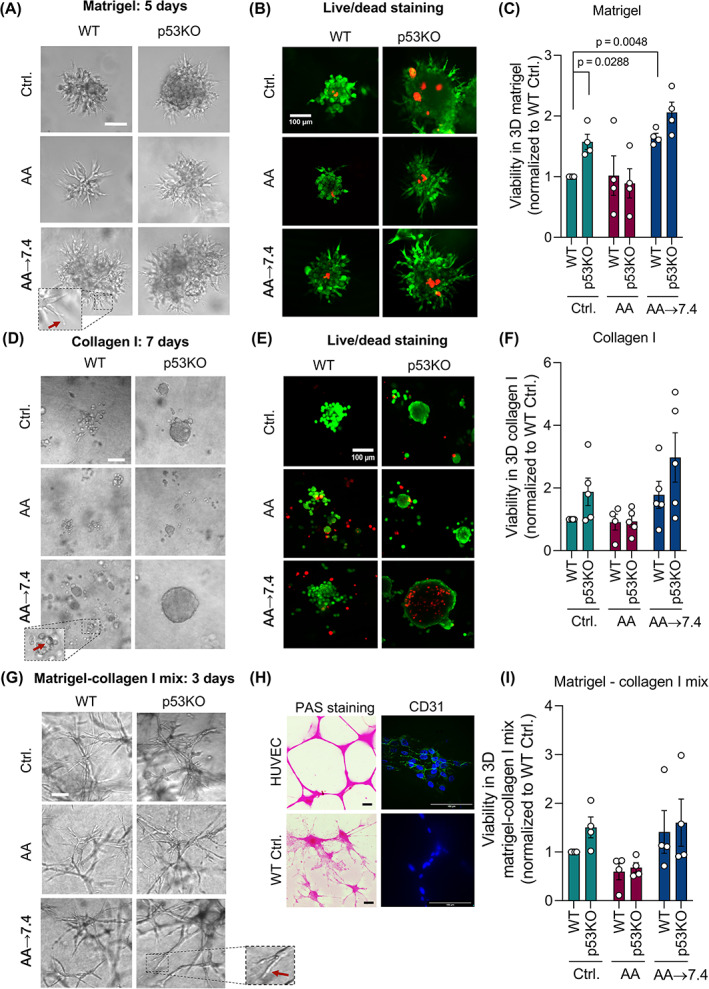
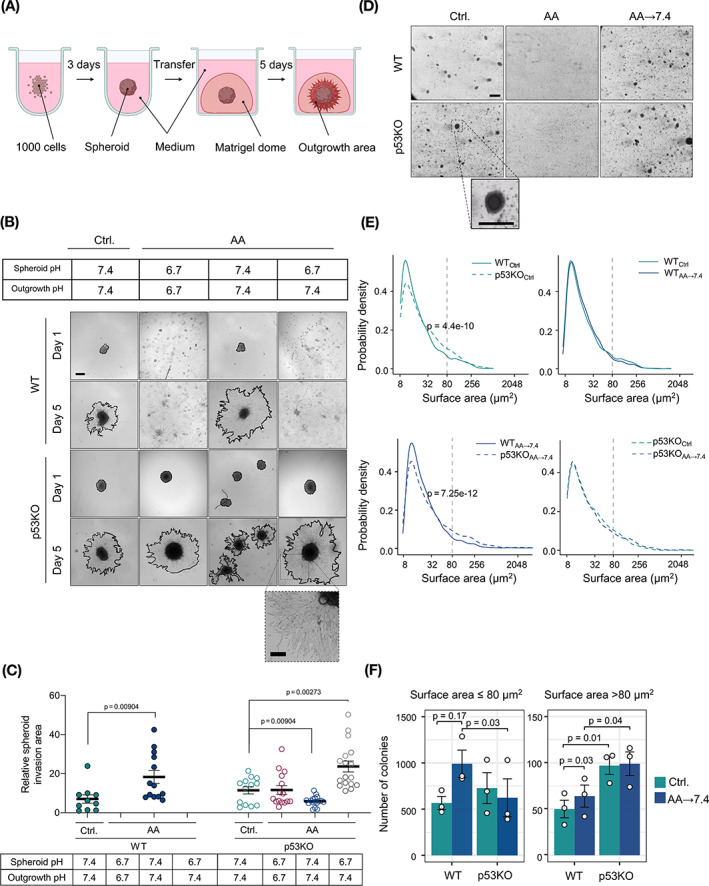
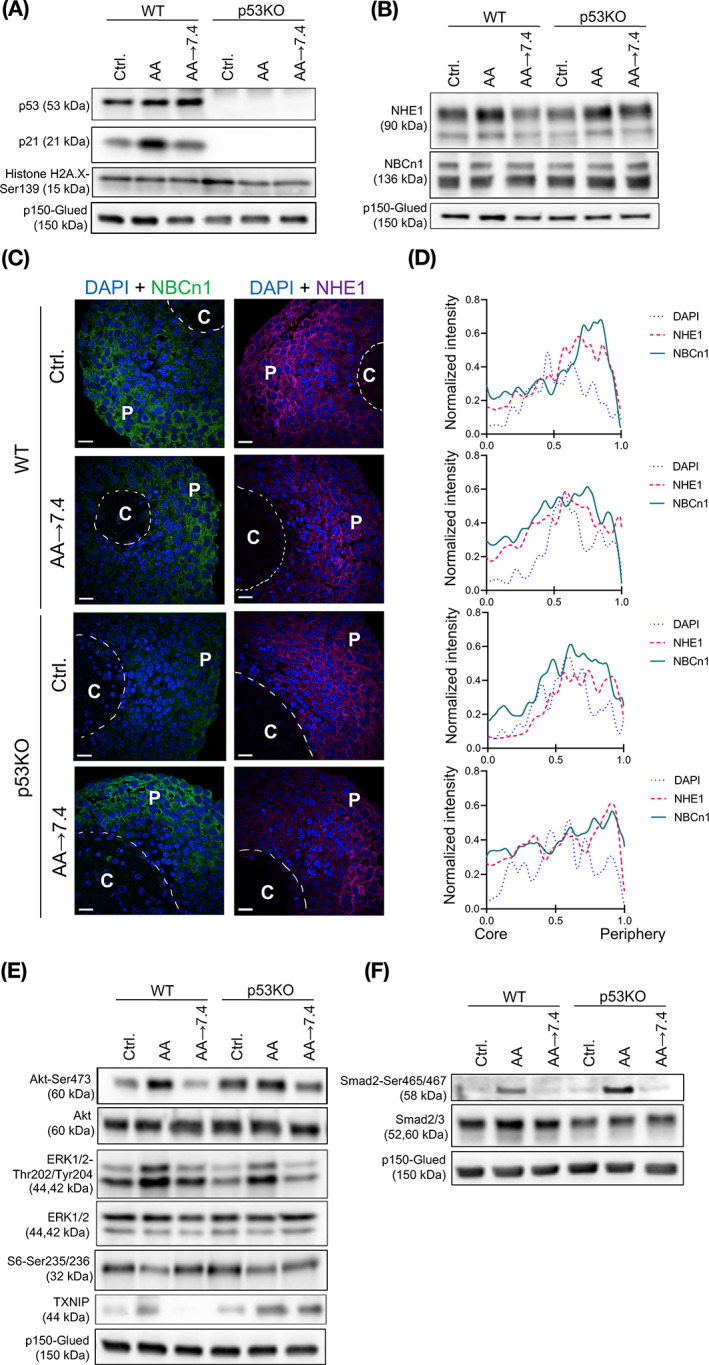
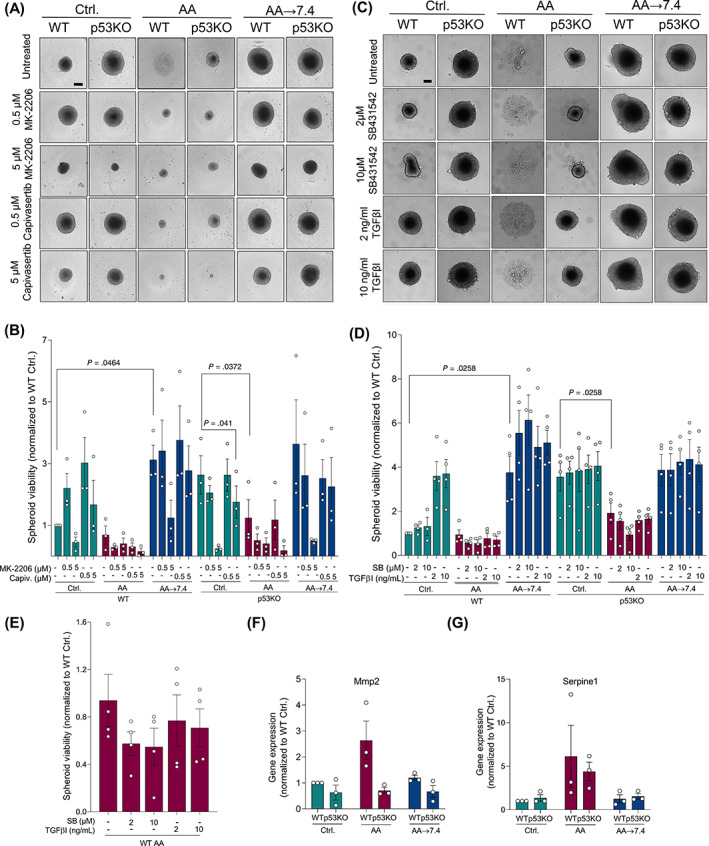
Pancreatic ductal adenocarcinoma (PDAC) is an extremely aggressive malignancy with minimal treatment options and a global rise in prevalence. PDAC is characterized by frequent driver mutations including KRAS and TP53 (p53), and a dense, acidic tumor microenvironment (TME). The relation between genotype and TME in PDAC development is unknown. Strikingly, when wild type (WT) Panc02 PDAC cells were adapted to growth in an acidic TME and returned to normal pH to mimic invasive cells escaping acidic regions, they displayed a strong increase of aggressive traits such as increased growth in 3-dimensional (3D) culture, adhesion-independent colony formation and invasive outgrowth. This pattern of acidosis-induced aggressiveness was observed in 3D spheroid culture as well as upon organotypic growth in matrigel, collagen-I and combination thereof, mimicking early and later stages of PDAC development. Acid-adaptation-induced gain of cancerous traits was further increased by p53 knockout (KO), but only in specific extracellular matrix (ECM) compositions. Akt- and Transforming growth factor-β (TGFβ) signaling, as well as expression of the Na /H exchanger NHE1, were increased by acid adaptation. Whereas Akt inhibition decreased spheroid growth regardless of treatment and genotype, stimulation with TGFβI increased growth of WT control spheroids, and inhibition of TGFβ signaling tended to limit growth under acidic conditions only. Our results indicate that a complex crosstalk between tumor acidosis, ECM composition and genotype contributes to PDAC development. The findings may guide future strategies for acidosis-targeted therapies.
胰腺导管腺癌(PDAC)是一种极具侵袭性的恶性肿瘤,治疗选择有限,且在全球范围内发病率呈上升趋势。PDAC 的特征是频繁出现驱动基因突变,包括 KRAS 和 TP53(p53),以及致密、酸性的肿瘤微环境(TME)。PDAC 发展过程中基因型与 TME 之间的关系尚不清楚。引人注目的是,当野生型(WT)Panc02 PDAC 细胞适应酸性 TME 生长并恢复到正常 pH 值以模拟侵袭性细胞逃避酸性区域时,它们表现出强烈的侵袭性特征增加,例如在 3 维(3D)培养中增加生长、非依赖性粘附的集落形成和侵袭性外生。这种酸中毒诱导的侵袭性模式在 3D 球体培养以及在 Matrigel、胶原-I 及其组合中的器官样生长中观察到,模拟了 PDAC 发展的早期和晚期阶段。酸适应诱导的癌症特征增益通过 p53 敲除(KO)进一步增加,但仅在特定细胞外基质(ECM)组成中。酸适应增加了 Akt 和转化生长因子-β(TGFβ)信号传导以及 Na+/H 交换器 NHE1 的表达。虽然 Akt 抑制无论治疗和基因型如何均降低球体生长,但 TGFβI 刺激增加了 WT 对照球体的生长,而 TGFβ 信号传导的抑制仅倾向于在酸性条件下限制生长。我们的结果表明,肿瘤酸中毒、ECM 组成和基因型之间的复杂相互作用有助于 PDAC 的发展。这些发现可能为酸中毒靶向治疗的未来策略提供指导。