Université Claude Bernard Lyon 1, Research on Healthcare Performance (RESHAPE), INSERM U1290, Lyon, France.
Hospices Civils de Lyon, Lyon Sud Hospital, Department of Emergency Medicine, Pierre Bénite, France.
West J Emerg Med. 2022 Oct 24;23(6):897-906. doi: 10.5811/westjem.2022.7.57135.
Few studies have investigated the management of COVID-19 cases from the operational perspective of the emergency department (ED), We sought to compare the management and outcome of COVID-19 positive and negative patients who presented to French EDs.
We conducted a prospective, multicenter, observational study in four EDs. Included in the study were adult patients (≥18 years) between March 6-May 10, 2020, were hospitalized, and whose presenting symptoms were evocative of COVID-19. We compared the clinical features, management, and prognosis of patients according to their confirmed COVID-19 status.
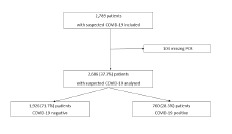
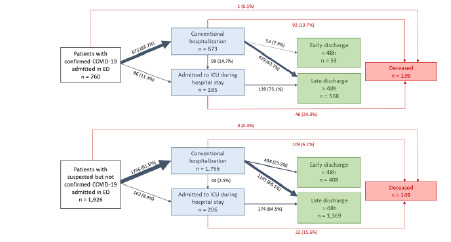
Of the 2,686 patients included in this study, 760 (28.3%) were COVID-19 positive. Among them, 364 (48.0%) had hypertension, 228 (30.0%) had chronic cardiac disease, 186 (24.5%) had diabetes, 126 (16.6%) were obese, and 114 (15.0%) had chronic respiratory disease. The proportion of patients admitted to intensive care units (ICU) was higher among COVID-19 positive patients (185/760, 24.3%) compared to COVID-19 negative patients (206/1,926, 10.7%; P <0.001), and they required mechanical ventilation (89, 11.9% vs 37, 1.9%; P <0.001) and high-flow nasal cannula oxygen therapy (135, 18.1% vs 41, 2.2%; P < 0.001) more frequently. The in-hospital mortality was significantly higher among COVID-19 positive patients (139, 18.3% vs 149, 7.7%; P <0.001).
Emergency departments were on the frontline during the COVID-19 pandemic and had to manage potential COVID-19 patients. Understanding what happened in the ED during this first outbreak is crucial to underline the importance of flexible organizations that can quickly adapt the bed capacities to the incoming flow of COVID-19 positive patients.
鲜有研究从急诊部(ED)的运营角度调查 COVID-19 病例的管理。我们试图比较在法国 ED 就诊的 COVID-19 阳性和阴性患者的管理和结局。
我们在 4 家 ED 进行了一项前瞻性、多中心、观察性研究。研究纳入 2020 年 3 月 6 日至 5 月 10 日期间年龄≥18 岁、住院且首发症状提示 COVID-19 的成年患者。我们根据患者的 COVID-19 确诊情况比较了他们的临床特征、管理和预后。
这项研究共纳入 2686 例患者,760 例(28.3%)COVID-19 阳性。其中,364 例(48.0%)有高血压,228 例(30.0%)有慢性心脏疾病,186 例(24.5%)有糖尿病,126 例(16.6%)肥胖,114 例(15.0%)有慢性呼吸系统疾病。COVID-19 阳性患者中入住重症监护病房(ICU)的比例高于 COVID-19 阴性患者(185/760,24.3% vs. 206/1926,10.7%;P<0.001),需要机械通气(89 例,11.9% vs. 37 例,1.9%;P<0.001)和高流量鼻导管给氧治疗(135 例,18.1% vs. 41 例,2.2%;P<0.001)的比例也更高。COVID-19 阳性患者的院内死亡率显著高于 COVID-19 阴性患者(139 例,18.3% vs. 149 例,7.7%;P<0.001)。
急诊部在 COVID-19 大流行期间处于前沿,必须管理可能的 COVID-19 患者。了解首次暴发期间 ED 发生的情况对于强调能够快速适应 COVID-19 阳性患者流入的灵活组织的重要性至关重要。