Aboubakr Esam M, Ibrahim Ahmed R N, Ali Fares E M, Mourad Ahmed A E, Ahmad Adel M, Hofni Amal
Department of Pharmacology and Toxicology, Faculty of Pharmacy, South Valley University, Qena 83523, Egypt.
Department of Clinical Pharmacy, College of Pharmacy, King Khalid University, Abha 62529, Saudi Arabia.
Pharmaceuticals (Basel). 2022 Nov 19;15(11):1436. doi: 10.3390/ph15111436.
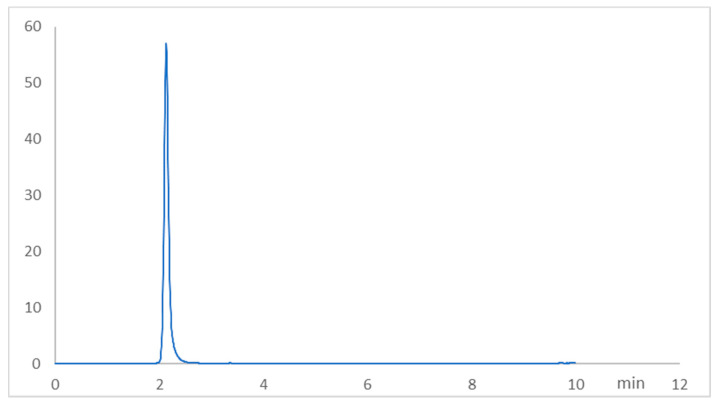
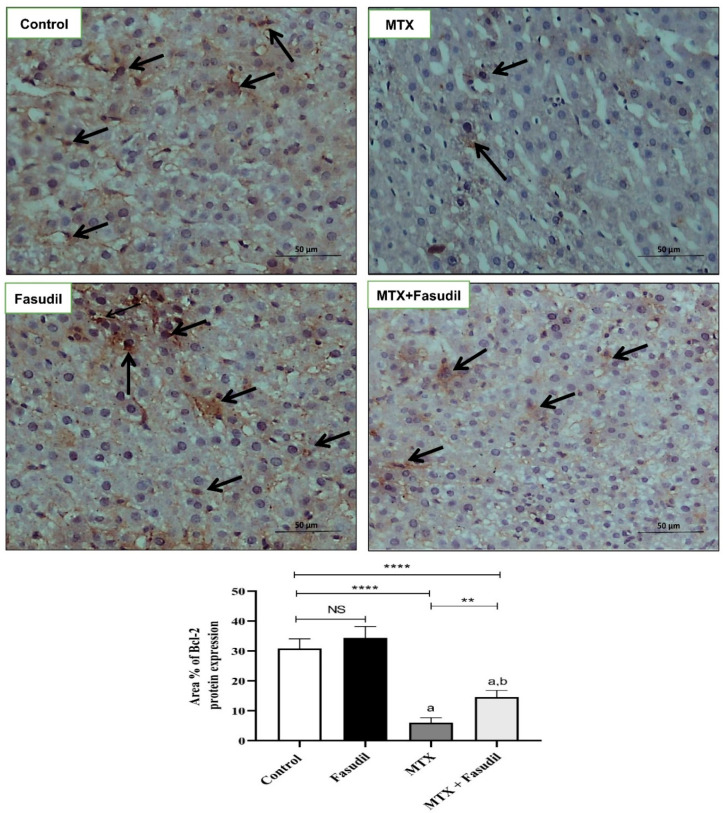
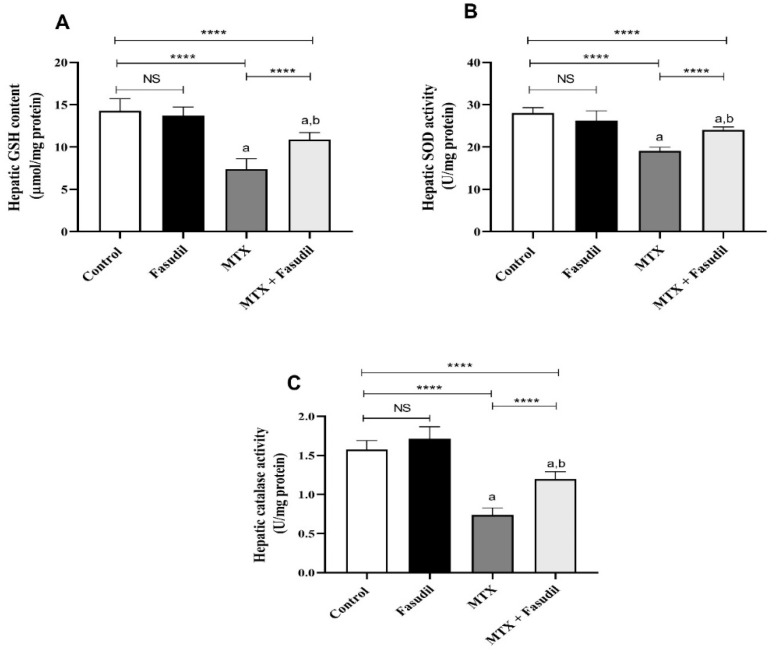
Methotrexate (MTX) is one of the most widely used cytotoxic chemotherapeutic agents, and it is used in the treatment of different autoimmune disorders. However, the clinical applications of MTX are limited by its hepatic toxicity. Hence, the present study was conducted to evaluate the efficacy of fasudil (Rho-Kinase inhibitor) in the amelioration of MTX hepatotoxicity and the possible underlying mechanisms. Experimentally, 32 male Sprague Dawley rats were used and divided into four groups: control, MTX (20 mg/kg, i.p., single dose), fasudil (10 mg/kg/day i.p.) for one week, and fasudil plus MTX. It was found that MTX significantly induced hepatitis and hepatocellular damage, as shown by abnormal histological findings and liver dysfunction (ALT and AST), with up-regulation of the inflammatory mediators NF-κB-p65 and IL-1β. Moreover, MTX remarkably disrupted oxidant/antioxidant status, as evidenced by malondialdehyde (MDA) up-regulation associated with the depletion of superoxide dismutase (SOD), catalase, and reduced glutathione (GSH) levels. Moreover, MTX reduced the hepatic expression of B-cell lymphoma 2 (Bcl-2). On the contrary, the i.p. administration of fasudil significantly ameliorated MTX hepatotoxicity by histopathological improvement, restoring oxidant/antioxidant balance, preventing hepatic inflammation, and improving the hepatic anti-apoptotic capability. Furthermore, fasudil hepatic concentration was determined for the first time using the validated RP-HPLC method. In conclusion, the present study revealed that fasudil has a reliable hepatoprotective effect against MTX hepatotoxicity with underlying antioxidant, anti-inflammatory, and anti-apoptotic mechanisms. It also introduced a new method for the determination of fasudil hepatic tissue concentration using the RP-HPLC technique.
甲氨蝶呤(MTX)是应用最为广泛的细胞毒性化疗药物之一,用于治疗多种自身免疫性疾病。然而,MTX的临床应用受到其肝毒性的限制。因此,本研究旨在评估法舒地尔(一种Rho激酶抑制剂)对MTX肝毒性的改善作用及其潜在机制。实验中,选用32只雄性Sprague Dawley大鼠,分为四组:对照组、MTX组(20 mg/kg,腹腔注射,单次剂量)、法舒地尔组(10 mg/kg/天,腹腔注射,持续一周)以及法舒地尔+MTX组。结果发现,MTX显著诱导肝炎和肝细胞损伤,组织学检查结果异常及肝功能(ALT和AST)异常,炎症介质NF-κB-p65和IL-1β上调。此外,MTX显著破坏氧化/抗氧化状态,丙二醛(MDA)上调,同时超氧化物歧化酶(SOD)、过氧化氢酶和还原型谷胱甘肽(GSH)水平降低。而且,MTX降低了肝脏中B细胞淋巴瘤2(Bcl-2)的表达。相反,腹腔注射法舒地尔通过组织病理学改善、恢复氧化/抗氧化平衡、预防肝脏炎症以及提高肝脏抗凋亡能力,显著改善了MTX的肝毒性。此外,首次采用经过验证的反相高效液相色谱法(RP-HPLC)测定了法舒地尔在肝脏中的浓度。总之,本研究表明法舒地尔对MTX肝毒性具有可靠的肝保护作用,其潜在机制包括抗氧化、抗炎和抗凋亡作用。同时,本研究还介绍了一种利用RP-HPLC技术测定法舒地尔肝组织浓度的新方法。