Institute of Immunopharmaceutical Sciences, School of Pharmaceutical Sciences, Shandong University, Jinan 250012, Shandong Province, China.
Department of Emergency Surgery, Qilu Hospital of Shandong University, Jinan 250012, Shandong Province, China.
World J Gastroenterol. 2021 Jun 28;27(24):3581-3594. doi: 10.3748/wjg.v27.i24.3581.
Fasudil, as a Ras homology family member A (RhoA) kinase inhibitor, is used to improve brain microcirculation and promote nerve regeneration clinically. Increasing evidence shows that Rho-kinase inhibition could improve liver fibrosis.
To evaluate the anti-fibrotic effects of Fasudil in a mouse model of liver fibrosis induced by thioacetamide (TAA).
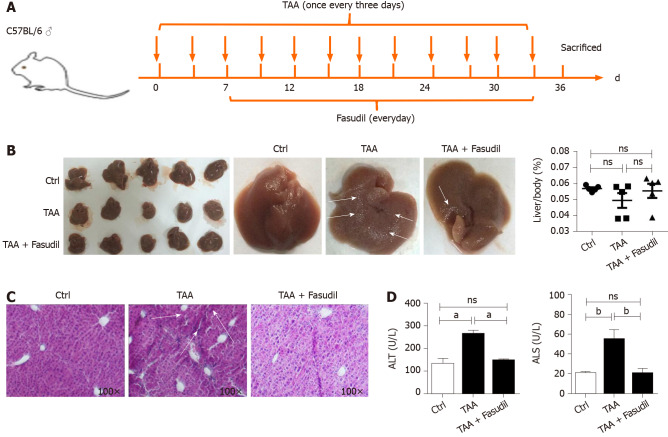
C57BL/6 mice were administered TAA once every 3 d for 12 times. At 1 wk after induction with TAA, Fasudil was intraperitoneally injected once a day for 3 wk, followed by hematoxylin and eosin staining, sirius red staining, western blotting, and quantitative polymerase chain reaction (qPCR), and immune cell activation was assayed by fluorescence-activated cell sorting. Furthermore, the effects of Fasudil on hepatic stellate cells and natural killer (NK) cells were assayed .
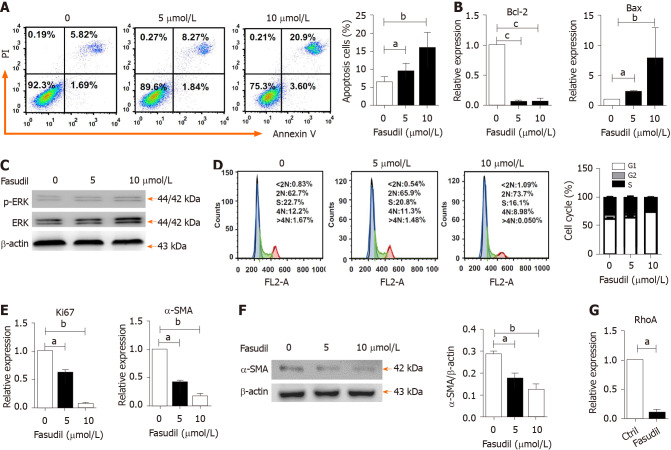
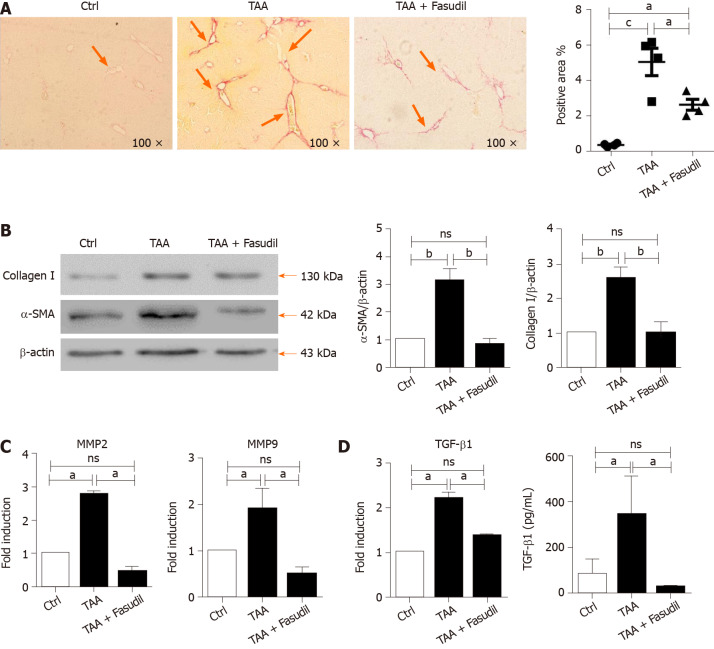
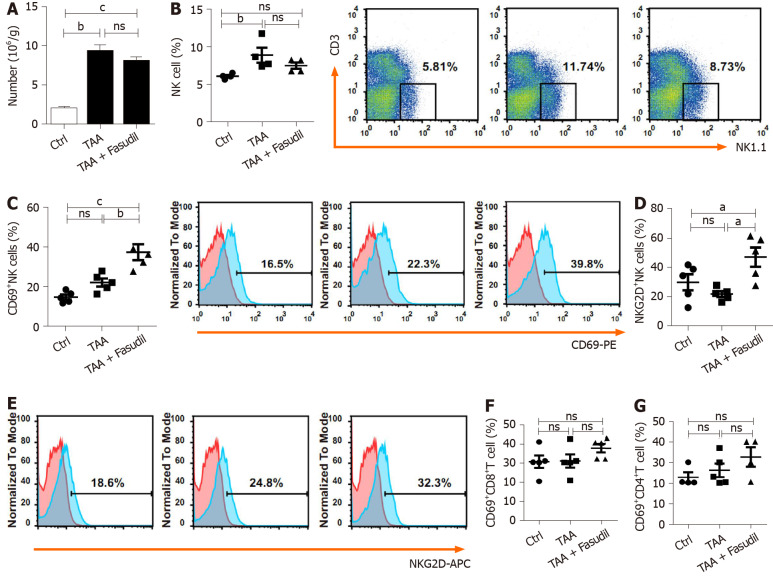
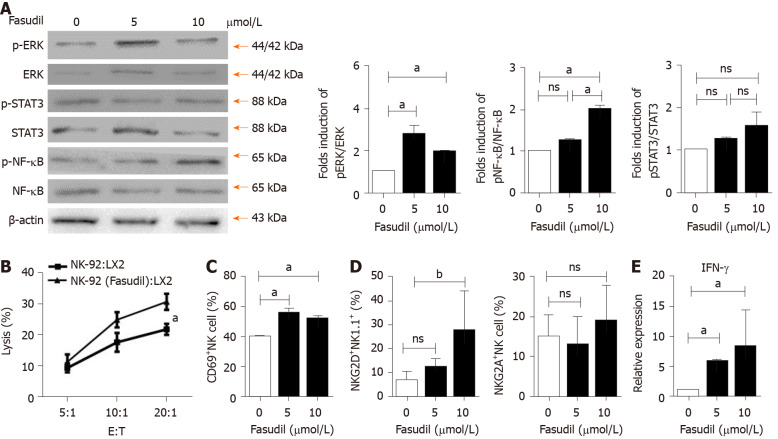
First, we found that TAA-induced liver injury was protected, and the positive area of sirius red staining and type I collagen deposition were significantly decreased by Fasudil treatment. Furthermore, western blot and qPCR assays showed that the levels of alpha smooth muscle actin (α-SMA), matrix metalloproteinase 2 (MMP-2), MMP-9, and transforming growth factor beta 1 (TGF-β1) were inhibited by Fasudil. Moreover, flow cytometry analysis revealed that NK cells were activated by Fasudil treatment in and . Furthermore, Fasudil directly promoted the apoptosis and inhibited the proliferation of hepatic stellate cells by decreasing α-SMA and TGF-β1.
Fasudil inhibits liver fibrosis by activating NK cells and blocking hepatic stellate cell activation, thereby providing a feasible solution for the clinical treatment of liver fibrosis.
法舒地尔是一种 Ras 同源家族成员 A(RhoA)激酶抑制剂,临床上用于改善脑微循环,促进神经再生。越来越多的证据表明,Rho 激酶抑制可改善肝纤维化。
评价法舒地尔在硫代乙酰胺(TAA)诱导的肝纤维化小鼠模型中的抗纤维化作用。
C57BL/6 小鼠每 3 天接受 TAA 一次,共 12 次。在 TAA 诱导后 1 周,每天腹腔注射法舒地尔,共 3 周,然后进行苏木精和伊红染色、天狼猩红染色、western blot 和定量聚合酶链反应(qPCR),并通过荧光激活细胞分选检测免疫细胞激活。此外,还检测了法舒地尔对肝星状细胞和自然杀伤(NK)细胞的作用。
首先,我们发现 TAA 诱导的肝损伤得到了保护,法舒地尔治疗可显著降低天狼猩红染色阳性面积和 I 型胶原沉积。此外,western blot 和 qPCR 检测显示,α 平滑肌肌动蛋白(α-SMA)、基质金属蛋白酶 2(MMP-2)、MMP-9 和转化生长因子β 1(TGF-β1)的水平被法舒地尔抑制。此外,流式细胞术分析显示,法舒地尔激活了 NK 细胞。此外,法舒地尔通过降低α-SMA 和 TGF-β1 直接促进肝星状细胞凋亡和抑制增殖。
法舒地尔通过激活 NK 细胞和阻断肝星状细胞激活抑制肝纤维化,为肝纤维化的临床治疗提供了一种可行的方法。