Sonntag Tanja, Ancel Sara, Karaz Sonia, Cichosz Paulina, Jacot Guillaume, Giner Maria Pilar, Sanchez-Garcia José Luis, Pannérec Alice, Moco Sofia, Sorrentino Vincenzo, Cantó Carles, Feige Jérôme N
Nestle Institute of Health Sciences, Lausanne, Switzerland.
EPFL School of Life Sciences, Ecole Polytechnique Fédérale de Lausanne, Lausanne, Switzerland.
Front Cell Dev Biol. 2022 Nov 9;10:1049653. doi: 10.3389/fcell.2022.1049653. eCollection 2022.
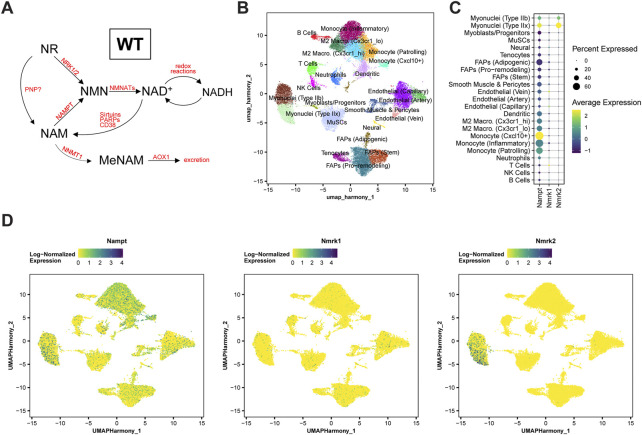
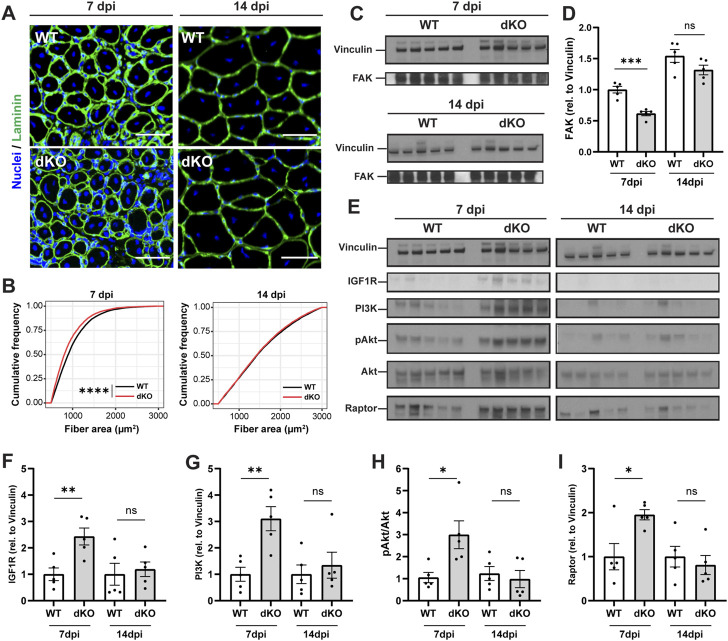
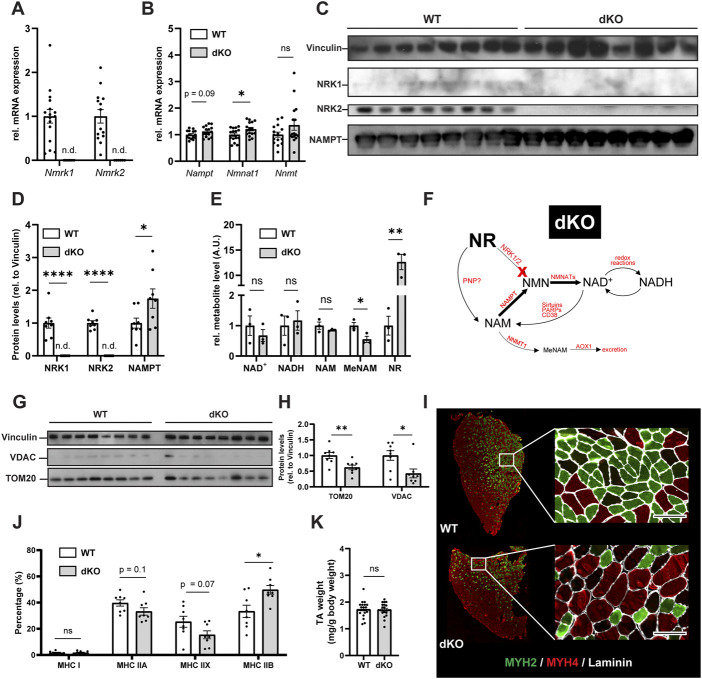
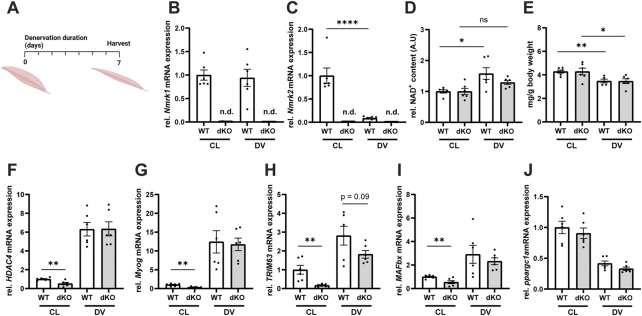
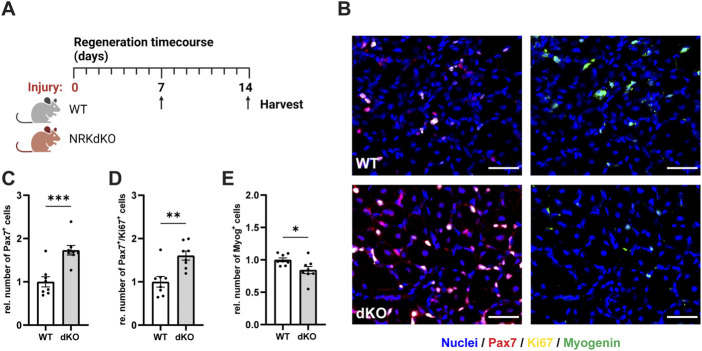
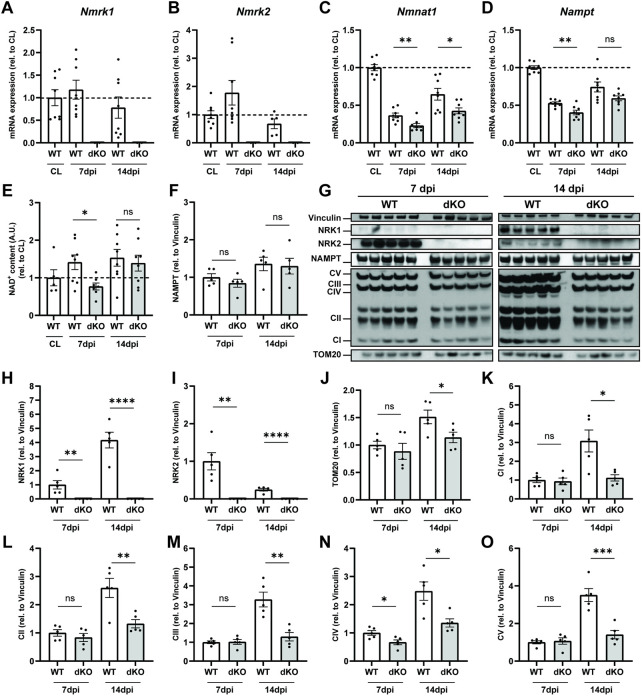
Nicotinamide riboside kinases (NRKs) control the conversion of dietary Nicotinamide Riboside (NR) to NAD, but little is known about their contribution to endogenous NAD turnover and muscle plasticity during skeletal muscle growth and remodeling. Using NRK1/2 double KO (NRKdKO) mice, we investigated the influence of NRKs on NAD metabolism and muscle homeostasis, and on the response to neurogenic muscle atrophy and regeneration following muscle injury. Muscles from NRKdKO animals have altered nicotinamide (NAM) salvage and a decrease in mitochondrial content. In single myonuclei RNAseq of skeletal muscle, NRK2 mRNA expression is restricted to type IIx muscle fibers, and perturbed NAD turnover and mitochondrial metabolism shifts the fiber type composition of NRKdKO muscle to fast glycolytic IIB fibers. NRKdKO does not influence muscle atrophy during denervation but alters muscle repair after myofiber injury. During regeneration, muscle stem cells (MuSCs) from NRKdKO animals hyper-proliferate but fail to differentiate. NRKdKO also alters the recovery of NAD during muscle regeneration as well as mitochondrial adaptations and extracellular matrix remodeling required for tissue repair. These metabolic perturbations result in a transient delay of muscle regeneration which normalizes during myofiber maturation at late stages of regeneration over-compensation of anabolic IGF1-Akt signaling. Altogether, we demonstrate that NAD synthesis controls mitochondrial metabolism and fiber type composition NRK1/2 and is rate-limiting for myogenic commitment and mitochondrial maturation during skeletal muscle repair.
烟酰胺核糖激酶(NRKs)控制膳食烟酰胺核糖(NR)向NAD的转化,但关于它们在骨骼肌生长和重塑过程中对内源性NAD周转和肌肉可塑性的贡献知之甚少。我们使用NRK1/2双敲除(NRKdKO)小鼠,研究了NRKs对NAD代谢和肌肉稳态的影响,以及对肌肉损伤后神经源性肌肉萎缩和再生反应的影响。NRKdKO动物的肌肉改变了烟酰胺(NAM)的补救途径,线粒体含量降低。在骨骼肌单个肌核的RNA测序中,NRK2 mRNA表达仅限于IIx型肌纤维,NAD周转紊乱和线粒体代谢改变将NRKdKO肌肉的纤维类型组成转变为快速糖酵解IIB型纤维。NRKdKO不影响去神经支配期间的肌肉萎缩,但会改变肌纤维损伤后的肌肉修复。在再生过程中,NRKdKO动物的肌肉干细胞(MuSCs)过度增殖但无法分化。NRKdKO还改变了肌肉再生过程中NAD的恢复以及组织修复所需的线粒体适应和细胞外基质重塑。这些代谢紊乱导致肌肉再生出现短暂延迟,在再生后期肌纤维成熟过程中恢复正常,这是合成代谢IGF1-Akt信号过度补偿的结果。总之,我们证明NAD合成控制线粒体代谢和纤维类型组成,NRK1/2在骨骼肌修复过程中对成肌分化和线粒体成熟起限速作用。