Okadome Toshiki, Yamaguchi Takahiro, Mukaino Takahiko, Sakata Ayumi, Ogata Katsuya, Shigeto Hiroshi, Isobe Noriko, Uehara Taira
Department of Neurology, Neurological Institute, Graduate School of Medical Sciences, Kyushu University, Fukuoka, Japan.
Department of Clinical Chemistry and Laboratory Medicine, Kyushu University Hospital, Fukuoka, Japan.
Front Neurol. 2022 Nov 10;13:979333. doi: 10.3389/fneur.2022.979333. eCollection 2022.
Interictal epileptic discharges (IEDs) are known to affect cognitive function in patients with epilepsy, but the mechanism has not been elucidated. Sleep spindles appearing in synchronization with IEDs were recently demonstrated to impair memory consolidation in rat, but this has not been investigated in humans. On the other hand, the increase of sleep spindles at night after learning is positively correlated with amplified learning effects during sleep for motor sequence learning. In this study, we examined the effects of IEDs and IED-coupled spindles on motor sequence learning in patients with epilepsy, and clarified their pathological significance.
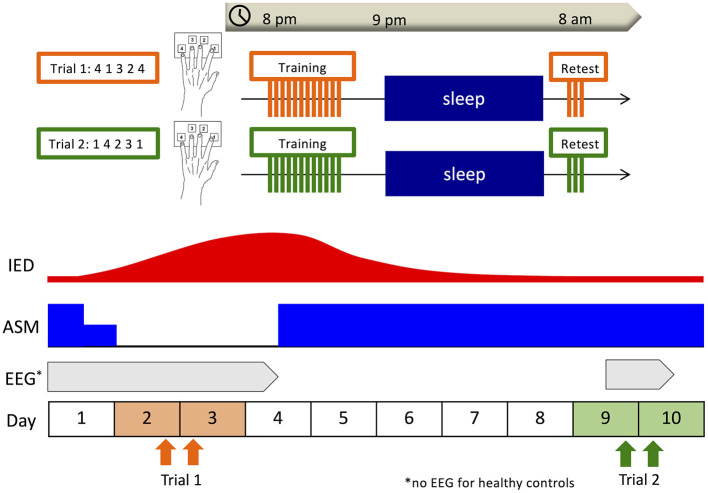
Patients undergoing long-term video-electroencephalography (LT-VEEG) at our hospital from June 2019 to November 2021 and age-matched healthy subjects were recruited. Motor sequence learning consisting of a finger-tapping task was performed before bedtime and the next morning, and the improvement rate of performance was defined as the sleep-dependent learning effect. We searched for factors associated with the changes in learning effect observed between the periods of when antiseizure medications (ASMs) were withdrawn for LT-VEEG and when they were returned to usual doses after LT-VEEG.
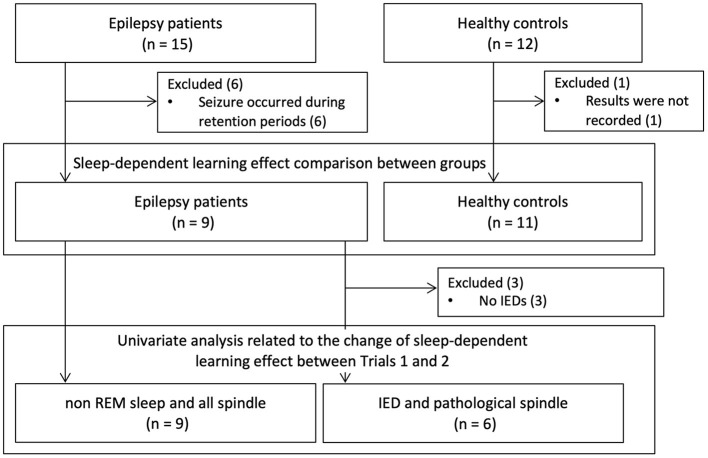
Excluding six patients who had epileptic seizures at night after learning, nine patients and 11 healthy subjects were included in the study. In the patient group, there was no significant learning effect when ASMs were withdrawn. The changes in learning effect of the patient group during ASM withdrawal were not correlated with changes in sleep duration or IED density; however, they were significantly negatively correlated with changes in IED-coupled spindle density.
We found that the increase of IED-coupled spindles correlated with the decrease of sleep-dependent learning effects of procedural memory. Pathological IED-coupled sleep spindles could hinder memory consolidation, that is dependent on physiological sleep spindles, resulting in cognitive dysfunction in patients with epilepsy.
发作间期癫痫样放电(IEDs)已知会影响癫痫患者的认知功能,但其机制尚未阐明。最近有研究表明,与IEDs同步出现的睡眠纺锤波会损害大鼠的记忆巩固,但这在人类中尚未得到研究。另一方面,学习后夜间睡眠纺锤波的增加与睡眠期间运动序列学习的增强学习效果呈正相关。在本研究中,我们研究了IEDs和与IEDs耦合的纺锤波对癫痫患者运动序列学习的影响,并阐明了它们的病理意义。
招募了2019年6月至2021年11月在我院接受长期视频脑电图(LT-VEEG)检查的患者以及年龄匹配的健康受试者。在睡前和第二天早上进行由手指敲击任务组成的运动序列学习,并将表现改善率定义为睡眠依赖性学习效果。我们寻找与在LT-VEEG期间停用抗癫痫药物(ASMs)和LT-VEEG后恢复常规剂量期间观察到的学习效果变化相关的因素。
排除6例学习后夜间癫痫发作的患者,研究纳入了9例患者和11名健康受试者。在患者组中,停用ASMs时没有显著的学习效果。患者组在ASM停药期间学习效果的变化与睡眠时间或IED密度的变化无关;然而,它们与IED耦合纺锤波密度的变化显著负相关。
我们发现,与IED耦合的纺锤波增加与程序性记忆的睡眠依赖性学习效果降低相关。病理性的与IED耦合的睡眠纺锤波可能会阻碍依赖于生理性睡眠纺锤波的记忆巩固,从而导致癫痫患者出现认知功能障碍。