Gutierrez-Carazo Encina, Dowle James, Coulon Frederic, Temple Tracey, Ladyman Melissa
Cranfield University, Centre for Defence Chemistry, Defence Academy of the United Kingdom, Shrivenham, SN6 8LA, UK.
Golder, Sirius Building, The Clocktower, Edinburgh, EH12 9LB, UK.
Heliyon. 2022 Nov 22;8(11):e11758. doi: 10.1016/j.heliyon.2022.e11758. eCollection 2022 Nov.
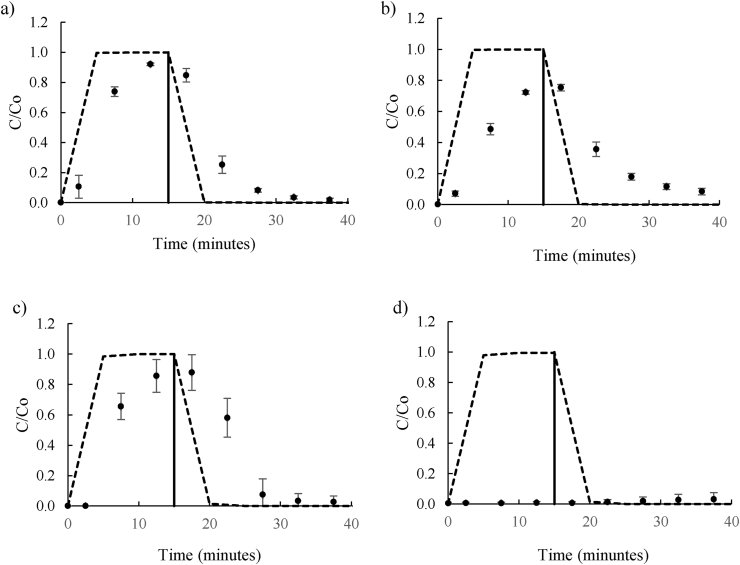
There is a trend toward the use of Insensitive High Explosives (IHE) in both military and civil applications as they are intended to be less prone to accidental detonation compared to traditional explosive fills. This has driven the development of new explosive formulations containing different chemical compounds whose behaviour once they are released into the environment is not fully understood. To date, research into the toxicity and the persistence of IHE compounds in the environment is scarce and little has been described about how they interact with, or move through soil. In this work, the transport of two IHE constituents, 2,4-dinitroanisole (DNAN) and 3-nitro-1,2,4-triazol-5-one (NTO), through two soil types (sand and sandy loam) was simulated in GoldSim using a stochastic approach. The simulation outputs were validated by comparison to results from empirical soil column experiments. Sorption of the IHE constituents to the soil was the most significant factor in predicting when the contaminants eluted from the soil column. Sensitivity analysis demonstrated that variation in the matrix water partition coefficient (K) had the greatest influence when used to predict the IHE compounds transport. K was measured empirically and, as expected, it was low in sand for NTO (0.334 L kg) and DNAN (0.401 L kg), suggesting high mobility. While in sandy loam K for NTO (0.242 L kg) was similar to one obtained in sand, it was significantly higher for DNAN (9.128 L kg), explaining the high retention and adsorption in the sandy loam soil. The use of stochastic modelling to estimate IHE breakthrough concentrations could enable the uncertainty inherent in environmental systems to be embedded into simulations, thus increasing their representativeness. This study is the first step toward proactive management of IHE in the environment, and may support decision making for remediation and mitigation strategies in different environments.
在军事和民用领域,有一种使用钝感高能炸药(IHE)的趋势,因为与传统炸药填充物相比,它们不太容易发生意外爆炸。这推动了含有不同化合物的新型炸药配方的开发,而这些化合物一旦释放到环境中的行为尚未完全了解。迄今为止,关于IHE化合物在环境中的毒性和持久性的研究很少,关于它们如何与土壤相互作用或在土壤中移动的描述也很少。在这项工作中,使用随机方法在GoldSim中模拟了两种IHE成分,2,4-二硝基苯甲醚(DNAN)和3-硝基-1,2,4-三唑-5-酮(NTO)在两种土壤类型(沙子和砂壤土)中的迁移。通过与经验性土柱实验结果进行比较,验证了模拟输出。IHE成分在土壤中的吸附是预测污染物何时从土柱中洗脱的最重要因素。敏感性分析表明,在预测IHE化合物迁移时,基质水分配系数(K)的变化影响最大。K是通过实验测量的,正如预期的那样,NTO(0.334 L/kg)和DNAN(0.401 L/kg)在沙子中的K值较低,表明迁移率较高。而在砂壤土中,NTO的K值(0.242 L/kg)与在沙子中获得的值相似,DNAN的K值(9.128 L/kg)则显著更高,这解释了其在砂壤土中的高保留和吸附。使用随机模型来估计IHE突破浓度可以将环境系统中固有的不确定性纳入模拟,从而提高其代表性。这项研究是朝着对环境中的IHE进行主动管理迈出的第一步,并可能为不同环境中的修复和缓解策略的决策提供支持。