Cilia Federica, Touchet Claire, Vandromme Luc, Driant Barbara Le
CRP-CPO: Centre de Recherche en Psychologie: Cognition, Psychisme et Organisations, EA 7273, University of Picardie Jules Verne, Amiens, France.
CHIMERE: Chirurgie et Extrémité Céphalique Caractérisation Morphologique et Fonctionnelle, EA 7516, University of Picardie Jules Verne, Amiens, France.
Autism Dev Lang Impair. 2020 Aug 31;5:2396941520950979. doi: 10.1177/2396941520950979. eCollection 2020 Jan-Dec.
Response to joint attention (RJA) and initiation of joint attention (IJA) are impaired in pre-schoolers with autism spectrum disorder (ASD). Children's response to joint attention may depend on the presence of the target in the child's field of vision or on the type of deictic index (head and eye orientation, pointing and verbalisations) used by the adult to initiate joint attention.
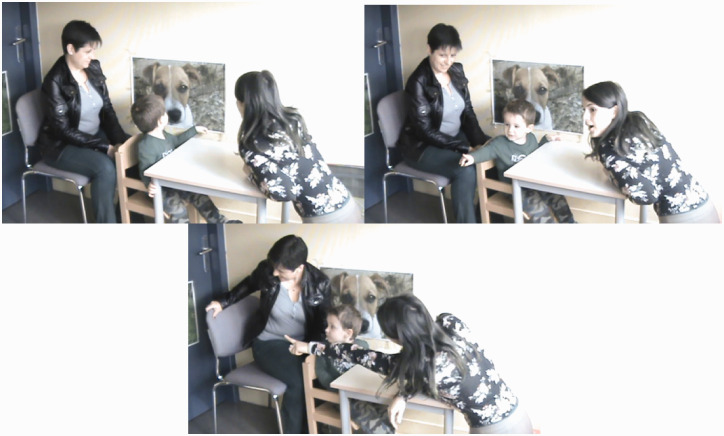
This study deals with 50 ASD children aged from 2 years 8 months to 11 years 7 months, with a communicative level comparable to children under 31 months of age, according to the French version of the Early Social Communication Scales (ECSP, by its French acronym). We compared the aforementioned ASD children with 50 typically developing (TD) children, aged 9 to 30 months who had no communication disorders according to the ECSP. During the ECSP test, we analysed joint attention behaviours on three posters present or absent from the children's visual field.
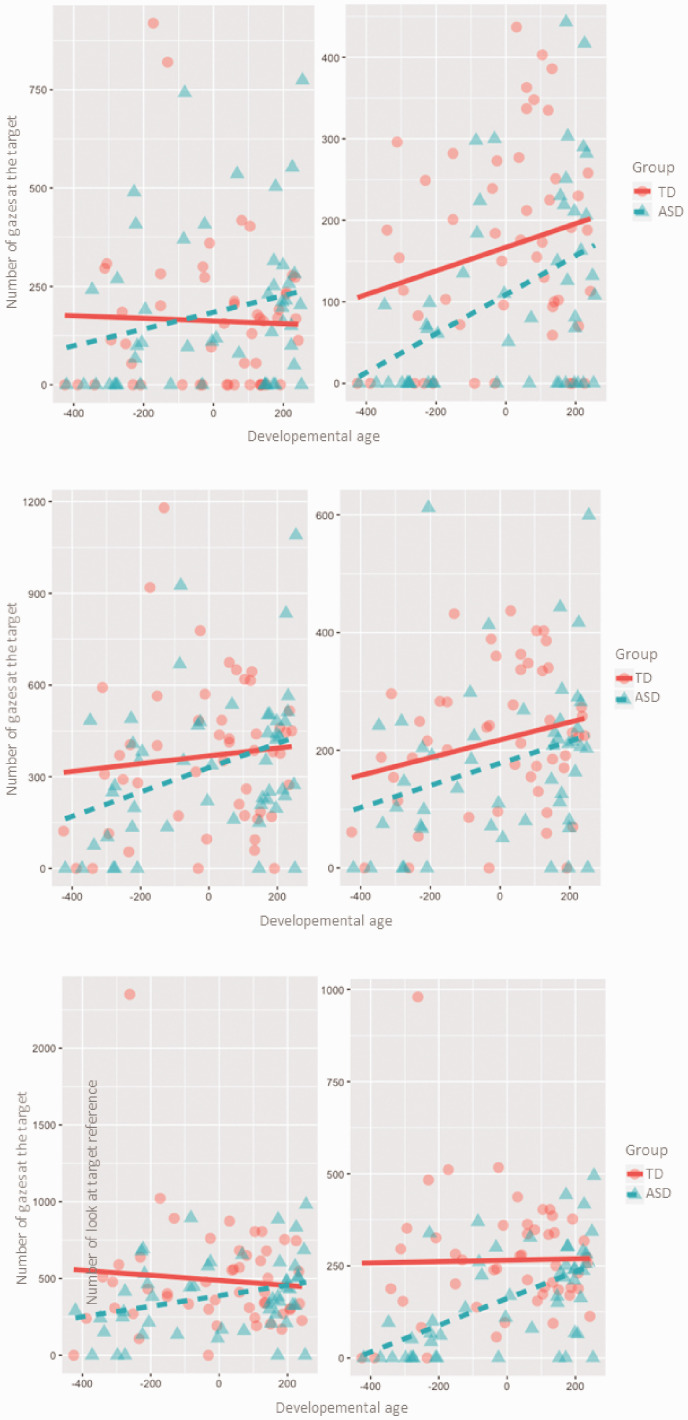
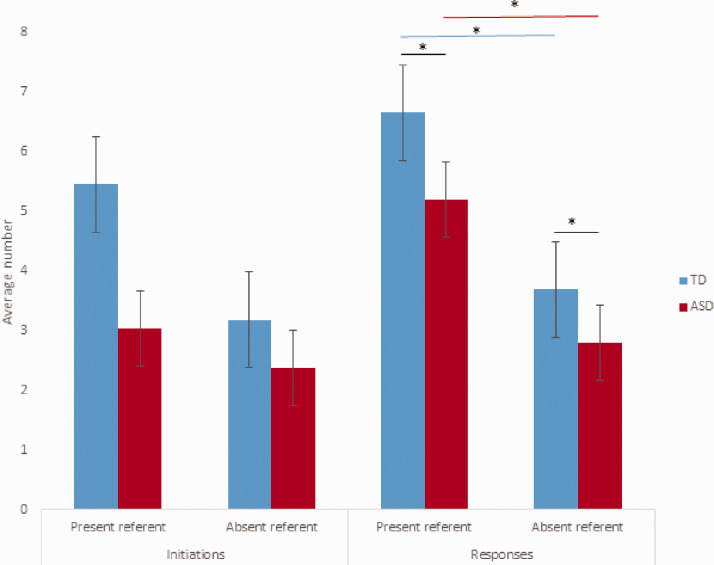
We did not observe any difference in the number of IJAs between groups, but ASD children were less responsive than TD children were. Our results showed a developmental progression in the responses of children with ASD if several deictic cues were used by an adult simultaneously (looking and pointing, or looking and verbalising to indicate a target), whether the referent was present or absent from the child's visual field. In addition, we observed developmental progression when the referent was behind the child and the adult only used their gaze to refer to it.
Thus, we argue that the type of cues used affects ASD children's response behaviours joint attention towards a referent that may be present or absent from their visual field. Regarding the social and the sensory difficulties of children with ASD, many therapeutic approaches focus their intervention methods on non-verbal communication skills and joint attention. This fundamental research makes it possible to identify the most appropriate type of deictic index for children with ASD with developmental delay, depending on the presence or absence of the referent in the child's visual field.
自闭症谱系障碍(ASD)学龄前儿童的联合注意反应(RJA)和联合注意发起(IJA)存在缺陷。儿童对联合注意的反应可能取决于目标是否出现在儿童视野中,或者取决于成人用于发起联合注意的指示性指标类型(头部和眼睛方向、指向和言语表达)。
本研究涉及50名年龄在2岁8个月至11岁7个月之间的ASD儿童,根据法语版早期社会沟通量表(ECSP,法语缩写),其沟通水平与31个月以下儿童相当。我们将上述ASD儿童与50名发育正常(TD)的儿童进行比较,这些TD儿童年龄在9至30个月之间,根据ECSP没有沟通障碍。在ECSP测试期间,我们分析了儿童视野中出现或未出现的三张海报上的联合注意行为。
我们没有观察到两组之间IJA数量的差异,但ASD儿童的反应比TD儿童少。我们的结果表明,如果成人同时使用多种指示性线索(注视和指向,或注视和言语表达来指示目标),无论目标是否出现在儿童视野中,ASD儿童的反应都有发育进程。此外,当目标在儿童身后且成人仅用目光指向它时,我们也观察到了发育进程。
因此,我们认为所使用的线索类型会影响ASD儿童对联合注意的反应行为,即对其视野中可能存在或不存在的目标的联合注意。鉴于ASD儿童的社交和感官困难,许多治疗方法将干预方法聚焦于非言语沟通技能和联合注意。这项基础研究使得根据目标在儿童视野中的存在与否,为发育迟缓的ASD儿童确定最合适的指示性指标类型成为可能。