Animal Systematics and Molecular Ecology Laboratory, Department of Biology, Faculty of Science, Mahidol University, Bangkok, Thailand.
School of Biology, Institute of Science, Suranaree University of Technology, Nakhon Ratchasima, Thailand.
Sci Rep. 2022 Nov 28;12(1):20458. doi: 10.1038/s41598-022-24844-9.
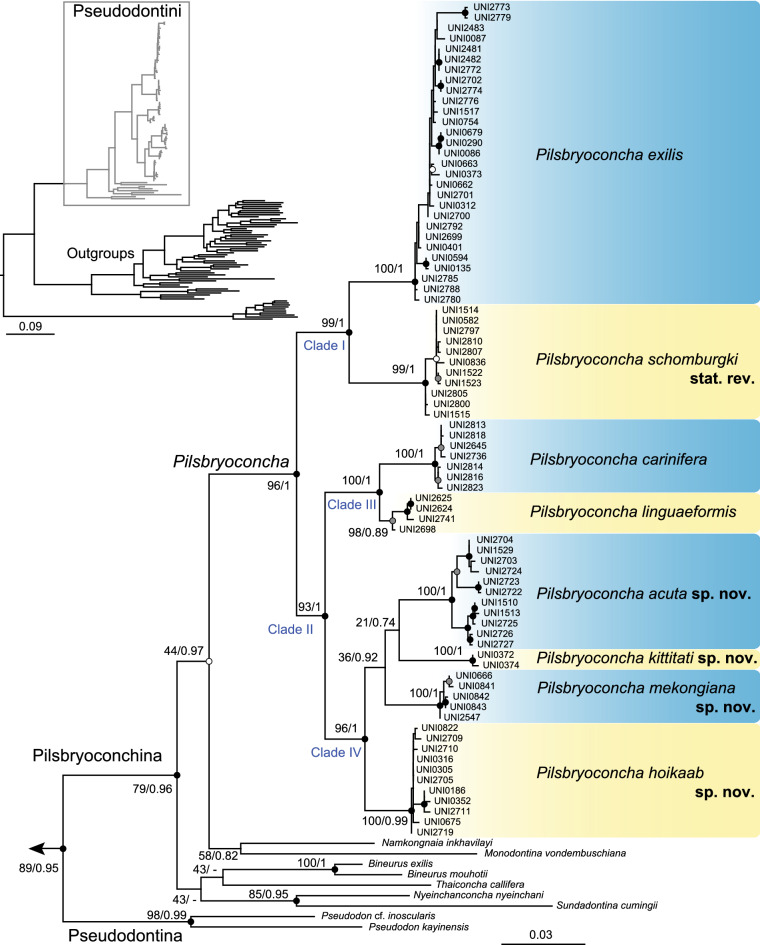
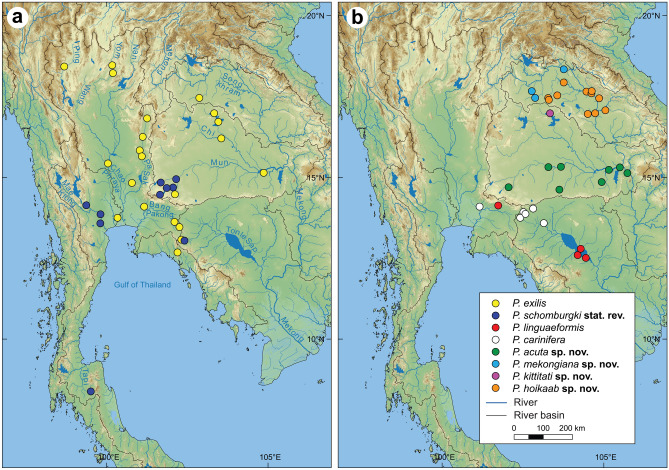
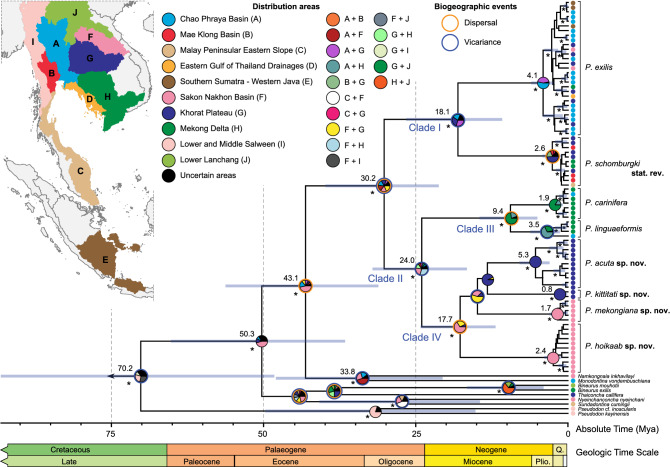
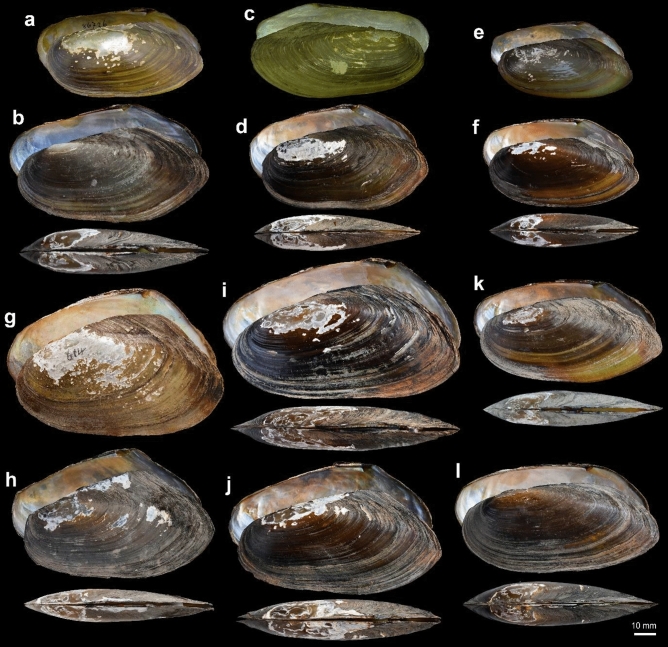
The body of knowledge regarding the classification and evolution of freshwater mussels in the family Unionidae (Bivalvia) in Indochina has recently increased. However, the taxonomic revision of all extant taxa in the region is still ongoing. In this study, the genus Pilsbryoconcha was revised based on an integrative analysis of shell morphology, biogeography, and molecular data. Multi-locus phylogeny indicated the availability of eight species within the genus. Four previously recognized species are P. exilis (Lea, 1838), P. schomburgki (Martens, 1860) stat. rev., P. linguaeformis (Morelet, 1875), and P. carinifera (Conrad, 1837), while four other species are described herein as P. acuta sp. nov., P. mekongiana sp. nov., P. kittitati sp. nov., and P. hoikaab sp. nov. In addition, the neotype of P. carinifera is also designated to clarify its long taxonomic ambiguity. Divergent time estimation and historical biogeography analysis revealed that Pilsbryoconcha originated in the area now called the Khorat Plateau around the middle of the Eocene (mean age = 43.12 Mya), before its range was expanded across Indochina through a series of complex geomorphological changes of river systems, which also led to diversification of the genus.
关于在家族河蚬科(双壳纲)中淡水贻贝的分类和进化的知识体系最近有所增加。然而,该地区所有现存分类群的分类修订仍在进行中。在这项研究中,根据壳形态、生物地理学和分子数据的综合分析,修订了 Pilsbryoconcha 属。多基因系统发育表明,该属内有八种物种。四个以前公认的物种是 P. exilis (Lea, 1838)、P. schomburgki (Martens, 1860) stat. rev.、P. linguaeformis (Morelet, 1875) 和 P. carinifera (Conrad, 1837),而另外四个物种则在此描述为 P. acuta sp. nov.、P. mekongiana sp. nov.、P. kittitati sp. nov. 和 P. hoikaab sp. nov.。此外,还指定了 P. carinifera 的正型标本,以澄清其长期存在的分类模糊性。分歧时间估计和历史生物地理学分析表明,Pilsbryoconcha 起源于现在称为呵叻高原的地区,大约在始新世中期(平均年龄= 43.12 Mya),在此之前,它的分布范围通过一系列河流系统的复杂地貌变化扩展到了整个印度支那半岛,这也导致了该属的多样化。