Department of Surgical Oncology, Faculty of Medicine, Andalas University, Padang, Indonesia.
Department of Anatomical Pathology, Faculty of Medicine, Andalas University, Padang, Indonesia.
Asian Pac J Cancer Prev. 2022 Nov 1;23(11):3617-3622. doi: 10.31557/APJCP.2022.23.11.3617.
This study aims to determine the relationship between BRAF V600E and Ki-67 expression with the recurrence of well-differentiated thyroid cancers.
The design of this study is a case-control and survival analysis. The data was taken from the thyroid cancer registry in Padang, Indonesia, where samples were taken from well-differentiated thyroid cancer patients who underwent therapy according to the protocol between 2015 and 2020. During this period, 396 well-differentiated thyroid cancer cases were obtained, of which 24 cases experienced recurrence. Of the cases that recurred, we found as many as 20 cases with complete tissue preservation documents later designated as cases. Calculating the expression of BRAF V600E and Ki-67 was performed semi-quantitatively per 100 tumor cells at random. For statistical tests, chi-square and survival analysis were performed using Kaplan-Meier and Cox regression analysis using a computer program with a determined significance level of p < 0.05.
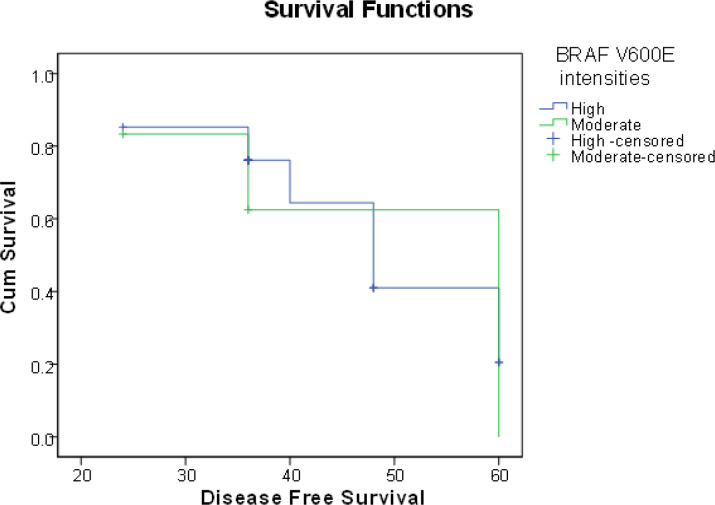
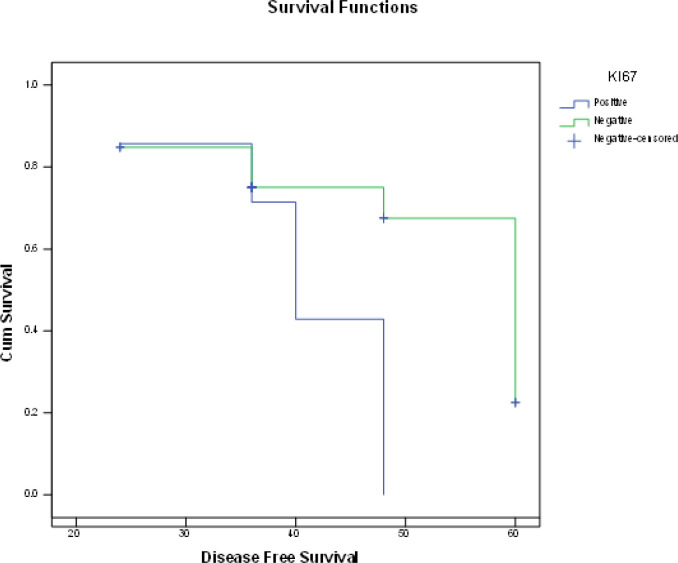
BRAF V600E expression was found in all cases and controls in which 85% of cases had vigorous intensity and 15% had moderate intensity. Ki-67 expression was found positive in 35% of the recurrent cases, while in control, there was no expression of Ki-67. Patients with positive Ki-67 expression had shorter median survival than patients with negative Ki-67 expression of 40 months (95% CI 35-45 months) to 60 months (95% CI 53-67 months). An association was obtained between Ki-67 expression and thyroid cancer recurrence based on disease-free survival (p<0.05) with HR 1.34 (95% CI 1.13-1.92).
This study confirms the association between Ki-67 expression and thyroid cancer recurrence based on disease-free survival and can be used as alternative to support the significance of Ki-67 as a predictor of thyroid cancer recurrence. In addition, Ki-67 can complement other molecular markers such as the BRAF V600E, to increase its prognostic strength.
本研究旨在确定 BRAF V600E 与 Ki-67 表达与分化型甲状腺癌复发之间的关系。
本研究设计为病例对照和生存分析。数据取自印度尼西亚巴东的甲状腺癌登记处,其中样本取自 2015 年至 2020 年期间根据方案接受治疗的分化型甲状腺癌患者。在此期间,获得了 396 例分化型甲状腺癌病例,其中 24 例复发。在复发的病例中,我们发现多达 20 例有完整的组织保存文件,后来被指定为病例。通过随机每 100 个肿瘤细胞进行半定量计算 BRAF V600E 和 Ki-67 的表达。统计检验采用卡方检验和 Kaplan-Meier 生存分析,以及使用计算机程序进行 Cox 回归分析,确定显著水平为 p<0.05。
所有病例和对照组均发现 BRAF V600E 表达,其中 85%的病例呈强阳性,15%呈中度阳性。复发病例中有 35%的 Ki-67 表达阳性,而对照组中没有 Ki-67 表达。Ki-67 表达阳性的患者中位生存时间短于 Ki-67 表达阴性的患者,分别为 40 个月(95%CI 35-45 个月)和 60 个月(95%CI 53-67 个月)。基于无病生存,获得了 Ki-67 表达与甲状腺癌复发之间的关联(p<0.05),HR 为 1.34(95%CI 1.13-1.92)。
本研究证实了 Ki-67 表达与无病生存相关的甲状腺癌复发之间的关联,可作为支持 Ki-67 作为甲状腺癌复发预测因子的意义的替代方法。此外,Ki-67 可以补充其他分子标志物,如 BRAF V600E,以提高其预后强度。