Department of Emergency Medicine, Chang Gung Memorial Hospital, Linkou, Taiwan.
Chang Gung University College of Medicine, Taoyuan, Taiwan.
BMC Med Educ. 2022 Nov 30;22(1):826. doi: 10.1186/s12909-022-03909-3.
In recent years, a national curriculum reform was implemented in undergraduate medical education in Taiwan to reduce clinical rotation training from 3 years to 2 years. The last generation of the old curriculum and the first generation of the new curriculum both graduated in 2019. This study aimed to compare the learning outcomes of the medical students in these two curriculum groups in terms of preparedness for practice during the transition from undergraduate to postgraduate study.
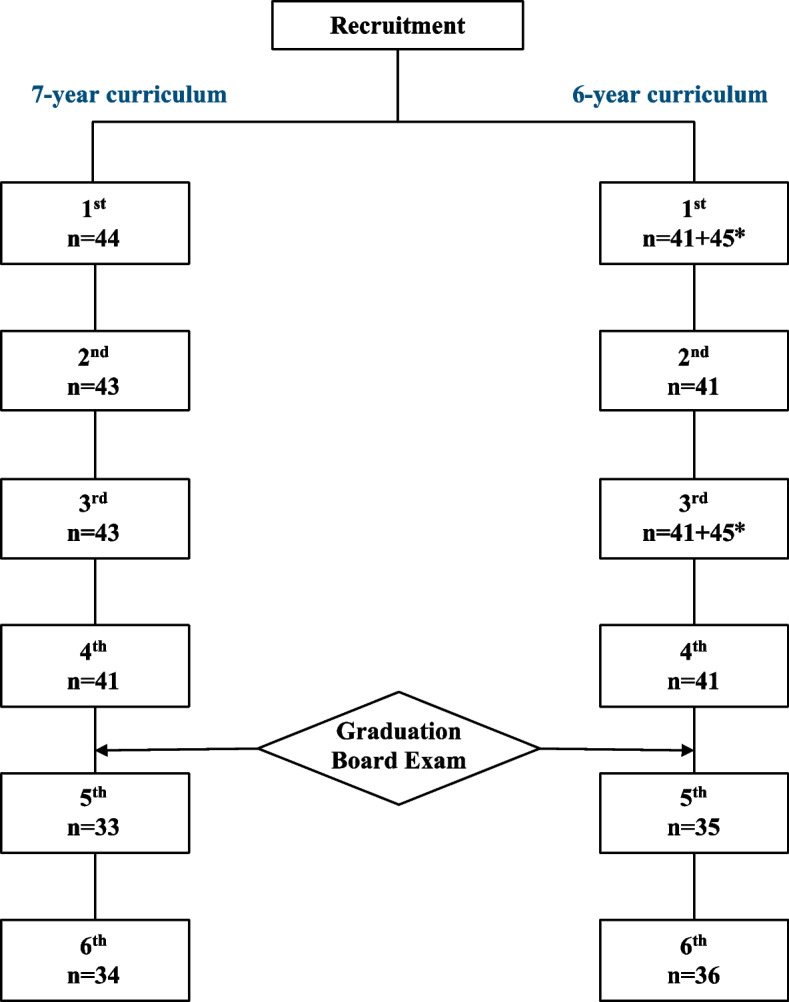
This was a 3-year prospective, longitudinal, comparative cohort study between 2017 and 2020. Medical students from both the 7-year and 6-year curriculum groups received biannual questionnaire surveys starting 18 months before graduation and running until 11 months after graduation. The measurement tools were the Preparedness for Hospital Practice Questionnaire (PHPQ) and Copenhagen Burnout Inventory (CBI). Personal demographic information was also collected. Linear mixed models were used to determine the effect of curriculum change on learners' preparedness and burnout levels.
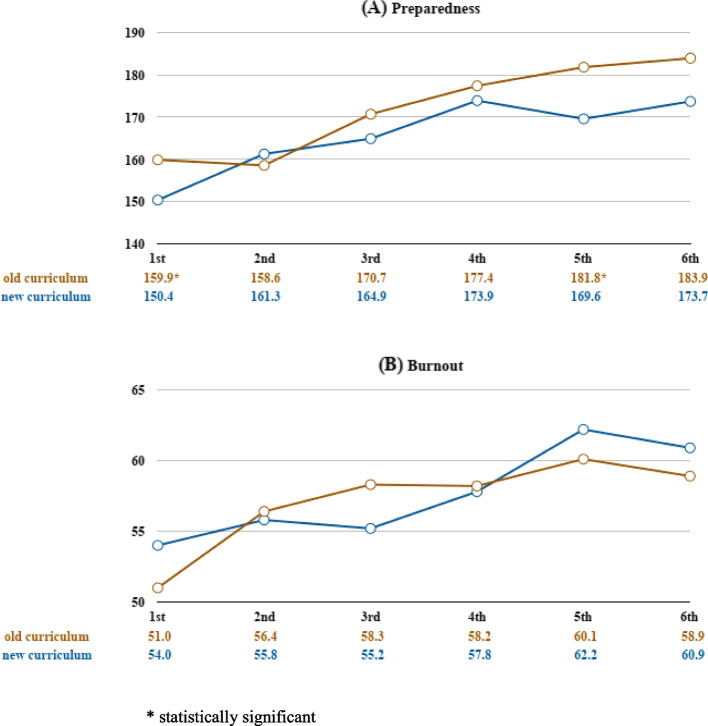
A total of 130 medical students from the two cohorts provided 563 measurements during the study period. Compared to their counterparts following the old curriculum, the participants following the new curriculum showed a lower level of preparedness when first entering clinical rotation (p = 0.027) and just after graduating (p = 0.049), especially in the domains of clinical confidence (p = 0.021) and patient management p = 0.015). The multivariate linear mixed model revealed gradual increases in preparedness and burnout in serial measurements in both curriculum groups. Students following the new curriculum, which involved a shortened clinical rotation, showed a slightly lower overall preparedness (p = 0.035) and the same level of burnout (p = 0.692) after adjustment. The factor of year of change did not show a significant effect on either preparedness (p = 0.258) or burnout (p = 0.457).
Shortened clinical rotation training for medical undergraduates is associated with a decrease in preparedness for practice during the transition from undergraduate to postgraduate study. Clinical confidence and patient management are the main domains affected.
近年来,台湾的本科医学教育实施了一项国家课程改革,将临床轮转培训从 3 年缩短至 2 年。最后一代旧课程和第一代新课程均于 2019 年毕业。本研究旨在比较这两个课程组的医学生在从本科到研究生学习过渡期间的实践准备方面的学习成果。
这是一项 2017 年至 2020 年进行的为期 3 年的前瞻性、纵向、比较队列研究。7 年制和 6 年制课程组的医学生在毕业前 18 个月开始接受每半年一次的问卷调查,并持续到毕业后 11 个月。测量工具是医院实习准备情况问卷(PHPQ)和哥本哈根倦怠量表(CBI)。还收集了个人人口统计学信息。线性混合模型用于确定课程改革对学习者准备度和倦怠水平的影响。
共有来自两个队列的 130 名医学生在研究期间提供了 563 次测量。与旧课程的对应者相比,新课程的参与者在首次进入临床轮转时(p=0.027)和毕业后立即(p=0.049)表现出较低的准备水平,尤其是在临床信心(p=0.021)和患者管理(p=0.015)方面。多变量线性混合模型显示,在两个课程组的连续测量中,准备度和倦怠度逐渐增加。在新课程中,临床轮转时间缩短的学生,在总体准备度方面表现略低(p=0.035),调整后倦怠度相同(p=0.692)。变革年份的因素对准备度(p=0.258)或倦怠(p=0.457)均没有显著影响。
缩短医学生的临床轮转培训与从本科到研究生学习过渡期间的实践准备度降低有关。受影响的主要领域是临床信心和患者管理。