Department of Neurosurgery, General Hospital of Northern Theater Command, Shenyang, China.
Department of Pathology, Xijing Hospital, Air Force Medical University, Xi'an, Shaanxi, China.
Medicine (Baltimore). 2022 Nov 25;101(47):e32042. doi: 10.1097/MD.0000000000032042.
To fully understand the clinical features and prognosis of Glioblastoma (GBM), we extracted the data from the Surveillance, Epidemiology, and End Results (SEER) database and performed a series of analyses.
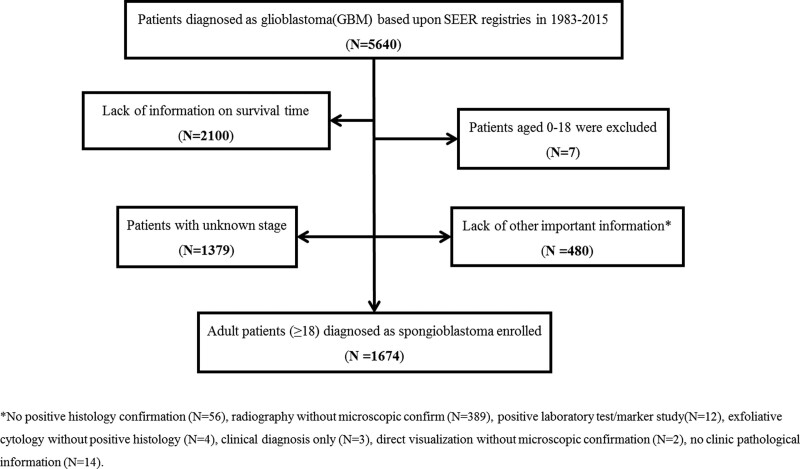
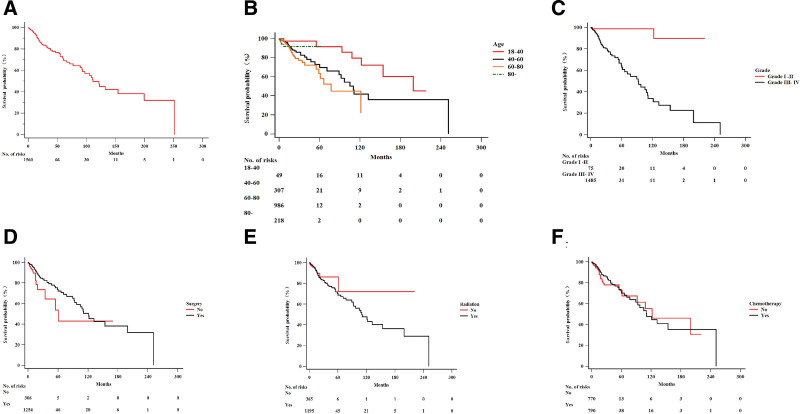
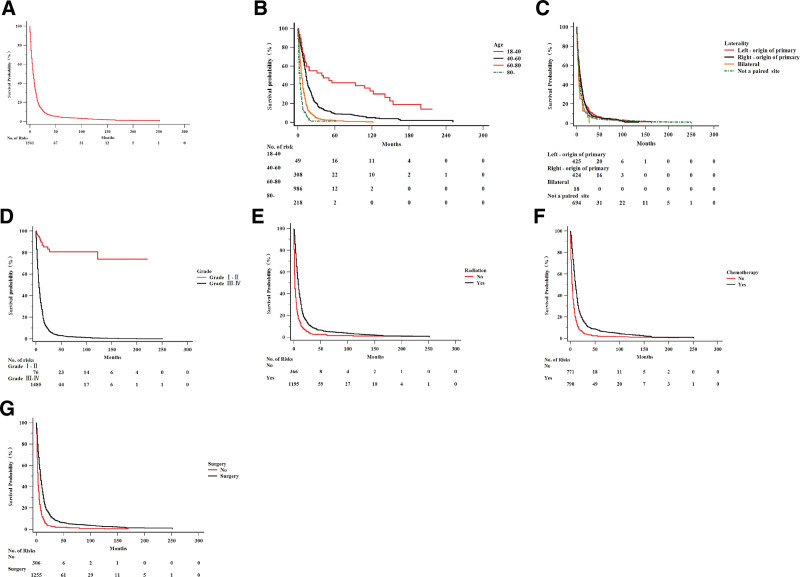
We retrospectively analyzed the data of 1674 patients with GBM obtained from the SEER database from 1983 to 2015. Kaplan-Meier analysis was performed to calculate the survival rate, and the log-rank test was used to analyze the survival outcomes.
Older patients with GBM had a worse survival period (P < .05). Laterality had no effect on the prognosis (P > .05). Patients with high-grade gliomas may have a shorter lifespan (P < .05). In terms of overall survival (OS) and disease specificity, all 3 classical treatments failed to improve the life expectancy (P > .05). In adult patients with GBM, we found that age, tumor grade, surgery, radiotherapy, and chemotherapy were independent risk factors for all-cause mortality. In the univariate disease-specific analysis, age, tumor grade, surgery, radiotherapy, and chemotherapy were independent risk factors. However, in multivariate disease-specific analysis, the results showed that only tumor grade and surgery were independent risk factors for GBM.
Older patients diagnosed with GBM have worse survival, and patients with glioma of higher grades have a shorter lifespan. Age, grade, surgery, radiation therapy, and chemotherapy were independent prognostic factors for patients with GBM.
为了充分了解胶质母细胞瘤(GBM)的临床特征和预后,我们从监测、流行病学和最终结果(SEER)数据库中提取数据,并进行了一系列分析。
我们回顾性分析了 1983 年至 2015 年从 SEER 数据库获得的 1674 例 GBM 患者的数据。采用 Kaplan-Meier 分析计算生存率,对数秩检验分析生存结果。
年龄较大的 GBM 患者的生存期较差(P<0.05)。侧别对预后无影响(P>0.05)。高级别胶质瘤患者的寿命可能较短(P<0.05)。在总生存期(OS)和疾病特异性方面,3 种经典治疗方法均未能提高预期寿命(P>0.05)。在 GBM 成年患者中,我们发现年龄、肿瘤分级、手术、放疗和化疗是全因死亡率的独立危险因素。在单变量疾病特异性分析中,年龄、肿瘤分级、手术、放疗和化疗是独立的危险因素。然而,在多变量疾病特异性分析中,结果表明只有肿瘤分级和手术是 GBM 的独立危险因素。
诊断为 GBM 的老年患者的生存率较差,肿瘤级别较高的患者寿命较短。年龄、分级、手术、放疗和化疗是 GBM 患者的独立预后因素。