Eun Yeonghee, Han Kyungdo, Lee Seung Woo, Kim Kyunga, Kang Seonyoung, Lee Seulkee, Cha Hoon-Suk, Koh Eun-Mi, Kim Hyungjin, Lee Jaejoon
Division of Rheumatology, Department of Internal Medicine, Kangbuk Samsung Hospital, Sungkyunkwan University School of Medicine, Seoul, South Korea.
Department of Statistics and Actuarial Science, Soongsil University, Seoul, South Korea.
Front Med (Lausanne). 2022 Nov 14;9:1010391. doi: 10.3389/fmed.2022.1010391. eCollection 2022.
To date, few studies have focused on risk factors for gout in young people, and large-scale studies on the relationship between metabolic syndrome (MetS) and gout are lacking. We aimed to investigate the association between gout and MetS in a large nationwide population-based cohort of young men who participated in national health examination.
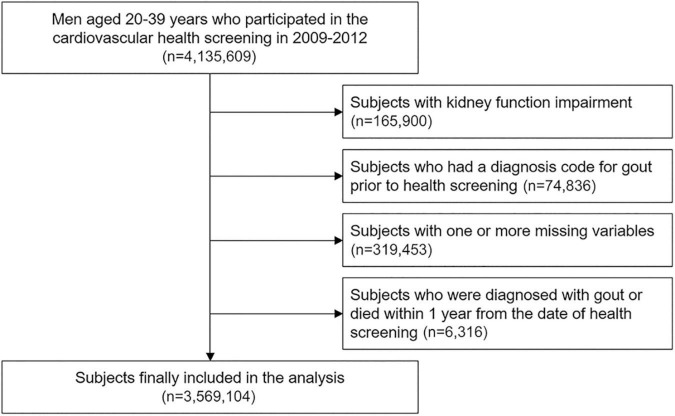
Cohort included men aged 20-39 years who participated in a health check-up in 2009-2012. A total of 3,569,104 subjects was included in the study, excluding those who had a previous diagnosis of gout or had renal impairment. The outcome was the occurrence of gout, which was defined using the diagnosis code of gout in the claims database. Cox proportional hazard model was used to evaluate the association between MetS and incident gout.
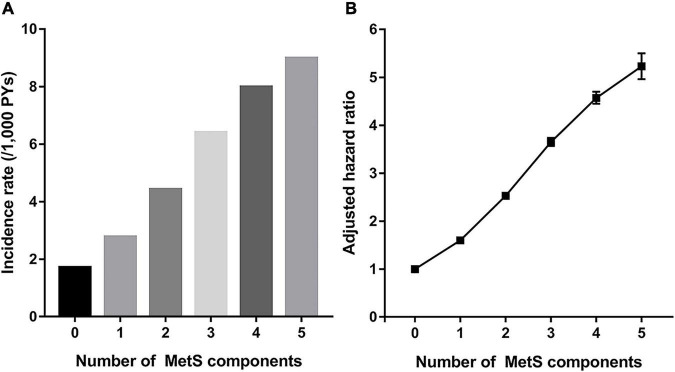
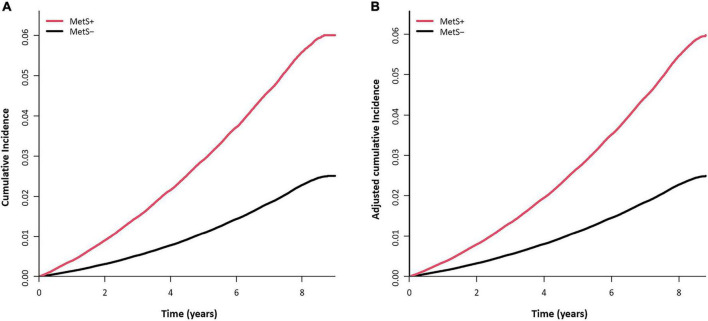
Mean follow-up duration was 7.35 ± 1.24 years and the incidence rate of gout was 3.36 per 1,000 person-years. The risk of gout in subjects with MetS was 2.4-fold higher than subjects without MetS. Among the components of MetS, hypertriglyceridemia and abdominal obesity showed the greatest association with gout. As the number of MetS components increased, the risk of gout increased. The association between gout and MetS was more pronounced in relatively young subjects and in low- or normal-weight subjects.
Metabolic syndrome is an important risk factor for the gout in young men. In particular, the association between MetS and gout was greater in young and non-obese men. Management of MetS in young men will be important for future gout prevention.
迄今为止,很少有研究关注年轻人痛风的危险因素,且缺乏关于代谢综合征(MetS)与痛风之间关系的大规模研究。我们旨在调查参与全国健康检查的大规模基于人群的年轻男性队列中痛风与MetS之间的关联。
队列包括2009年至2012年参加健康检查的20至39岁男性。共有3,569,104名受试者纳入研究,排除既往诊断为痛风或有肾功能损害的患者。结局指标为痛风的发生,通过索赔数据库中痛风的诊断代码来定义。采用Cox比例风险模型评估MetS与新发痛风之间的关联。
平均随访时间为7.35±1.24年,痛风发病率为每1000人年3.36例。患有MetS的受试者患痛风的风险比未患MetS的受试者高2.4倍。在MetS的各组分中,高甘油三酯血症和腹型肥胖与痛风的关联最为显著。随着MetS组分数量的增加,痛风风险增加。痛风与MetS之间的关联在相对年轻的受试者以及低体重或正常体重受试者中更为明显。
代谢综合征是年轻男性痛风的重要危险因素。特别是,MetS与痛风之间的关联在年轻和非肥胖男性中更大。对年轻男性的MetS进行管理对未来预防痛风至关重要。