Department of Biochemistry, Purdue University, West Lafayette, Indiana, USA.
Department of Medicine, Brigham and Women's Hospital, Harvard Medical School, Boston, Massachusetts, USA.
J Med Virol. 2023 Jan;95(1):e28362. doi: 10.1002/jmv.28362.
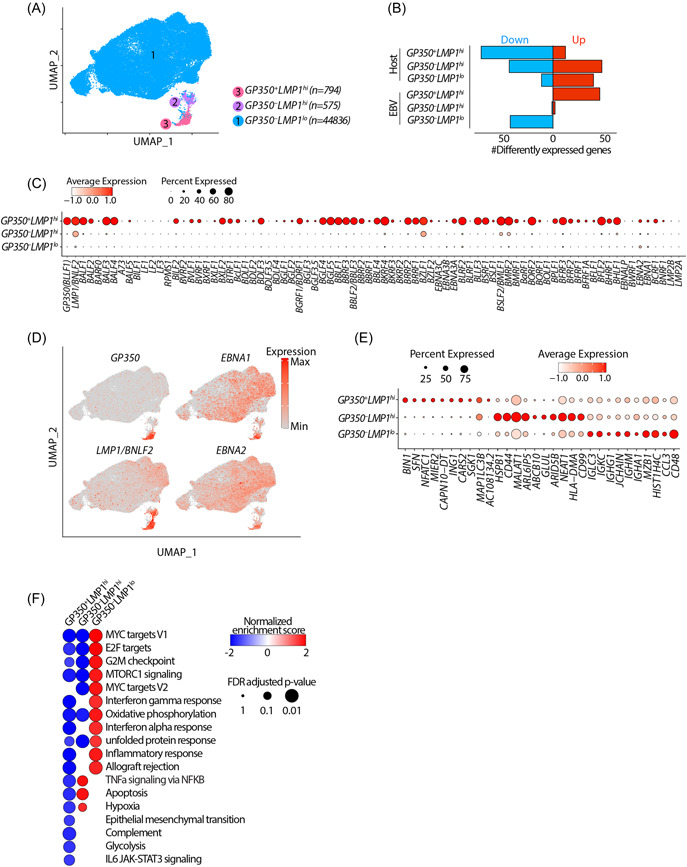
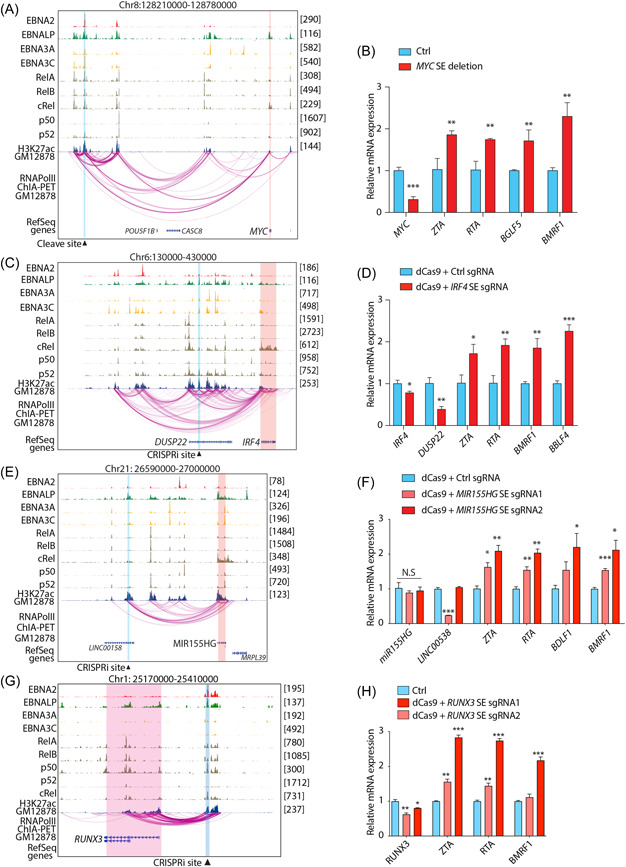
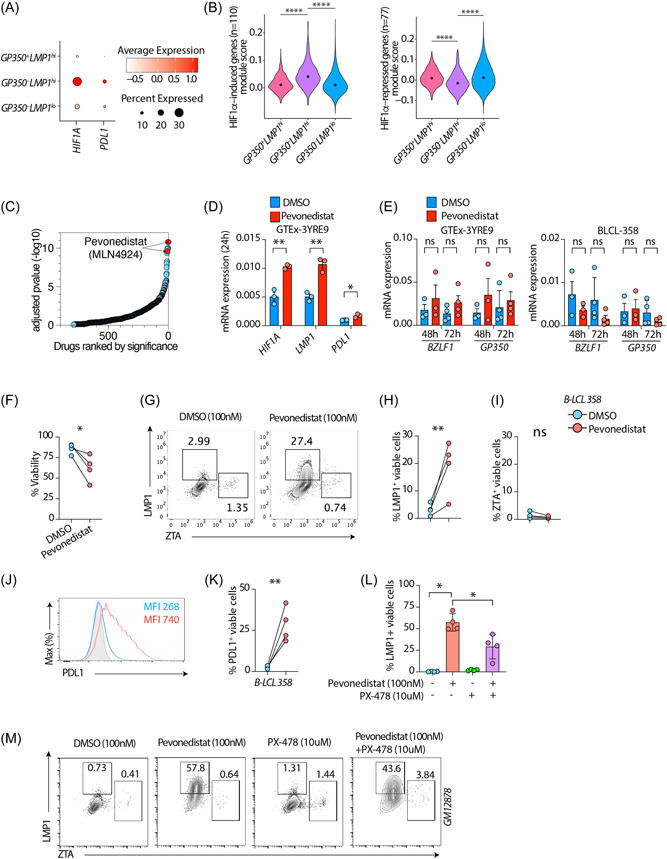
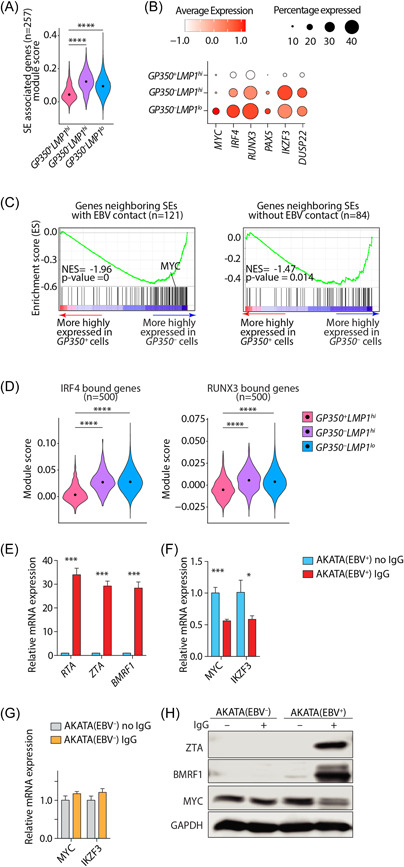
We probed the lifecycle of Epstein-Barr virus (EBV) on a cell-by-cell basis using single cell RNA sequencing (scRNA-seq) data from nine publicly available lymphoblastoid cell lines (LCLs). While the majority of LCLs comprised cells containing EBV in the latent phase, two other clusters of cells were clearly evident and were distinguished by distinct expression of host and viral genes. Notably, both were high expressors of EBV LMP1/BNLF2 and BZLF1 compared to another cluster that expressed neither gene. The two novel clusters differed from each other in their expression of EBV lytic genes, including glycoprotein gene GP350. The first cluster, comprising GP350 LMP1 cells, expressed high levels of HIF1A and was transcriptionally regulated by HIF1-α. Treatment of LCLs with Pevonedistat, a drug that enhances HIF1-α signaling, markedly induced this cluster. The second cluster, containing GP350 LMP1 cells, expressed EBV lytic genes. Host genes that are controlled by super-enhancers (SEs), such as transcription factors MYC and IRF4, had the lowest expression in this cluster. Functionally, the expression of genes regulated by MYC and IRF4 in GP350 LMP1 cells were lower compared to other cells. Indeed, induction of EBV lytic reactivation in EBV AKATA reduced the expression of these SE-regulated genes. Furthermore, CRISPR-mediated perturbation of the MYC or IRF4 SEs in LCLs induced the lytic EBV gene expression, suggesting that host SEs and/or SE target genes are required for maintenance of EBV latency. Collectively, our study revealed EBV-associated heterogeneity among LCLs that may have functional consequence on host and viral biology.
我们使用来自九个公开可用的淋巴母细胞系 (LCL) 的单细胞 RNA 测序 (scRNA-seq) 数据,在单细胞基础上探究了 Epstein-Barr 病毒 (EBV) 的生命周期。虽然大多数 LCL 包含处于潜伏阶段的 EBV,但另外两个细胞簇显然是明显的,并且其宿主和病毒基因的表达也不同。值得注意的是,与另一个既不表达这两个基因的基因簇相比,这两个簇都高表达 EBV LMP1/BNLF2 和 BZLF1。这两个新簇在其 EBV 裂解基因的表达上彼此不同,包括糖蛋白基因 GP350。第一个簇由 GP350 LMP1 细胞组成,高水平表达 HIF1A,并受 HIF1-α的转录调控。用 Pevonedistat(一种增强 HIF1-α信号的药物)处理 LCL,可显著诱导该簇。第二个簇含有 GP350 LMP1 细胞,表达 EBV 裂解基因。受超级增强子 (SE) 控制的宿主基因,如转录因子 MYC 和 IRF4,在该簇中的表达最低。功能上,GP350 LMP1 细胞中受 MYC 和 IRF4 调控的基因表达水平低于其他细胞。事实上,在 EBV AKATA 中诱导 EBV 裂解再激活降低了这些 SE 调控基因的表达。此外,CRISPR 介导的 LCL 中 MYC 或 IRF4 SE 的扰动诱导了 EBV 裂解基因的表达,表明宿主 SE 和/或 SE 靶基因是维持 EBV 潜伏所必需的。总之,我们的研究揭示了 LCL 中与 EBV 相关的异质性,这可能对宿主和病毒生物学具有功能后果。