Department of Cell Biology, Yale School of Medicine, New Haven, CT 06511.
Integrated Graduate Program in Physical and Engineering Biology, New Haven, CT 06511.
Proc Natl Acad Sci U S A. 2022 Dec 6;119(49):e2215124119. doi: 10.1073/pnas.2215124119. Epub 2022 Dec 1.
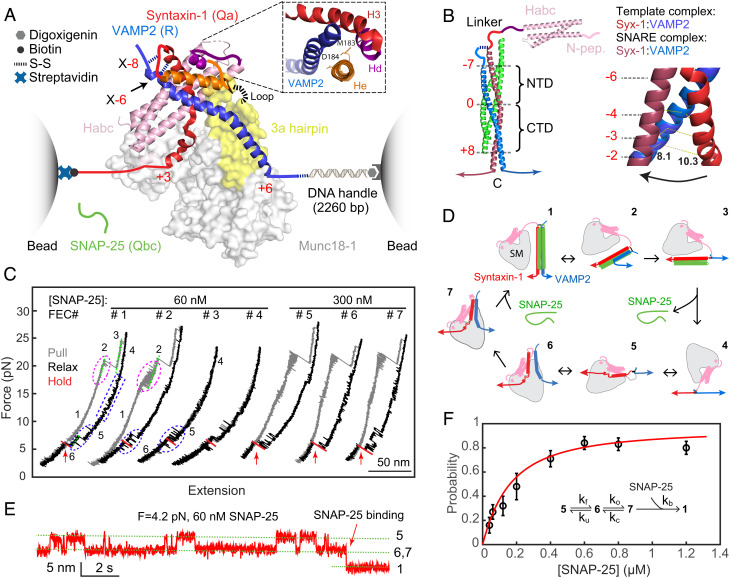
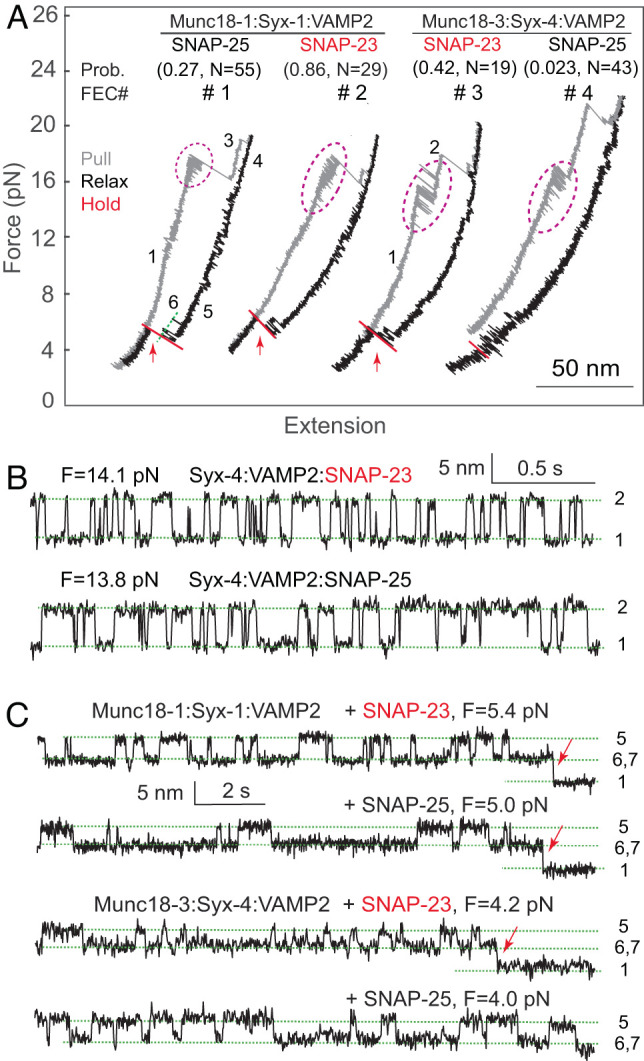
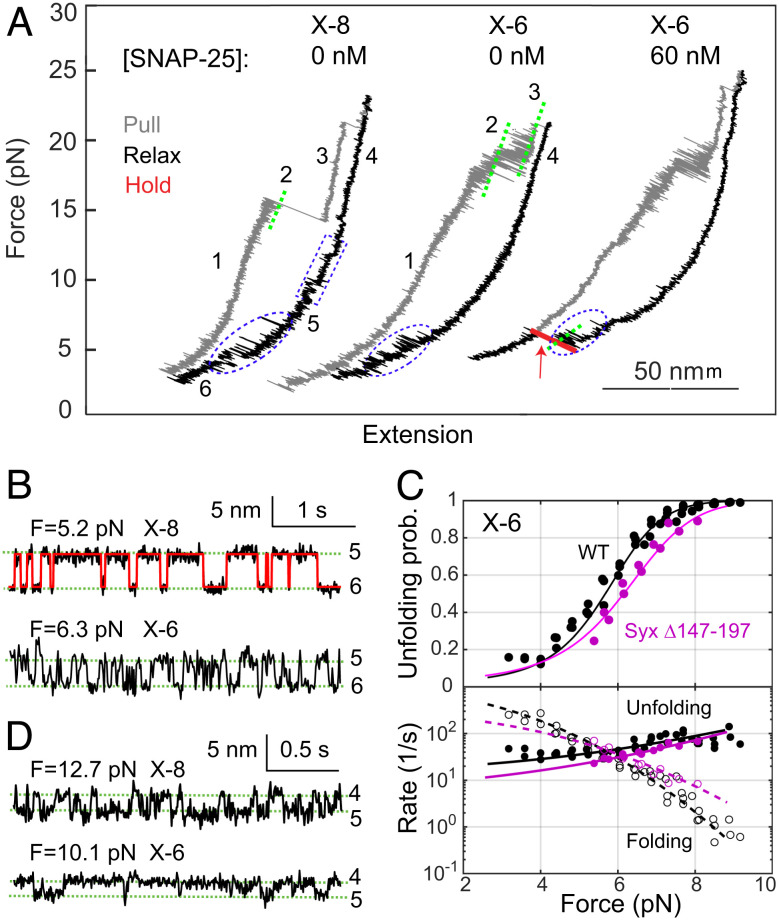
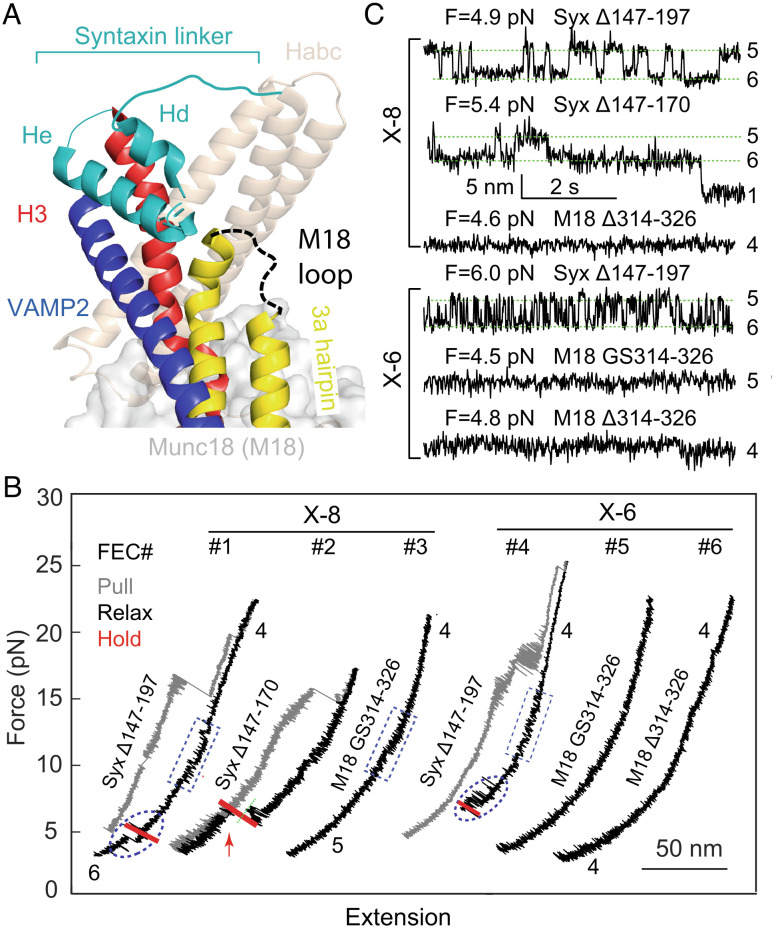
Munc18 chaperones assembly of three membrane-anchored soluble N-ethylmaleimide-sensitive factor attachment protein receptors (SNAREs) into a four-helix bundle to mediate membrane fusion between vesicles and plasma membranes, leading to neurotransmitter or insulin release, glucose transporter (GLUT4) translocation, or other exocytotic processes. Yet, the molecular mechanism underlying chaperoned SNARE assembly is not well understood. Recent evidence suggests that Munc18-1 and Munc18-3 simultaneously bind their cognate SNAREs to form ternary template complexes - Munc18-1:Syntaxin-1:VAMP2 for synaptic vesicle fusion and Munc18-3:Syntaxin-4:VAMP2 for GLUT4 translocation and insulin release, which facilitate the binding of SNAP-25 or SNAP-23 to conclude SNARE assembly. Here, we further investigate the structure, dynamics, and function of the template complexes using optical tweezers. Our results suggest that the synaptic template complex transitions to an activated state with a rate of 0.054 s for efficient SNAP-25 binding. The transition depends upon the linker region of syntaxin-1 upstream of its helical bundle-forming SNARE motif. In addition, the template complex is stabilized by a poorly characterized disordered loop region in Munc18-1. While the synaptic template complex efficiently binds both SNAP-25 and SNAP-23, the GLUT4 template complex strongly favors SNAP-23 over SNAP-25, despite the similar stabilities of their assembled SNARE bundles. Together, our data demonstrate that a highly dynamic template complex mediates efficient and specific SNARE assembly.
Munc18 作为分子伴侣,协助三个膜锚定可溶性 N-乙基马来酰亚胺敏感因子附着蛋白受体(SNAREs)组装成四螺旋束,介导囊泡与质膜之间的融合,从而促进神经递质或胰岛素释放、葡萄糖转运体(GLUT4)易位或其他胞吐过程。然而,分子伴侣介导的 SNARE 组装的分子机制尚不清楚。最近的证据表明,Munc18-1 和 Munc18-3 同时结合其同源 SNARE 形成三元模板复合物——突触小泡融合的 Munc18-1:Syntaxin-1:VAMP2 和 GLUT4 易位和胰岛素释放的 Munc18-3:Syntaxin-4:VAMP2,这有利于 SNAP-25 或 SNAP-23 的结合,从而完成 SNARE 组装。在这里,我们使用光学镊子进一步研究了模板复合物的结构、动力学和功能。我们的结果表明,突触模板复合物以 0.054s 的速率转变为激活状态,从而有效结合 SNAP-25。这种转变取决于Syntaxin-1 螺旋束形成 SNARE 模体上游的连接区。此外,模板复合物通过 Munc18-1 中一个特征不明显的无序环区稳定。虽然突触模板复合物能够有效地结合 SNAP-25 和 SNAP-23,但 GLUT4 模板复合物强烈偏好 SNAP-23 而不是 SNAP-25,尽管它们组装的 SNARE 束具有相似的稳定性。总之,我们的数据表明,一个高度动态的模板复合物介导了有效的和特异性的 SNARE 组装。