National Clinical Research Center of Cardiovascular Diseases, State Key Laboratory of Cardiovascular Disease, Fuwai Hospital, National Center for Cardiovascular Diseases, Chinese Academy of Medical Sciences and Peking Union Medical College, Beijing, People's Republic of China.
Department of Cardiovascular Surgery, Fuwai Hospital, National Center for Cardiovascular Diseases, Chinese Academy of Medical Sciences and Peking Union Medical College, Beijing, People's Republic of China.
BMJ Open. 2022 Dec 1;12(12):e064761. doi: 10.1136/bmjopen-2022-064761.
A multidisciplinary heart team approach has been recommended by revascularisation guidelines, but how to organise and implement the heart team in a standardised way has not been validated. Inter-team and intra-team decision instability existed in the guideline-based heart team protocol, and our standardised heart team protocol based on a mixed method study may improve decision stability. The objective of this study is to evaluate the effect of the standardised heart team protocol versus the guideline-based protocol on decision-making stability in stable complex coronary artery disease (CAD).
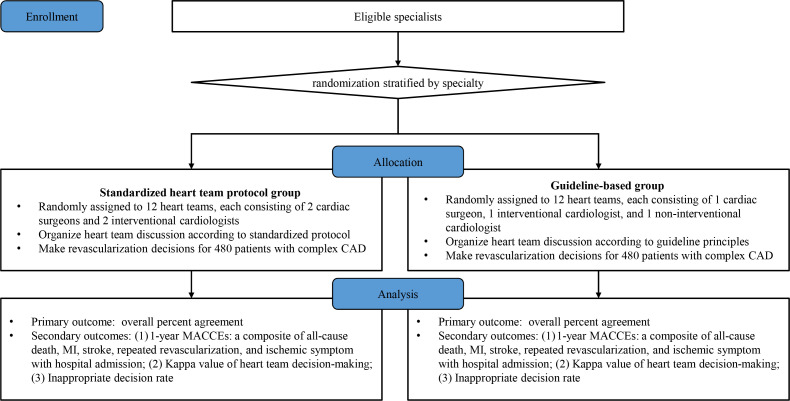
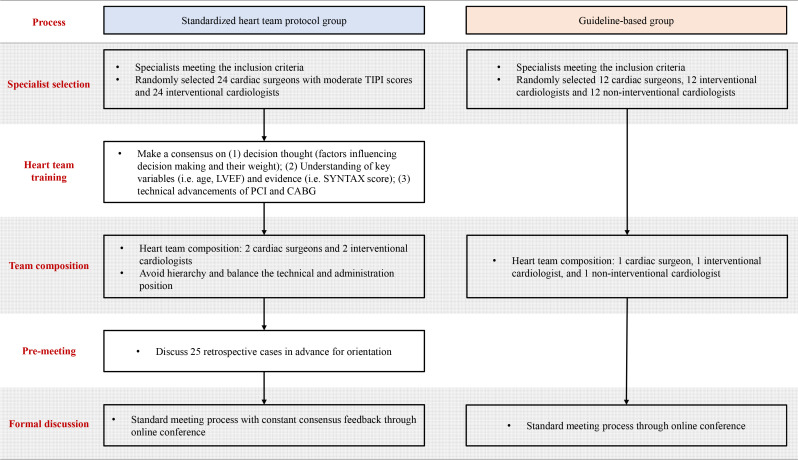
Eighty-four eligible interventional cardiologists, cardiac surgeons or non-interventional cardiologists from 26 hospitals in China have been enrolled. They will be randomised to a standardised heart team protocol group or a guideline-based protocol group to make revascularisation decisions for 480 historic cases (from a prospective registry) with stable complex CAD. In the standardised group, we will establish 12 heart teams based on an evidence-based protocol, including specialist selection, specialist training, team composition, team training and a standardised meeting process. In the guideline-based group, we will organise 12 heart teams according to the guideline principles, including team composition and standardised meeting process. The primary outcome is the overall percent agreement in revascularisation decisions between heart teams within a group. To demonstrate the clinical implication of decision-making stability, we will further explore the association between decision stability and 1-year clinical outcomes.
The study was approved by the Institutional Review Board (IRB) of Fuwai Hospital (No. 2019-1303). All participants have provided informed consent and all patients included as historic cases provided written informed consent at the time of entry to the prospective registry. The results of this trial will be disseminated through manuscript publication and national/international conferences, and reported in the trial registry entry.
NCT05039567.
血运重建指南推荐采用多学科心脏团队方法,但如何以标准化方式组织和实施心脏团队尚未得到验证。基于指南的心脏团队方案中存在团队间和团队内决策不稳定的情况,而我们基于混合方法研究制定的标准化心脏团队方案可能会提高决策稳定性。本研究的目的是评估标准化心脏团队方案与基于指南的方案对稳定型复杂冠状动脉疾病(CAD)患者决策稳定性的影响。
我们从中国 26 家医院招募了 84 名符合条件的介入心脏病专家、心脏外科医生或非介入心脏病专家。他们将被随机分配到标准化心脏团队方案组或基于指南的方案组,对 480 例稳定型复杂 CAD 的历史病例(来自前瞻性注册研究)进行血运重建决策。在标准化组中,我们将根据循证方案建立 12 个心脏团队,包括专家选择、专家培训、团队组成、团队培训和标准化会议流程。在基于指南的组中,我们将根据指南原则组织 12 个心脏团队,包括团队组成和标准化会议流程。主要结局是组内心脏团队在血运重建决策上的总体一致率。为了展示决策稳定性的临床意义,我们将进一步探讨决策稳定性与 1 年临床结局之间的关系。
本研究已获得阜外医院机构审查委员会(IRB)的批准(编号:2019-1303)。所有参与者均提供了知情同意,所有作为历史病例纳入的患者在进入前瞻性注册研究时均签署了书面知情同意书。本试验的结果将通过论文发表和国内外会议传播,并在试验注册处报告。
NCT05039567。