National University of Ireland Galway, Galway, Ireland.
Amsterdam UMC, University of Amsterdam, Amsterdam, The Netherlands.
BMJ Open. 2020 Dec 10;10(12):e038152. doi: 10.1136/bmjopen-2020-038152.
The previously published SYNTAX III REVOLUTION trial demonstrated that clinical decision-making between coronary artery bypass graft (CABG) and percutaneous coronary intervention based on coronary CT angiography (CCTA) had a very high agreement with the treatment decision derived from invasive coronary angiography (ICA). The study objective of the FASTTRACK CABG is to assess the feasibility of CCTA and fractional flow reserve derived from CTA (FFR) to replace ICA as a surgical guidance method for planning and execution of CABG in patients with three-vessel disease with or without left main disease.
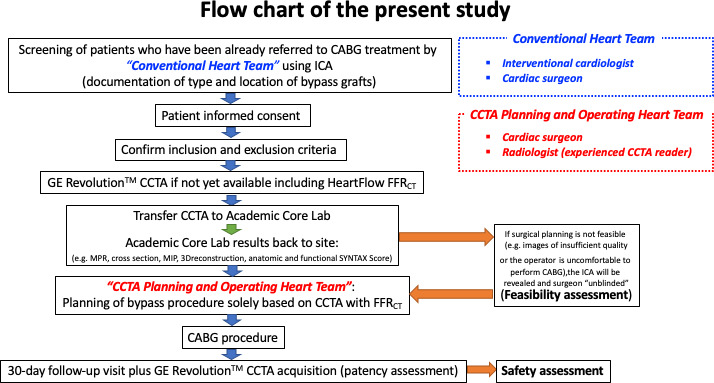
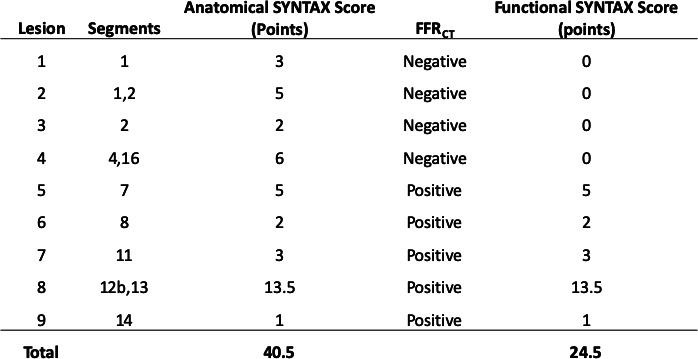
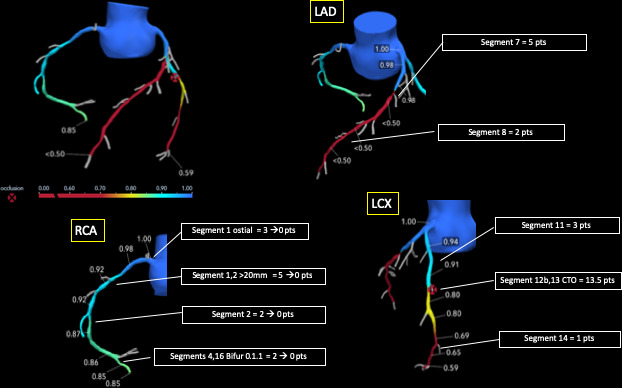
The FASTTRACK CABG is an investigator-initiated single-arm, multicentre, prospective, proof-of-concept and first-in-man study with feasibility and safety analysis. Surgical revascularisation strategy and treatment planning will be solely based on CCTA and FFR without knowledge of the anatomy defined by ICA. Clinical follow-up visit including CCTA will be performed 30 days after CABG in order to assess graft patency and adequacy of the revascularisation with respect to the surgical planning based on non-invasive imaging (CCTA) with functional assessment (FFR) and compared with ICA. Primary feasibility endpoint is CABG planning and execution solely based on CCTA and FFR in 114 patients. Primary safety endpoint based on 30 day CCTA is graft assessment and topographical adequacy of the revascularisation procedure. Automatic non-invasive assessment of functional coronary anatomy complexity is also evaluated with FFR for functional Synergy Between percutaneous coronary intervention With Taxus and Cardiac Surgery Score assessment on CCTA. CCTA with FFR might provide better anatomical and functional analysis of the coronary circulation leading to appropriate anatomical and functional revascularisation, and thereby contributing to a better outcome.
Each patient has to provide written informed consent as approved by the ethical committee of the respective clinical site. Results will be submitted for publication in peer-reviewed journals and will be disseminated at scientific conferences.
NCT04142021.
之前发表的 SYNTAX III REVOLUTION 试验表明,基于冠状动脉 CT 血管造影(CCTA)的冠状动脉旁路移植术(CABG)与经皮冠状动脉介入治疗之间的临床决策与基于有创冠状动脉造影(ICA)的治疗决策具有非常高的一致性。FASTTRACK CABG 的研究目的是评估 CCTA 和 CTA 衍生的血流储备分数(FFR)是否可以替代 ICA,作为伴有或不伴有左主干病变的三血管病变患者行 CABG 的手术指导方法,用于计划和执行。
FASTTRACK CABG 是一项由研究者发起的、单臂、多中心、前瞻性、概念验证和首例人体研究,具有可行性和安全性分析。外科血运重建策略和治疗计划将完全基于 CCTA 和 FFR,而不了解 ICA 定义的解剖结构。在 CABG 后 30 天进行临床随访,包括 CCTA,以评估根据非侵入性影像学(CCTA)进行功能评估(FFR)的手术计划的桥接通畅性和血运重建的充分性,并与 ICA 进行比较。主要可行性终点是在 114 例患者中仅基于 CCTA 和 FFR 进行 CABG 计划和执行。基于 30 天 CCTA 的主要安全性终点是桥接评估和血运重建手术的拓扑充分性。还通过 FFR 评估自动非侵入性功能冠状动脉解剖复杂性,用于 CCTA 上功能 Taxus 和心脏手术评分评估的功能协同作用。FFR 指导下的 CCTA 可能提供更好的冠状动脉循环解剖和功能分析,从而进行适当的解剖和功能血运重建,从而改善预后。
每位患者都必须提供书面知情同意书,该同意书已获得各自临床站点伦理委员会的批准。结果将提交给同行评议的期刊发表,并在科学会议上传播。
NCT04142021。