Department of Clinical Nutrition, King Abdulaziz University, Jeddah, Saudi Arabia.
Department of Nutritional Sciences, University of Michigan, Ann Arbor, MI, USA.
Int J Behav Nutr Phys Act. 2022 Dec 1;19(1):143. doi: 10.1186/s12966-022-01375-0.
Sedentary behavior is a modifiable risk factor for cardiometabolic health; however, the assessment of total sedentary time may not capture youth's highly active and interrupted activity patterns. This study examined the associations between sedentary activity patterns and cardiometabolic risk factors among Mexican youth, who have a disproportionate burden of metabolic diseases, using a repeated measure design out of a longitudinal data.
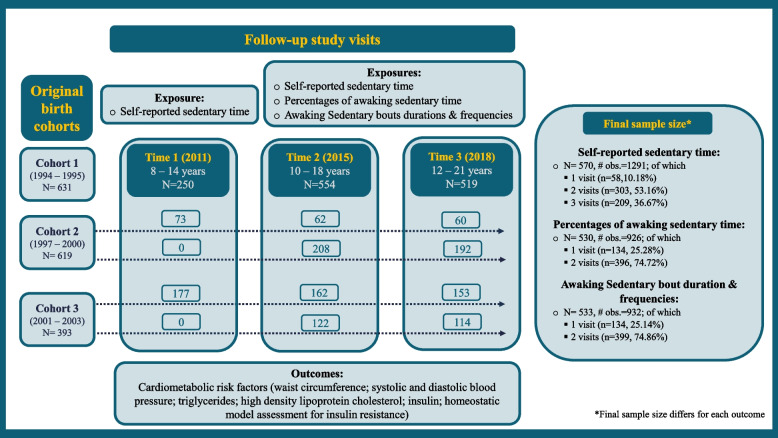
570 subjects in the Early Life Exposure in Mexico to ENvironmental Toxicants (ELEMENT) birth cohort, who were followed up to three-time points during adolescence, were included. Bout duration, and frequency and percentages of waking time spent in specific intensities of activity, were quantified using ActiGraph wGT3X-BT wrist accelerometers. Self-reported questionnaires were used to query the usual duration of different sedentary behaviors. Outcomes were fasting lipid profile, markers for glucose homeostasis, anthropometry, and blood pressure. Associations were modeled using linear mixed-effects models, and isotemporal substitution approach was additionally used to assess the effect of replacing objectively assessed sedentary activity with other activity intensities, adjusting for potential confounders.
Each hour of self-reported screen-based time was positively associated with diastolic blood pressure (mm Hg) [β = 0.30, 95% confidence interval (95% CI) = 0.10, 0.51], and an hour of other sedentary time was associated with log serum glucose (mg/dL) [β = 0.01, 95% CI = 0.004, 0.017]. Substitution models showed that replacing 5% of sedentary time with moderate to vigorous physical activity (MVPA) was associated with lower waist circumference (cm) [β = - 1.35, 95% CI = - 1.91, - 0.79] and log serum triglycerides (mg/dL) [β = - 0.11, 95% CI = - 0.18, - 0.03]. Substituting one uninterrupted sedentary bout with light activity was associated with lower insulin (μIU/mL) [β = - 0.06, 95% CI = - 0.10, - 0.02].
Sedentary time was associated with cardiometabolic risk factors in Mexican youth in a context-specific manner. Replacing sedentary time with higher intensities was associated with improvements in some cardiometabolic markers.
久坐行为是影响心血管代谢健康的可改变风险因素;然而,评估总的久坐时间可能无法捕捉到年轻人高度活跃和间断的活动模式。本研究采用重复测量设计,从一项纵向数据中分析了墨西哥青少年久坐活动模式与心血管代谢危险因素之间的关系,这些青少年患有代谢疾病的比例过高。
纳入了早期生活暴露于环境毒素的墨西哥(ELEMENT)出生队列中的 570 名受试者,这些受试者在青少年时期被随访了三次。使用 ActiGraph wGT3X-BT 腕部加速度计来量化持续时间、频率和特定活动强度的觉醒时间百分比。使用自我报告问卷查询不同久坐行为的通常持续时间。结果是空腹血脂谱、葡萄糖稳态标志物、人体测量学和血压。使用线性混合效应模型对关联进行建模,并使用等时替代方法来评估用其他活动强度替代客观评估的久坐活动对调整潜在混杂因素后的影响。
每小时自我报告的屏幕时间与舒张压(mmHg)呈正相关[β=0.30,95%置信区间(95%CI)=0.10,0.51],1 小时其他久坐时间与血清葡萄糖(mg/dL)呈正相关[β=0.01,95%CI=0.004,0.017]。替代模型显示,用中等到剧烈的体力活动(MVPA)替代 5%的久坐时间与腰围(cm)降低有关[β=-1.35,95%CI=-1.91,-0.79]和血清甘油三酯(mg/dL)降低有关[β=-0.11,95%CI=-0.18,-0.03]。用轻活动替代一个不间断的久坐时段与胰岛素(μIU/mL)降低有关[β=-0.06,95%CI=-0.10,-0.02]。
在特定背景下,久坐时间与墨西哥青少年的心血管代谢危险因素有关。用更高强度的活动替代久坐时间与一些心血管代谢标志物的改善有关。