van Ballegooijen Adriana J, van der Ploeg Hidde P, Visser Marjolein
Department of Health Sciences, Faculty of Science, Amsterdam Public Health Research Institute, Vrije Universiteit, De Boelelaan 1085, 1081 HV Amsterdam, the Netherlands.
2Department of Public and Occupational Health, Amsterdam Public Health Research Institute, VU University Medical Center Amsterdam, Amsterdam, the Netherlands.
Eur Rev Aging Phys Act. 2019 Feb 18;16:3. doi: 10.1186/s11556-019-0210-9. eCollection 2019.
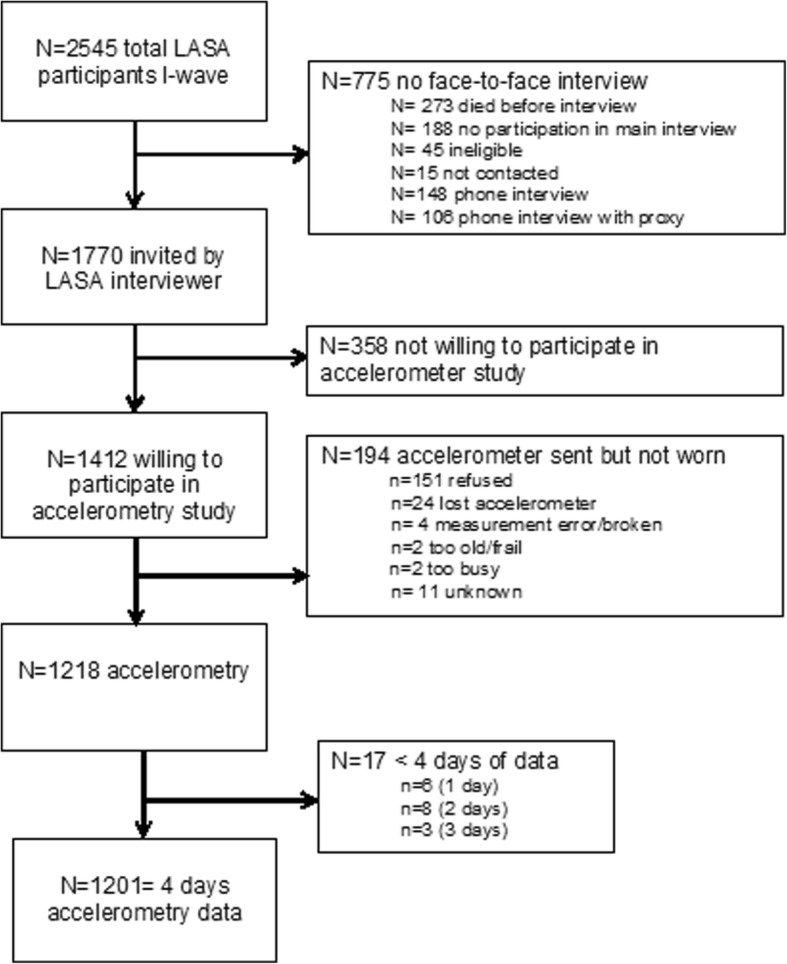
Higher physical activity is associated with lower chronic disease risk among older adults. However, less is known about the optimal balance between daily physical activity and sedentary time and their correlates among older adults. We described objectively measured physical activity patterns using 7 day hip-accelerometry and assessed its correlates in a large cross-sectional sample of the Longitudinal Aging Study Amsterdam, a population-based cohort of older Dutch adults. In addition, we examined different combined profiles of sedentary time and physical activity across strata of sex, age, education and BMI groups.
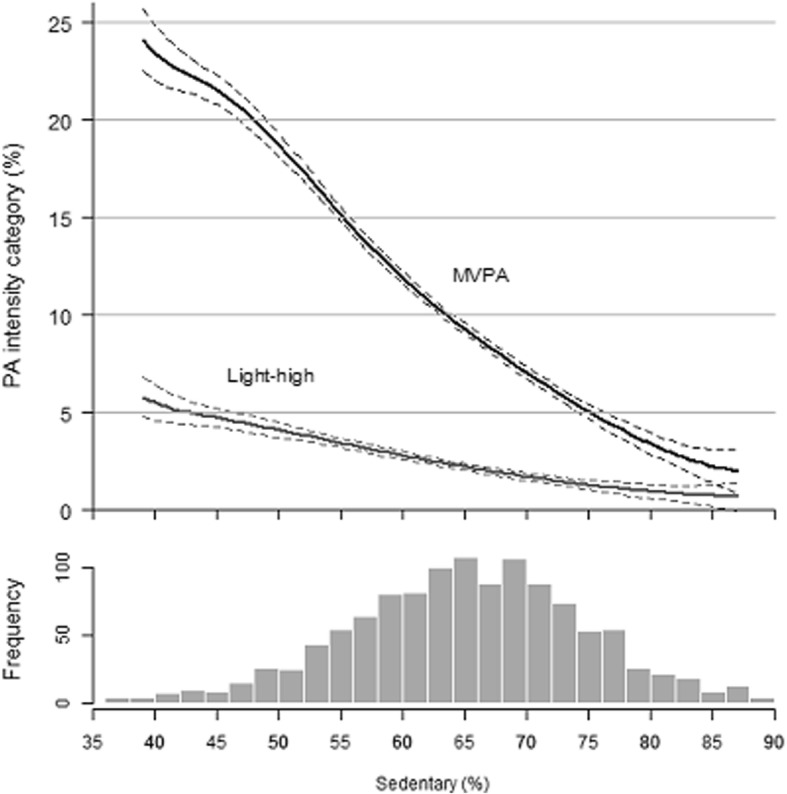
Mean age was 71 (SD 8) years and 51% ( = 615) were women. The majority of wear time was spent sedentary (65%) followed by light (33%), and MVPA (2%). Higher age and higher BMI were related to more time spent sedentary, while female sex and lower education were related lower sedentary time. The combination of high sedentary time (≥65.4% of waking time) and low physical activity (< 9.1% of waking time) was significantly associated with higher age, higher BMI, and slower walking speed compared to the combination of low sedentary time and high physical activity < 0.001.
Dutch older adults spend on average 65% of their waking time sedentary. Older adults' sedentary time differs by age, sex, education and BMI groups. The combination of high sedentary time and low physical was associated with higher age, higher BMI, and slower walking speed compared to the combination of low sedentary time and high MVPA. This suggests that increasing light activity might be an effective and feasible strategy in older persons to reduce sedentary time. Future studies should assess whether low- sedentary and high-light physical activity are associated with improved long-term health outcomes (also independent of MVPA).
在老年人中,较高的身体活动水平与较低的慢性病风险相关。然而,关于老年人日常身体活动与久坐时间之间的最佳平衡及其相关因素,我们了解得较少。我们使用7天的髋部加速度计客观地描述了身体活动模式,并在阿姆斯特丹纵向老龄化研究的一个大型横断面样本中评估了其相关因素,该研究是一个以荷兰老年人群为基础的队列。此外,我们还研究了不同性别、年龄、教育程度和体重指数(BMI)组中久坐时间和身体活动的不同组合情况。
平均年龄为71(标准差8)岁,女性占51%(n = 615)。大部分佩戴时间是久坐状态(65%),其次是轻度活动(33%)和中度至剧烈身体活动(MVPA,2%)。年龄较大和BMI较高与久坐时间较长有关,而女性和教育程度较低与久坐时间较短有关。与低久坐时间和高身体活动的组合相比,高久坐时间(≥清醒时间的65.4%)和低身体活动(<清醒时间的9.1%)的组合与年龄较大、BMI较高和步行速度较慢显著相关(P < 0.001)。
荷兰老年人平均清醒时间的65%处于久坐状态。老年人的久坐时间因年龄、性别、教育程度和BMI组而异。与低久坐时间和高MVPA 的组合相比,高久坐时间和低身体活动与年龄较大、BMI较高和步行速度较慢有关。这表明增加轻度活动可能是老年人减少久坐时间的一种有效且可行的策略。未来的研究应评估低久坐和高轻度身体活动是否与改善长期健康结果相关(也独立于MVPA)。