National Center for PTSD, VA Palo Alto Healthcare System, Menlo Park, CA, United States.
Department of Psychiatry and Behavioral Sciences, Stanford University School of Medicine, Stanford, CA, United States.
Front Public Health. 2022 Nov 15;10:984505. doi: 10.3389/fpubh.2022.984505. eCollection 2022.
The US Department of Veterans Affairs (VA) has over 15 years of experience in delivery of evidence-based psychotherapies (EBPs). This paper describes strategies for using clinical documentation and administrative data to understand adherence and modifications to EBPs for Posttraumatic Stress Disorder (PTSD).
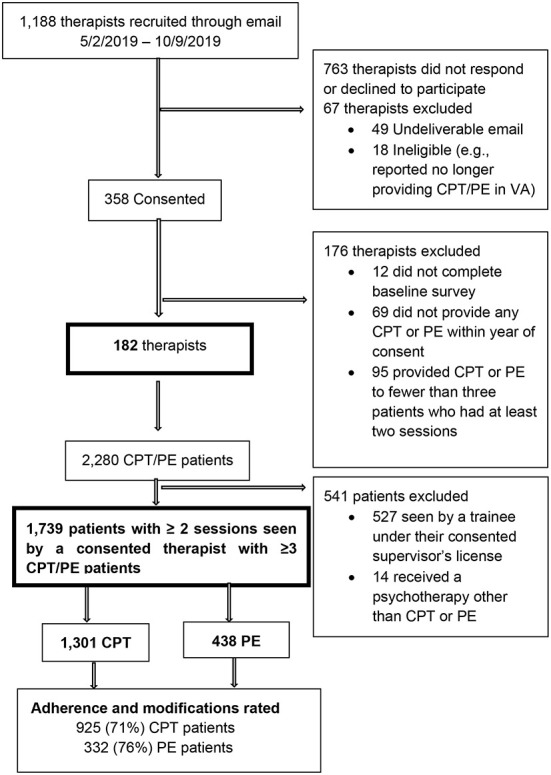
This study focused on two EBPs for PTSD, Cognitive Processing Therapy (CPT) and Prolonged Exposure (PE). The sample included VA therapists from across the US who provided CPT and PE and the patients they treated over a 1-year period. The data sources for this study were templated EBP chart notes and VA administrative data. We used a manual review of note content and administrative data rules to code therapy adherence and modifications in 7,297 EBP sessions for 1,257 patients seen by 182 therapists. Two trained coders rated each therapy note and resolved discrepancies through consensus. To contextualize and explain variation in adherence and modifications, we conducted brief 30-45-min semi-structured interviews with a purposive subsample of these therapists ( = 32).
Combining manual chart review and administrative data allowed for identification of 11 types of modifications. Raters disagreed on adherence for 30% of notes. The disagreement stemmed from the presence of therapy modifications that were not clearly documented, necessitating the development of decision rules and strategies for modification coding. Both therapists and patients contributed to the variance in the extent to which different modifications occurred. Therapist interviews demonstrated therapist awareness of modifying the protocols in the ways identified through chart review.
Healthcare systems can use data collected as part of routine care to understand how and when EBPs are modified but need to develop scalable strategies to document adaptations and modifications to EBPs in routine care.
美国退伍军人事务部(VA)在提供循证心理疗法(EBPs)方面拥有超过 15 年的经验。本文介绍了使用临床文档和管理数据来了解创伤后应激障碍(PTSD)的 EBPs 的依从性和修改的策略。
本研究专注于两种 PTSD 的 EBPs,即认知加工疗法(CPT)和延长暴露(PE)。该样本包括来自美国各地的 VA 治疗师,他们提供 CPT 和 PE 以及他们在一年期间治疗的患者。本研究的数据来源是模板化的 EBP 图表说明和 VA 管理数据。我们使用注释内容和管理数据规则的手动审查来对 7,297 次 EBP 会话中的治疗依从性和修改进行编码,这些会话涉及 182 名治疗师治疗的 1,257 名患者。两名经过培训的编码员对每个治疗记录进行评分,并通过共识解决差异。为了使依从性和修改的变化具有背景和解释,我们对这些治疗师的一个有目的的子样本进行了简短的 30-45 分钟半结构化访谈(n = 32)。
结合手动图表审查和管理数据,可以识别出 11 种类型的修改。对于 30%的注释,评分员在依从性上存在分歧。分歧源于治疗修改未明确记录,需要制定决策规则和修改编码策略。治疗师和患者都对不同修改发生的程度的差异做出了贡献。治疗师访谈表明,治疗师意识到以通过图表审查确定的方式修改方案。
医疗保健系统可以使用常规护理中收集的数据来了解 EBPs 是如何以及何时被修改的,但需要开发可扩展的策略来记录常规护理中对 EBPs 的适应和修改。