Tunc Nurettin, Sahin Abdurahman, Demirel Ulvi, Artas Gokhan, Sahin Kazım, Bahcecioglu İbrahim Halil, Yalniz Mehmet
Department of Gastroenterology, Health Sciences University Gazi Yasargil Training and Research Hospital, Diyarbakir, Turkey.
Department of Gastroenterology, School of Medicine, Firat University, Elazig, Turkey.
Arch Med Sci. 2021 Mar 21;18(6):1617-1625. doi: 10.5114/aoms/105839. eCollection 2022.
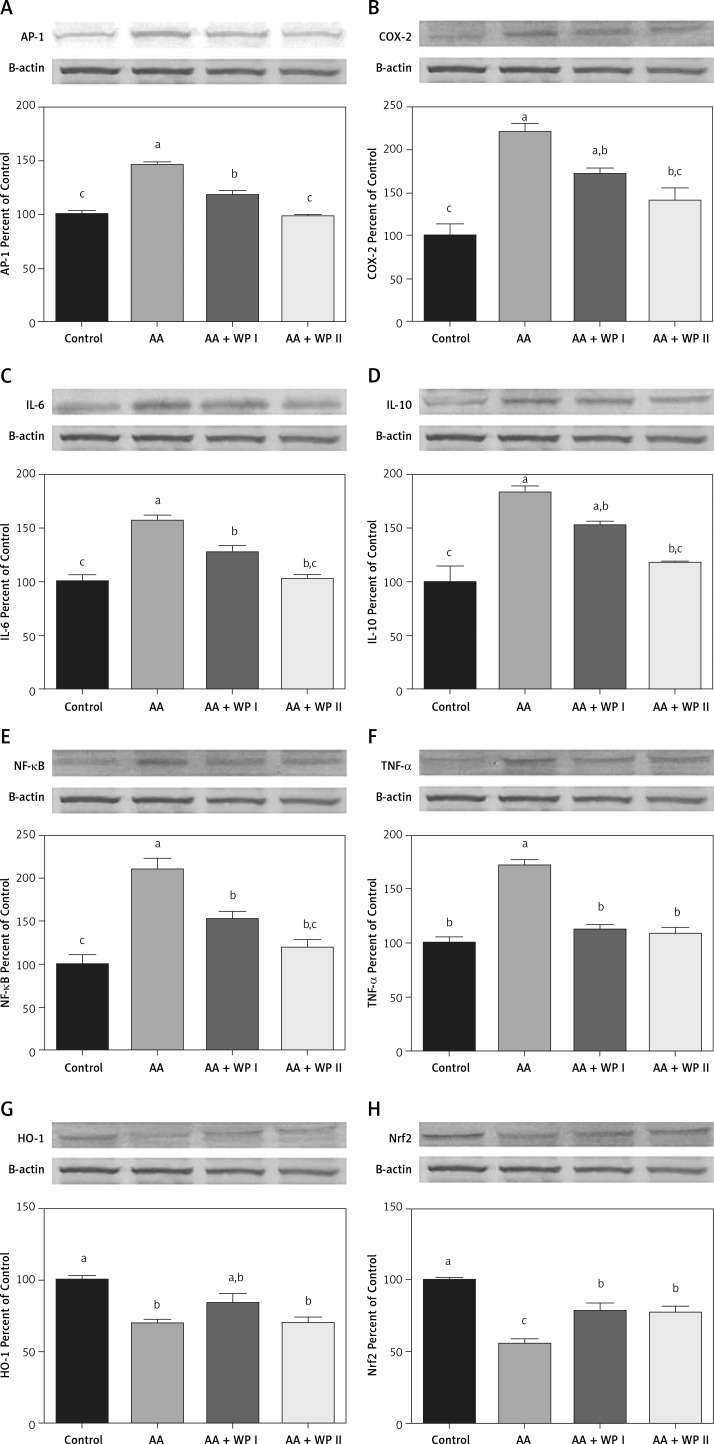
In the present study, we aimed to examine the effects of the administration of whey protein through rectal enema to rats with acetic acid-induced ulcerative colitis on the pathways of nuclear-related factor-2 (Nrf-2), haem oxygenase-1 (HO-1), nuclear factor κB (NF-κB), active protein kinase-1 (AP-1), tumour necrotising factor-α (TNF-α), and cyclooxygenase-2 (COX-2), IL-6, IL-10.
Twenty-eight rats were employed for the trial. Ulcerative colitis was induced through the use of acetic acid. The therapeutic doses of whey protein were administered rectally. Ulcerative colitis was subjected to histopathological examination and protein levels in colon tissue were measured with the Western blot method.
The significant increases observed in the levels of AP-1, COX-2, IL-6, IL-10, NF-κB, and TNF-α as markers of inflammation following the development of ulcerative colitis showed remarkable decreases along with the administration of whey protein ( < 0.05). On the other hand, we identified a decrease in the Nrf2-ARE signal pathway and HO-1 protein having protective roles in the colon inflammatory response along with the development of ulcerative colitis and activation of the Nrf2-HO-1 pathway by the whey protein.
Whey protein modulates Nrf2/HO-1 and NF-kB pathways, thereby creating a therapeutic effect against colonic inflammation induced by acetic acid (AA) due to its anti-inflammatory effects.
在本研究中,我们旨在研究通过直肠灌肠给乙酸诱导的溃疡性结肠炎大鼠施用乳清蛋白对核相关因子-2(Nrf-2)、血红素加氧酶-1(HO-1)、核因子κB(NF-κB)、活性蛋白激酶-1(AP-1)、肿瘤坏死因子-α(TNF-α)、环氧化酶-2(COX-2)、白细胞介素-6(IL-6)、白细胞介素-10(IL-10)通路的影响。
28只大鼠用于该试验。通过使用乙酸诱导溃疡性结肠炎。经直肠给予乳清蛋白治疗剂量。对溃疡性结肠炎进行组织病理学检查,并用蛋白质印迹法测量结肠组织中的蛋白质水平。
溃疡性结肠炎发生后,作为炎症标志物的AP-1、COX-2、IL-6、IL-10、NF-κB和TNF-α水平显著升高,随着乳清蛋白的施用,这些水平显著降低(<0.05)。另一方面,我们发现随着溃疡性结肠炎的发展,在结肠炎症反应中起保护作用的Nrf2-ARE信号通路和HO-1蛋白减少,而乳清蛋白激活了Nrf2-HO-1通路。
乳清蛋白调节Nrf2/HO-1和NF-kB通路,从而因其抗炎作用对乙酸(AA)诱导的结肠炎症产生治疗效果。