Department of Pharmacology, Faculty of Pharmacy, Delta University for Science and Technology, Gamasa, 11152, Egypt.
Department of Pharmacology and Toxicology, Faculty of Pharmacy, Mansoura University, Mansoura, 35516, Egypt.
Inflammopharmacology. 2022 Aug;30(4):1351-1362. doi: 10.1007/s10787-022-01016-9. Epub 2022 Jul 14.
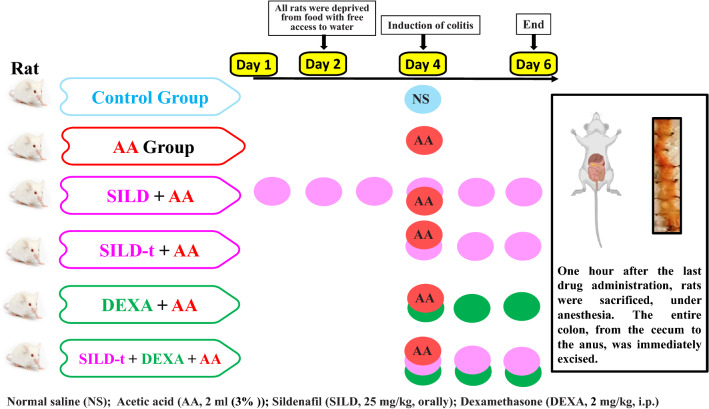
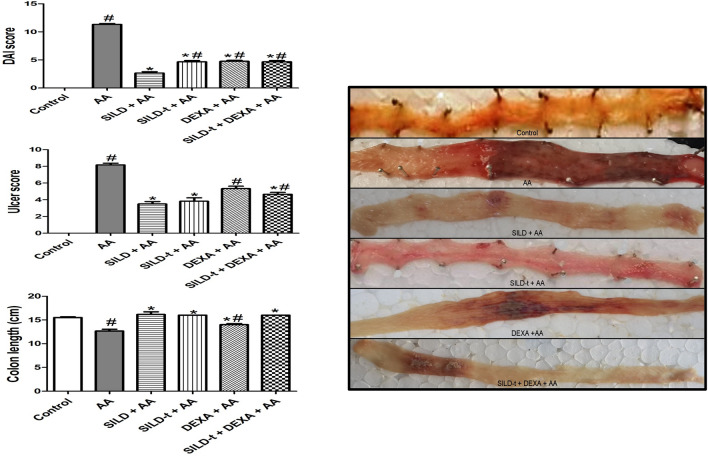
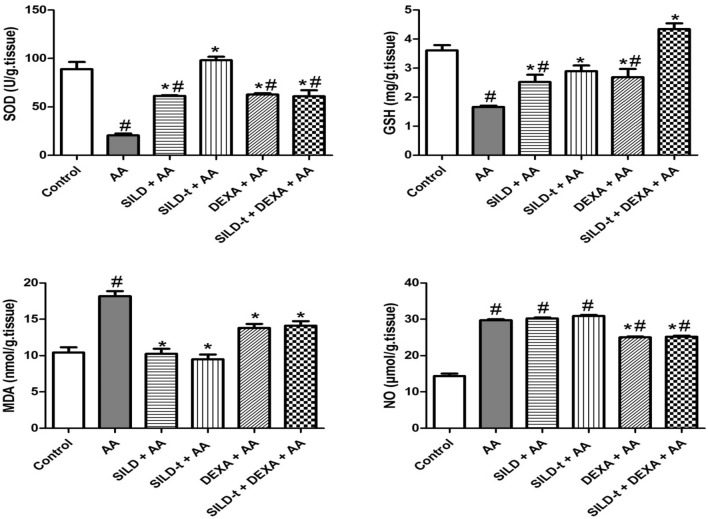
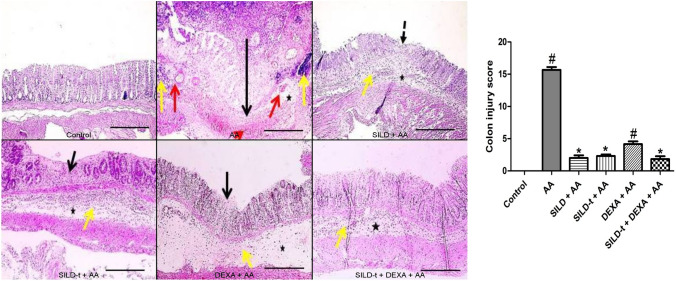
The current work explored the influences of time dependent Sildenafil (SILD) administration, and the possible outcomes from its concomitant administration with dexamethasone against acetic acid-induced ulcerative colitis in rats. Rats were assigned into six random groups: diseased group (AA), injected once with 2 ml acetic acid (3%) intrarectally, 2 days before sacrification. SILD + AA, received sildenafil (25 mg/kg, orally) for 6 days starting 3 days pre-injection of AA; SILD-t + AA, received sildenafil (25 mg/kg, orally), starting at time of AA injection and continued for 3 days; DEXA + AA, received dexamethasone (2 mg/kg, i.p.) for 3 days, starting at time of AA injection; SILD-t + DEXA + AA, received sildenafil (25 mg/kg, orally) and dexamethasone (2 mg/kg, i.p.), as mentioned. Sildenafil markedly ameliorated disease activity index (DAI), ulcer scores, colon length shortening and colonic histopathological changes. Mechanistically, Sildenafil markedly attenuated immunoexpression of NF-κB p65/ TNF-α and COX-2, diminished oxidative stress (↓ MDA/NO levels and ↑ GSH level and SOD activity), increased levels of Nrf-2/HO-1, compared to untreated group. Taken together, Sildenafil treatment suppressed acetic acid-induced ulcerative colitis, probably via inhibiting NF-κB/TNF-α signaling dependent of Nrf-2/HO-1 pathway, reducing oxidative stress and attenuating inflammation. Surprisingly, effects of sildenafil were unpromoted in a time dependant manner. Short term treatment with sildenafil was sufficient to exert its coloprotective effect, while longer term pretreatment was only superior among other treatments in the macroscopical changes. Moreover, concurrent administration of sildenafil and dexamethasone had the preference in boosting the antioxidant defense and anti-inflammatory mechanisms, visualized by histopathological/immunohistochemical changes.
本研究旨在探讨时间依赖性 Sildenafil(SILD)给药的影响,以及其与地塞米松联合给药对乙酸诱导的溃疡性结肠炎大鼠的可能影响。将大鼠随机分为六组:疾病组(AA),直肠内单次注射 2ml 3%乙酸,在牺牲前 2 天。SILD+AA 组,在 AA 注射前 3 天开始口服给予 Sildenafil(25mg/kg),连续 6 天;SILD-t+AA 组,在 AA 注射时开始口服给予 Sildenafil(25mg/kg),连续 3 天;DEXA+AA 组,在 AA 注射时开始腹腔内给予地塞米松(2mg/kg),连续 3 天;SILD-t+DEXA+AA 组,如前所述,口服给予 Sildenafil(25mg/kg)和地塞米松(2mg/kg)。SILD 显著改善疾病活动指数(DAI)、溃疡评分、结肠缩短和结肠组织病理学变化。机制上,SILD 显著减弱 NF-κB p65/TNF-α 和 COX-2 的免疫表达,降低氧化应激(↓MDA/NO 水平和↑GSH 水平和 SOD 活性),增加 Nrf-2/HO-1 水平,与未治疗组相比。总之,Sildenafil 治疗抑制了乙酸诱导的溃疡性结肠炎,可能通过抑制 NF-κB/TNF-α 信号通路依赖于 Nrf-2/HO-1 途径,减少氧化应激和减轻炎症。令人惊讶的是,Sildenafil 的作用在时间上没有得到促进。短期治疗 Sildenafil 足以发挥其结肠保护作用,而长期预处理仅在其他治疗中在宏观变化方面具有优势。此外,Sildenafil 和地塞米松的同时给药在增强抗氧化防御和抗炎机制方面具有优势,这可以通过组织病理学/免疫组织化学变化来观察到。