Animal Welfare Division, Vetsuisse Faculty, University of Bern, Bern, Switzerland.
Department of Infectious Diseases and Pathobiology, Vetsuisse Faculty, Institute of Parasitology, University of Bern, Bern, Switzerland.
Sci Rep. 2022 Dec 3;12(1):20938. doi: 10.1038/s41598-022-25090-9.
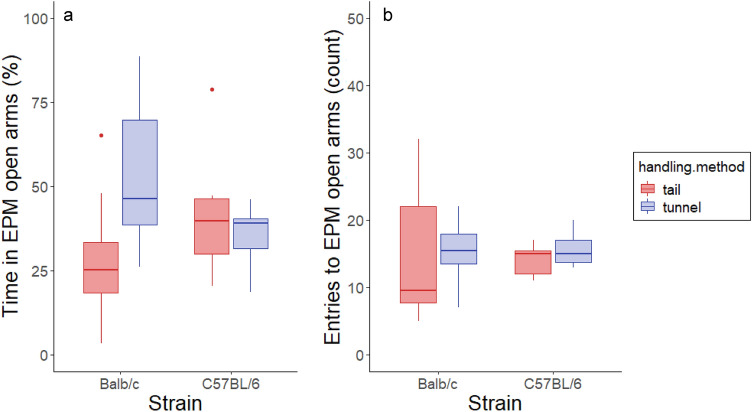
Studies in mice have shown that less aversive handling methods (e.g. tunnel or cup handling) can reduce behavioural measures of anxiety in comparison to picking mice up by their tail. Despite such evidence, tail handling continues to be used routinely. Besides resistance to change accustomed procedures, this may also be due to the fact that current evidence in support of less aversive handling is mostly restricted to effects of extensive daily handling, which may not apply to routine husbandry practices. The aim of our study was to assess whether, and to what extent, different handling methods during routine husbandry induce differences in behavioural and physiological measures of stress in laboratory mice. To put the effects of handling method in perspective with chronic stress, we compared handling methods to a validated paradigm of unpredictable chronic mild stress (UCMS). We housed mice of two strains (Balb/c and C57BL/6) and both sexes either under standard laboratory conditions (CTRL) or under UCMS. Half of the animals from each housing condition were tail handled and half were tunnel handled twice per week, once during a cage change and once for a routine health check. We found strain dependent effects of handling method on behavioural measures of anxiety: tunnel handled Balb/c mice interacted with the handler more than tail handled conspecifics, and tunnel handled CTRL mice showed increased open arm exploration in the elevated plus-maze. Mice undergoing UCMS showed increased plasma corticosterone levels and reduced sucrose preference. However, we found no effect of handling method on these stress-associated measures. Our results therefore indicate that routine tail handling can affect behavioural measures of anxiety, but may not be a significant source of chronic husbandry stress. Our results also highlight strain dependent responses to handling methods.
在老鼠身上的研究表明,与用尾巴提起老鼠相比,采用较少令老鼠感到不适的处理方法(例如通过隧道或杯子处理)可以减少焦虑的行为测量。尽管有这样的证据,但仍然继续采用尾巴处理。除了对改变习惯程序的抵制之外,这可能还因为目前支持减少令老鼠不适的处理的证据主要限于广泛的日常处理的影响,而这可能不适用于常规的饲养实践。我们的研究目的是评估在常规饲养过程中,不同的处理方法是否以及在何种程度上会导致实验室老鼠的行为和生理应激测量值产生差异。为了从慢性应激的角度来评估处理方法的效果,我们将处理方法与经过验证的不可预测的慢性轻度应激(UCMS)范式进行了比较。我们饲养了两种品系(Balb/c 和 C57BL/6)的雄性和雌性老鼠,将它们分别安置在标准实验室条件(CTRL)或 UCMS 下。每种饲养条件下的一半动物每周进行两次尾巴处理或隧道处理,一次在笼子更换时,一次进行常规健康检查。我们发现处理方法对行为焦虑测量值有品系依赖性的影响:隧道处理的 Balb/c 老鼠与处理者的互动比尾巴处理的同种老鼠多,而隧道处理的 CTRL 老鼠在高架十字迷宫中表现出更多的开放臂探索。经历 UCMS 的老鼠显示出更高的血浆皮质酮水平和降低的蔗糖偏好。然而,我们没有发现处理方法对这些与应激相关的测量值有影响。因此,我们的结果表明,常规的尾巴处理可能会影响焦虑的行为测量值,但它可能不是慢性饲养应激的重要来源。我们的结果还突出了对处理方法的品系依赖性反应。