
使用脂肪变性移植物进行肝移植后的结果:重新定义脂肪变性移植物的可接受阈值。
Outcomes after Liver Transplantation with Steatotic Grafts: Redefining Acceptable Cutoffs for Steatotic Grafts.
作者信息
Da Ben L, Satiya Jinendra, Heda Rajiv P, Jiang Yu, Lau Lawrence F, Fahmy Ahmed, Winnick Aaron, Roth Nitzan, Grodstein Elliot, Thuluvath Paul J, Singal Ashwani K, Schiano Thomas D, Teperman Lewis W, Satapathy Sanjaya K
机构信息
Division of Hepatology, Department of Internal Medicine, Sandra Atlas Bass Center for Liver Diseases and Transplantation, Barbara and Zucker School of Medicine for Hofstra/Northwell Health, Manhasset, New York, United States of America.
Division of Gastroenterology, Beth Israel Deaconess Medical Center, Boston, Massachusetts, United States of America.
出版信息
Euroasian J Hepatogastroenterol. 2022 Jul;12(Suppl 1):S5-S14. doi: 10.5005/jp-journals-10018-1361.
BACKGROUND
Graft macrosteatosis can predispose to a higher risk of graft loss so we sought to redefine acceptable cutoffs for graft steatosis.
METHODS
Data of 26,103 donors who underwent liver transplantation (LT) between January 2004 and December 2018 from the UNOS-STAR database were utilized. A high-risk steatotic (HRS) graft and a low-risk steatotic (LRS) graft were defined as ≥20% and <20% macrosteatosis, respectively. High-risk steatotic grafts were further classified as grafts with 20-29% (G1S grafts), 30-39% (G2S grafts), and ≥40% steatosis (G3S grafts). Outcomes between groups were compared.
RESULTS
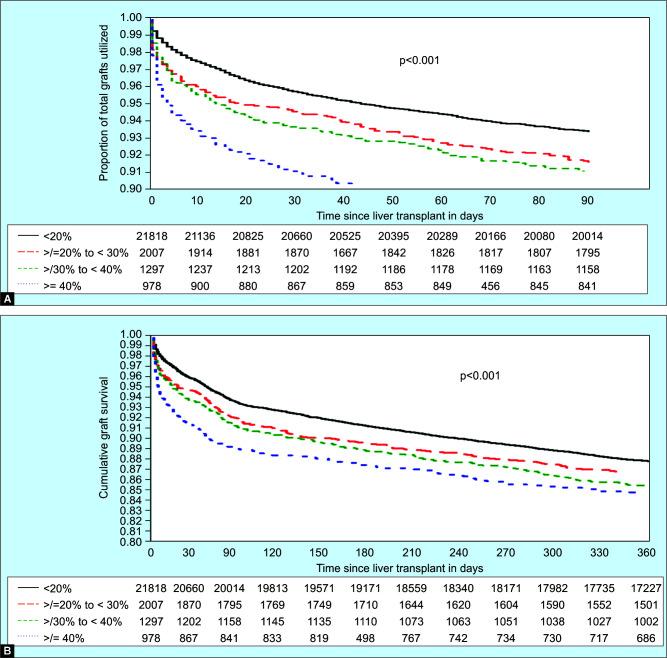
LRS grafts had excellent graft (93.3 and 87.7%) and overall survival (95.4 and 90.5%) at 90 days and 1 year. Compared to LRS grafts, G1S, G2S, and G3S grafts had worse graft and overall survival at 90 days and 1-year ( <0.001). There was no difference in graft or overall survival of G1S or G3S grafts compared to G2S grafts until after adjustment in which G3S grafts were found to be associated with an increased risk of graft loss-aHR 1.27 (1.03-1.57), = 0.02.
DISCUSSION
Liver grafts can be categorized into three categories: (1) <20% or "very low risk", (2) 20-39% or "low-to-moderate risk", and usually acceptable, and (3) ≥40% steatosis or "moderate-to-high risk".
HOW TO CITE THIS ARTICLE
Da BL, Satiya J, Heda RP, . Outcomes after Liver Transplantation with Steatotic Grafts: Redefining Acceptable Cutoffs for Steatotic Grafts. Euroasian J Hepato-Gastroenterol 2022;12(Suppl 1):S5-S14.
背景
移植肝大脂肪变性会增加移植肝丢失的风险,因此我们试图重新定义移植肝脂肪变性可接受的临界值。
方法
利用2004年1月至2018年12月期间来自UNOS-STAR数据库的26103例接受肝移植(LT)供体的数据。将高风险脂肪变性(HRS)移植肝和低风险脂肪变性(LRS)移植肝分别定义为大脂肪变性≥20%和<20%。高风险脂肪变性移植肝进一步分为脂肪变性20%-29%(G1S移植肝)、30%-39%(G2S移植肝)和≥40%(G3S移植肝)。比较各组之间的结局。
结果
LRS移植肝在90天和1年时具有出色的移植肝存活率(分别为93.3%和87.7%)和总体存活率(分别为95.4%和90.5%)。与LRS移植肝相比,G1S、G2S和G3S移植肝在90天和1年时的移植肝存活率和总体存活率较差(P<0.001)。与G2S移植肝相比,G1S或G3S移植肝的移植肝存活率或总体存活率在调整前无差异,调整后发现G3S移植肝与移植肝丢失风险增加相关——校正后风险比1.27(1.03-1.57),P=0.02。
讨论
移植肝可分为三类:(1)<20%或“极低风险”;(2)20%-39%或“低至中度风险”,通常可接受;(3)脂肪变性≥40%或“中至高度风险”。
如何引用本文
Da BL, Satiya J, Heda RP, 等。脂肪变性移植肝肝移植后的结局:重新定义脂肪变性移植肝可接受的临界值。《欧亚肝脏胃肠病学杂志》2022年;12(增刊1):S5-S14。


 Zotero 插件