Sarkio Katri, Korhonen Tiina, Hakkarainen Kai
Faculty of Educational Sciences, University of Helsinki, Helsinki, Finland.
Learn Environ Res. 2023;26(2):469-489. doi: 10.1007/s10984-022-09442-w. Epub 2022 Nov 24.
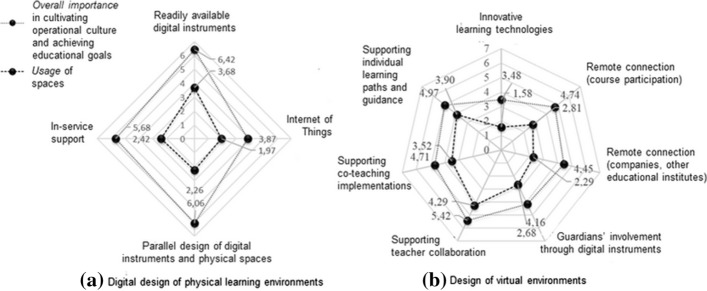
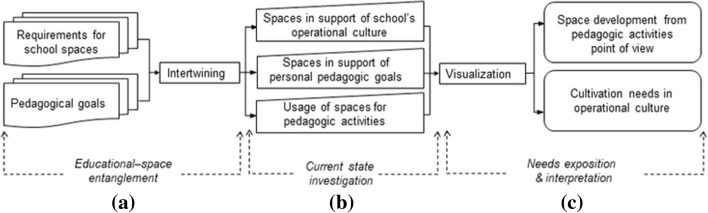
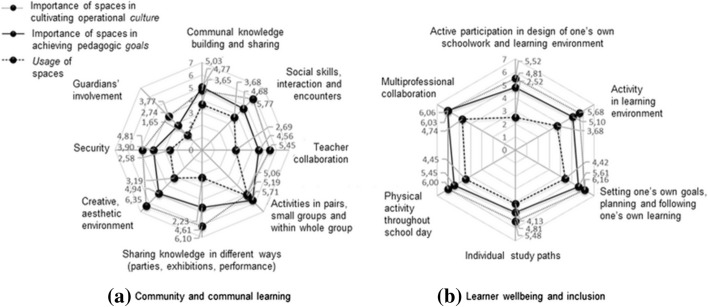
School spaces, technologies, and educational activities shape each other reciprocally. This mixed-methods study (i) developed a methodological framework for tracing the interdependence between school spaces, digital instruments, and teachers' practices in their use, and (ii) created practice-based knowledge about the relations of teachers' perceptions of educational activities to school spaces in order to acknowledge architects and educational practitioners in designing learning environments that support educational renewal. We participated in the construction process of a new general upper-secondary school building in Finland, taking into consideration the school's operating culture and teachers' pedagogic needs (social aspects), as well as the mediation of school spaces by digitalization and national curriculum reformation (material aspects). The data were collected through a teacher survey ( = 31), teacher interviews ( = 10), and the analysis of group notes that teachers ( = 39) generated in a participatory workshop. The results revealed that teachers consider it critical in the design of new learning environments to foster a collaborative and multidisciplinary school culture that emphasizes learners' wellbeing and inclusion, as well as utilizing readily-available digital instruments with basic-level functionality. The developed methodological framework appeared suitable for visualizing (with radar charts) the sociomaterial interdependence of school spaces, digital instruments, and teachers' personal and collective pedagogical activities. We argue that teachers' perceptions of school spaces, digital instruments, and pedagogic practices entanglement consolidates learning environments design from an educational point of view and should be taken into consideration when constructing new school buildings.
学校空间、技术和教育活动相互塑造。这项混合方法研究:(i)开发了一个方法框架,用于追踪学校空间、数字工具以及教师在使用中的实践之间的相互依存关系;(ii)创建了基于实践的知识,内容涉及教师对教育活动的认知与学校空间的关系,以便在设计支持教育革新的学习环境时让建筑师和教育从业者有所认识。我们参与了芬兰一所新的普通高中教学楼的建设过程,考虑到学校的运营文化和教师的教学需求(社会层面),以及数字化和国家课程改革对学校空间的中介作用(物质层面)。数据通过教师调查(n = 31)、教师访谈(n = 10)以及对教师(n = 39)在参与式研讨会上生成的小组笔记的分析来收集。结果表明,教师认为在新学习环境的设计中,培养一种强调学习者福祉和包容性的协作性和多学科学校文化,以及使用具有基本功能的现成数字工具至关重要。所开发的方法框架似乎适合(用雷达图)可视化学校空间、数字工具以及教师个人和集体教学活动的社会物质相互依存关系。我们认为,教师对学校空间、数字工具和教学实践相互交织的认知从教育角度巩固了学习环境设计,在建造新学校建筑时应予以考虑。