Moser Carlee, Li Jonathan Z, Eron Joseph J, Aga Evgenia, Daar Eric S, Wohl David A, Coombs Robert W, Javan Arzhang Cyrus, Bender Ignacio Rachel A, Jagannathan Prasanna, Ritz Justin, Sieg Scott F, Parikh Urvi M, Hughes Michael D, Currier Judith S, Smith Davey M, Chew Kara W
Center for Biostatistics in AIDS Research, Harvard T.H. Chan School of Public Health, Boston, Massachusetts, USA.
Department of Medicine, Brigham and Women's Hospital, Harvard Medical School, Boston, Massachusetts, USA.
Open Forum Infect Dis. 2022 Nov 11;9(11):ofac618. doi: 10.1093/ofid/ofac618. eCollection 2022 Nov.
Identifying characteristics associated with severe acute respiratory syndrome coronavirus 2 (SARS-CoV-2) RNA shedding may be useful to understand viral compartmentalization, disease pathogenesis, and risks for viral transmission.
Participants were enrolled August 2020 to February 2021 in ACTIV-2/A5401, a placebo-controlled platform trial evaluating investigational therapies for mild-to-moderate coronavirus disease 2019 (COVID-19), and underwent quantitative SARS-CoV-2 RNA testing on nasopharyngeal and anterior nasal swabs, oral wash/saliva, and plasma at entry (day 0, pretreatment) and days 3, 7, 14, and 28. Concordance of RNA levels (copies/mL) across compartments and predictors of nasopharyngeal RNA levels were assessed at entry (n = 537). Predictors of changes over time were evaluated among placebo recipients (n = 265) with censored linear regression models.
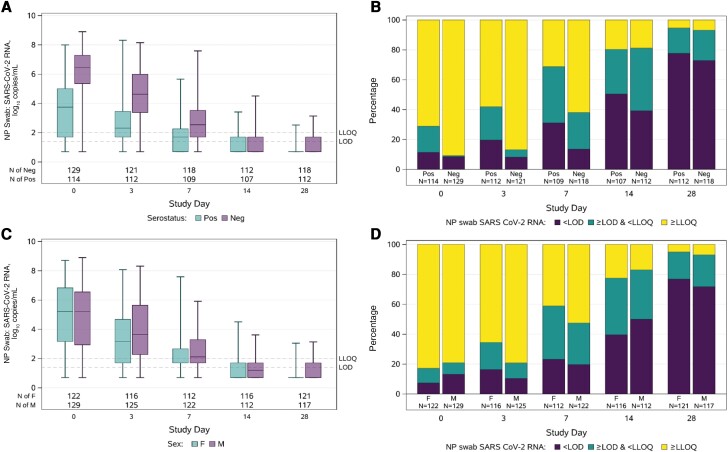
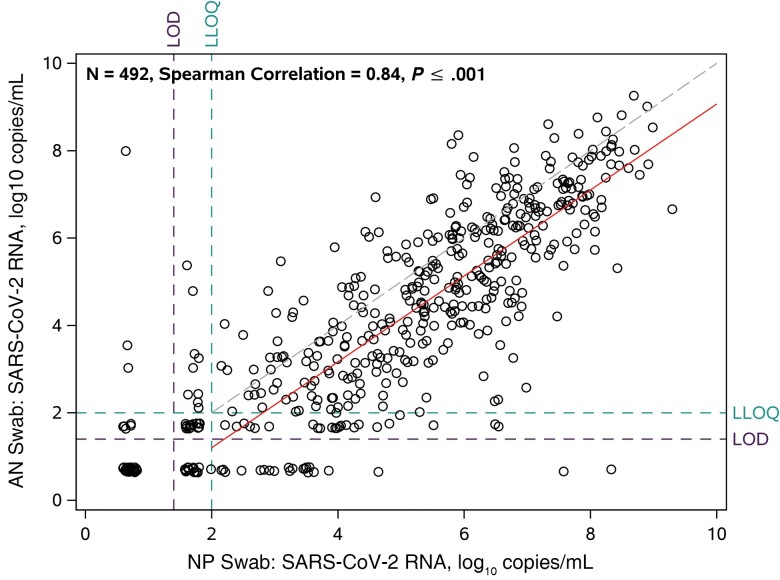
Nasopharyngeal and anterior nasal RNA levels at study entry were highly correlated ( = 0.84); higher levels of both were associated with greater detection of RNA in plasma and oral wash/saliva. Older age, White non-Hispanic race/ethnicity, lower body mass index (BMI), SARS-CoV-2 immunoglobulin G seronegativity, and shorter prior symptom duration were associated with higher nasopharyngeal RNA at entry. In adjusted models, body mass index and race/ethnicity associations were attenuated, but the association with age remained (for every 10 years older, mean nasopharyngeal RNA was 0.27 log copies/mL higher; < .001). Examining longitudinal viral RNA levels among placebo recipients, women had faster declines in nasopharyngeal RNA than men (mean change, -2.0 vs -1.3 log copies/mL, entry to day 3; < .001).
SARS-CoV-2 RNA shedding was concordant across compartments. Age was strongly associated with viral shedding, and men had slower viral clearance than women, which could explain sex differences in acute COVID-19 outcomes.
确定与严重急性呼吸综合征冠状病毒2(SARS-CoV-2)RNA脱落相关的特征,可能有助于理解病毒的分布、疾病发病机制以及病毒传播风险。
参与者于2020年8月至2021年2月入选ACTIV-2/A5401研究,这是一项安慰剂对照的平台试验,旨在评估针对轻度至中度2019冠状病毒病(COVID-19)的研究性疗法。参与者在入组时(第0天,预处理)以及第3、7、14和28天,接受了鼻咽拭子、前鼻拭子、口腔冲洗液/唾液以及血浆的SARS-CoV-2 RNA定量检测。在入组时(n = 537)评估了各部位RNA水平(拷贝数/毫升)的一致性以及鼻咽RNA水平的预测因素。在安慰剂接受者(n = 265)中,使用删失线性回归模型评估了随时间变化的预测因素。
研究入组时,鼻咽和前鼻的RNA水平高度相关( = 0.84);两者水平越高,血浆和口腔冲洗液/唾液中RNA的检测率越高。年龄较大、非西班牙裔白人种族/族裔、较低的体重指数(BMI)、SARS-CoV-2免疫球蛋白G血清阴性以及较短的先前症状持续时间,与入组时较高的鼻咽RNA水平相关。在调整模型中,体重指数和种族/族裔的关联减弱,但与年龄的关联仍然存在(每大10岁,平均鼻咽RNA高0.27 log拷贝数/毫升; <.001)。在安慰剂接受者中检查纵向病毒RNA水平,女性鼻咽RNA的下降速度比男性快(平均变化,入组至第3天为-2.0对-1.3 log拷贝数/毫升; <.001)。
SARS-CoV-2 RNA脱落在各部位是一致的。年龄与病毒脱落密切相关,男性的病毒清除速度比女性慢,这可以解释急性COVID-19结局中的性别差异。