Yang Riyun, Pan Jingying, Wang Yankai, Xia Panhui, Tai Mingliang, Jiang Zhihao, Chen Gang
Department of Histology and Embryology, Medical School of Nantong University, Nantong, China.
Center for Basic Medical Research, Medical School of Nantong University, Nantong, China.
Front Cell Neurosci. 2022 Nov 17;16:1005399. doi: 10.3389/fncel.2022.1005399. eCollection 2022.
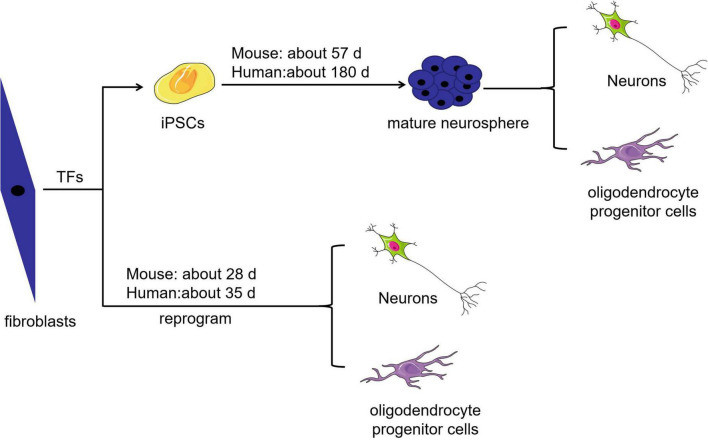
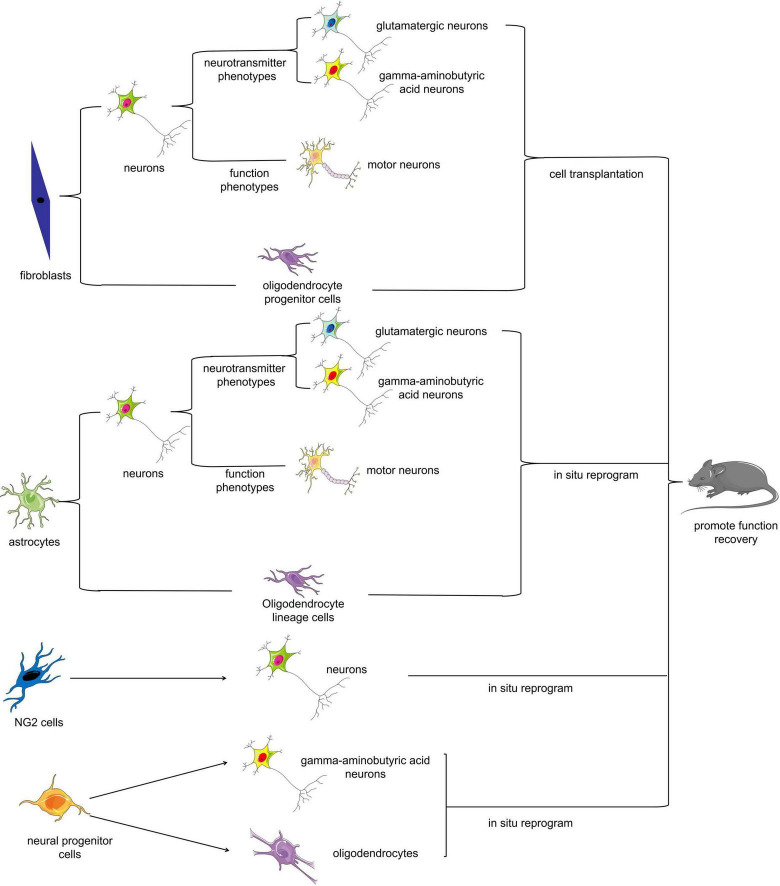
Spinal cord injury (SCI) is a serious neurological trauma that is challenging to treat. After SCI, many neurons in the injured area die due to necrosis or apoptosis, and astrocytes, oligodendrocytes, microglia and other non-neuronal cells become dysfunctional, hindering the repair of the injured spinal cord. Corrective surgery and biological, physical and pharmacological therapies are commonly used treatment modalities for SCI; however, no current therapeutic strategies can achieve complete recovery. Somatic cell reprogramming is a promising technology that has gradually become a feasible therapeutic approach for repairing the injured spinal cord. This revolutionary technology can reprogram fibroblasts, astrocytes, NG2 cells and neural progenitor cells into neurons or oligodendrocytes for spinal cord repair. In this review, we provide an overview of the transcription factors, genes, microRNAs (miRNAs), small molecules and combinations of these factors that can mediate somatic cell reprogramming to repair the injured spinal cord. Although many challenges and questions related to this technique remain, we believe that the beneficial effect of somatic cell reprogramming provides new ideas for achieving functional recovery after SCI and a direction for the development of treatments for SCI.
脊髓损伤(SCI)是一种严重的神经创伤,治疗具有挑战性。SCI后,损伤区域的许多神经元因坏死或凋亡而死亡,星形胶质细胞、少突胶质细胞、小胶质细胞和其他非神经元细胞功能失调,阻碍了受损脊髓的修复。矫正手术以及生物、物理和药物疗法是SCI常用的治疗方式;然而,目前没有治疗策略能够实现完全康复。体细胞重编程是一项有前景的技术,已逐渐成为修复受损脊髓的一种可行治疗方法。这项革命性技术可将成纤维细胞、星形胶质细胞、NG2细胞和神经祖细胞重编程为神经元或少突胶质细胞用于脊髓修复。在本综述中,我们概述了可介导体细胞重编程以修复受损脊髓的转录因子、基因、微小RNA(miRNA)、小分子以及这些因子的组合。尽管与该技术相关的许多挑战和问题仍然存在,但我们相信体细胞重编程的有益效果为SCI后实现功能恢复提供了新思路,并为SCI治疗的发展指明了方向。