Dziemba Oliver C, Oberhoffner Tobias, Müller Alexander
Klinik und Poliklinik für Hals‑, Nasen‑, Ohrenkrankheiten, Kopf- und Halschirurgie, Universitätsmedizin Greifswald, Ferdinand-Sauerbruch-Straße, 17489, Greifswald, Deutschland.
Klinik und Poliklinik für Hals-Nasen-Ohrenheilkunde, Kopf- und Halschirurgie "Otto Körner", Universitätsmedizin Rostock, Rostock, Deutschland.
HNO. 2023 Feb;71(2):100-105. doi: 10.1007/s00106-022-01251-0. Epub 2022 Dec 5.
Speech audiometry measurements under the influence of background noise are a fundamental part of evaluating the outcome of hearing care. As yet far, there are no recommendations for selecting a suitable method for adaptive speech audiometry measurements in background noise in cochlear implant (CI) care, so either the choice the adaptive level change of the speech signal (S) with constant noise (N) or the adaptive level change of N with constant S.
Do the measurement results of the monaural speechrecognition threshold in noise (SRT) with the Oldenburg Sentence Test (OLSA) depend on the choice of level control?
A total of 50 series of measurements with OLSA in noise and the Freiburg speech intelligibility test in quiet (FBE) on middle-aged CI patients from clinical routine.
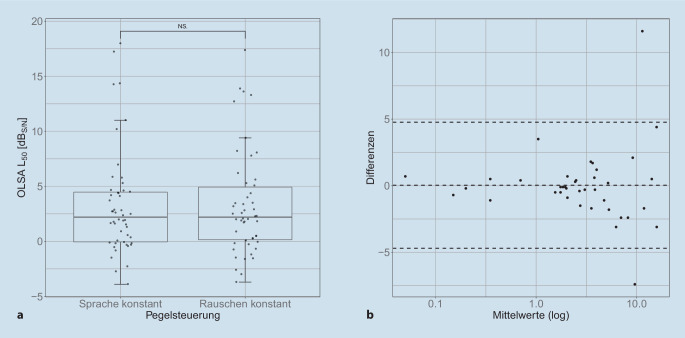
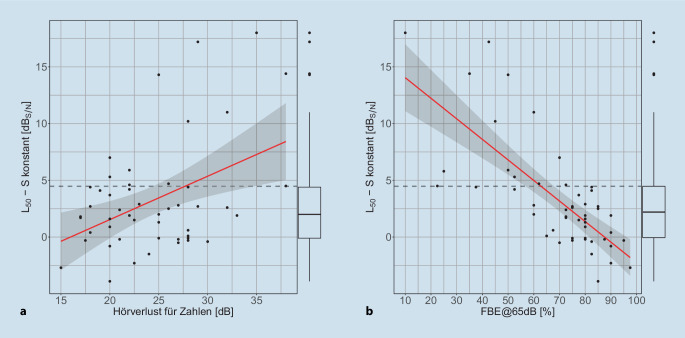
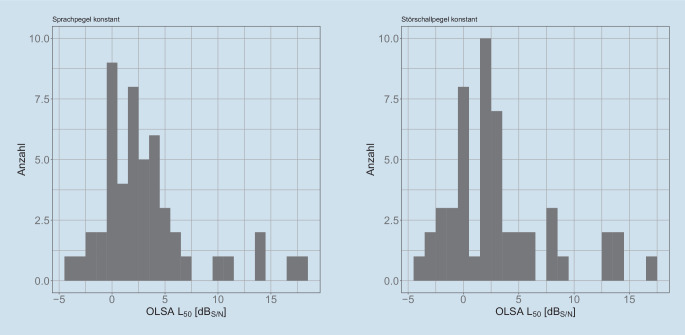
There is no significant difference in the measurement results with different level controls when the SRT is less than 5 [Formula: see text]. Below 55 % monosyllabic intelligibility in quiet, the SRT in noise becomes greater than 5 [Formula: see text].
From a clinical, audiological and methodological point of view, it is advisable to carry out the adaptive monaural speech intelligibility measurement with a constant speech signal at 65 [Formula: see text].
在背景噪声影响下的言语听力测量是评估听力保健效果的重要组成部分。到目前为止,在人工耳蜗(CI)护理中,对于在背景噪声下选择合适的自适应言语听力测量方法尚无建议,因此要么选择在恒定噪声(N)下改变言语信号(S)的自适应水平,要么选择在恒定S下改变N的自适应水平。
使用奥尔登堡句子测试(OLSA)进行的单耳噪声中言语识别阈值(SRT)测量结果是否取决于水平控制的选择?
对临床常规中年CI患者,共进行了50组在噪声中使用OLSA以及在安静环境中使用弗莱堡言语可懂度测试(FBE)的测量。
当SRT小于5 [公式:见正文] 时,不同水平控制下的测量结果无显著差异。在安静环境下单音节可懂度低于55%时,噪声中的SRT大于5 [公式:见正文]。
从临床、听力学和方法学角度来看,建议在65 [公式:见正文] 处以恒定言语信号进行自适应单耳言语可懂度测量。