David Geffen School of Medicine at UCLA, UCLA Fielding School of Public Health, Center for Healthy Climate Solutions and Center for Public Health and Disasters, 1100 Glendon Avenue, Suite 850-878, Los Angeles, CA, 90024, USA.
Lakehead University Department of Health Sciences, 955 Oliver Road, Thunder Bay, ON, P7B 5E1, Canada.
BMC Public Health. 2022 Dec 5;22(1):2274. doi: 10.1186/s12889-022-14662-z.
Smoke from wildfires is a growing public health risk due to the enormous amount of smoke-related pollution that is produced and can travel thousands of kilometers from its source. While many studies have documented the physical health harms of wildfire smoke, less is known about the effects on mental health and well-being. Understanding the effects of wildfire smoke on mental health and well-being is crucial as the world enters a time in which wildfire smoke events become more frequent and severe. We conducted a scoping review of the existing information on wildfire smoke's impact on mental health and well-being and developed a model for understanding the pathways in which wildfire smoke may contribute to mental health distress.
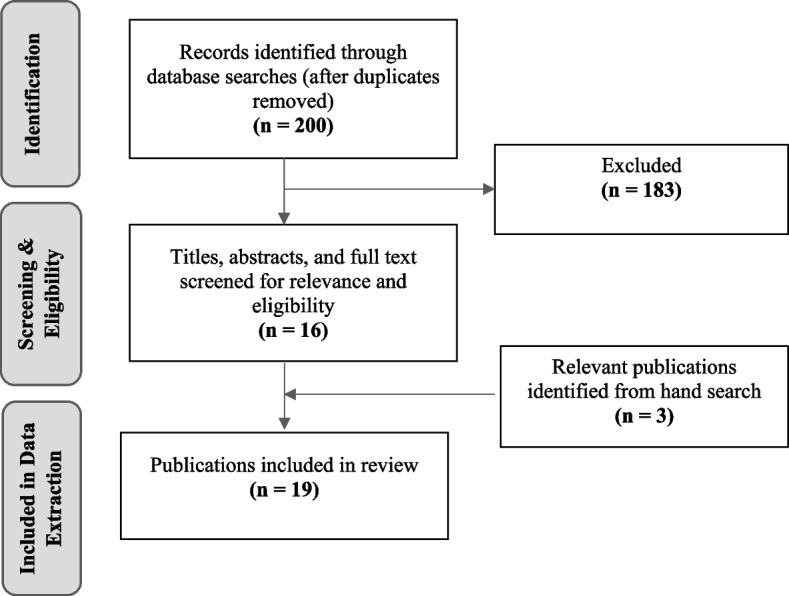
We conducted searches using PubMed, Medline, Embase, Google, Scopus, and ProQuest for 1990-2022. These searches yielded 200 articles. Sixteen publications met inclusion criteria following screening and eligibility assessment. Three more publications from the bibliographies of these articles were included for a total of 19 publications.
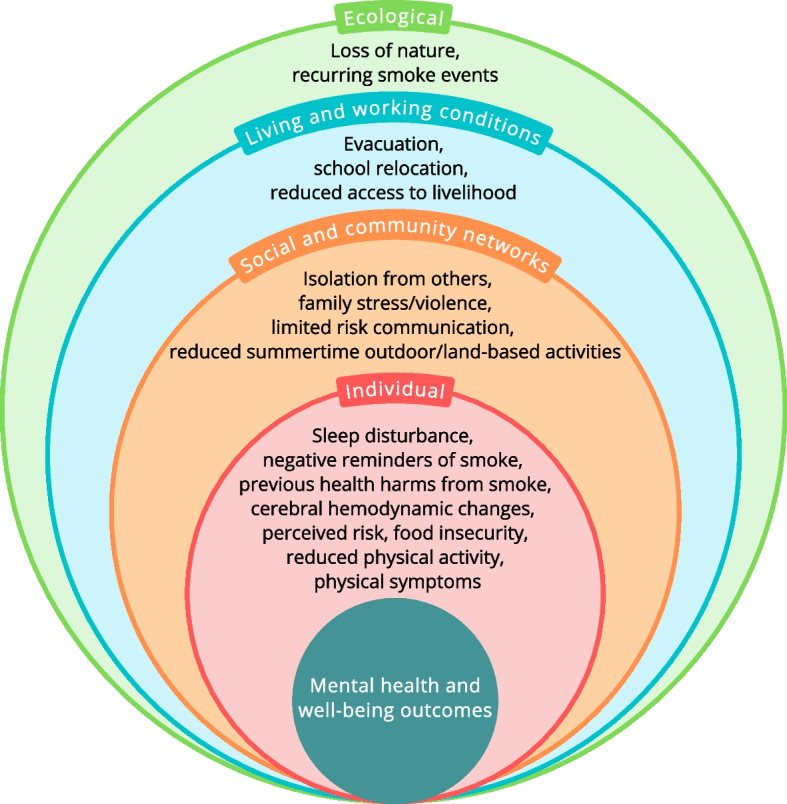
Our review suggests that exposure to wildfire smoke may have mental health impacts, particularly in episodes of chronic and persistent smoke events, but the evidence is inconsistent and limited. Qualitative studies disclose a wider range of impacts across multiple mental health and well-being domains. The potential pathways connecting wildfire smoke with mental health and well-being operate at multiple interacting levels including individual, social and community networks, living and working conditions, and ecological levels.
Priorities for future research include: 1) applying more rigorous methods; 2) differentiating between mental illness and emotional well-being; 3) studying chronic, persistent or repeated smoke events; 4) identifying the contextual factors that set the stage for mental health and well-being effects, and 5) identifying the causal processes that link wildfire smoke to mental health and well-being effects. The pathways model can serve as a basis for further research and knowledge synthesis on this topic. Also, it helps public health, community mental health, and emergency management practitioners mitigate the mental health and well-being harms of wildfire smoke.
由于野火产生的大量与烟雾有关的污染以及其可以从源头传播数千公里,野火烟雾已成为一个日益严重的公共卫生风险。虽然许多研究都记录了野火烟雾对身体健康的危害,但对其对心理健康和幸福感的影响了解较少。了解野火烟雾对心理健康和幸福感的影响至关重要,因为世界正进入一个野火烟雾事件变得更加频繁和严重的时期。我们对现有的关于野火烟雾对心理健康和幸福感影响的信息进行了范围界定审查,并建立了一个理解野火烟雾可能导致心理健康困扰的途径模型。
我们使用 PubMed、Medline、Embase、Google、Scopus 和 ProQuest 进行了 1990 年至 2022 年的搜索。这些搜索产生了 200 篇文章。经过筛选和资格评估,有 16 篇出版物符合纳入标准。从这些文章的参考文献中又有 3 篇文章被纳入,总共 19 篇文章。
我们的综述表明,暴露于野火烟雾中可能会对心理健康产生影响,特别是在慢性和持续性烟雾事件中,但证据不一致且有限。定性研究揭示了多个心理健康和幸福感领域的更广泛影响。将野火烟雾与心理健康和幸福感联系起来的潜在途径在多个相互作用的层面上运作,包括个人、社会和社区网络、生活和工作条件以及生态层面。
未来研究的优先事项包括:1)应用更严格的方法;2)区分精神疾病和情绪健康;3)研究慢性、持续性或反复性烟雾事件;4)确定为心理健康和幸福感影响奠定基础的情境因素;5)确定将野火烟雾与心理健康和幸福感影响联系起来的因果过程。该途径模型可以作为进一步研究和知识综合的基础,了解这一主题。此外,它可以帮助公共卫生、社区心理健康和应急管理从业人员减轻野火烟雾对心理健康和幸福感的危害。