Gastroenterology and Hepatology Unit, Department of Medicine, Faculty of Medicine, University of Malaya, Kuala Lumpur, Malaysia.
Clin Mol Hepatol. 2023 Feb;29(Suppl):S58-S67. doi: 10.3350/cmh.2022.0350. Epub 2022 Dec 5.
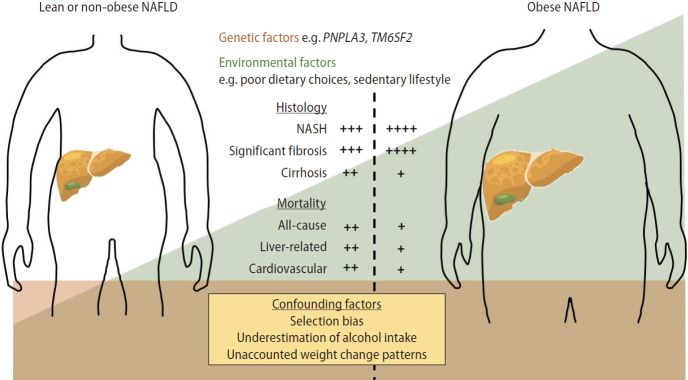
Nonalcoholic fatty liver disease (NAFLD) encompasses a spectrum of liver conditions that are characterized by excess accumulation of fat in the liver, and is diagnosed after exclusion of significant alcohol intake and other causes of chronic liver disease. In the majority of cases, NAFLD is associated with overnutrition and obesity, although it may be also found in lean or non-obese individuals. It has been estimated that 19.2% of NAFLD patients are lean and 40.8% are non-obese. The proportion of patients with more severe liver disease and the incidence of all-cause mortality, liver-related mortality, and cardiovascular mortality among non-obese and obese NAFLD patients varies across studies and may be confounded by selection bias, underestimation of alcohol intake, and unaccounted weight changes over time. Genetic factors may have a greater effect towards the development of NAFLD in lean or non-obese individuals, but the effect may be less pronounced in the presence of strong environmental factors, such as poor dietary choices and a sedentary lifestyle, as body mass index increases in the obese state. Overall, non-invasive tests, such as the Fibrosis-4 index, NAFLD fibrosis score, and liver stiffness measurement, perform better in lean or non-obese patients compared to obese patients. Lifestyle intervention works in non-obese patients, and less amount of weight loss may be required to achieve similar results compared to obese patients. Pharmacological therapy in non-obese NAFLD patients may require special consideration and a different approach compared to obese patients.
非酒精性脂肪性肝病(NAFLD)涵盖了一系列以肝脏脂肪过度堆积为特征的肝脏疾病,在排除大量饮酒和其他慢性肝病原因后诊断。在大多数情况下,NAFLD 与营养过剩和肥胖有关,尽管它也可能发生在瘦或非肥胖个体中。据估计,19.2%的 NAFLD 患者为瘦,40.8%为非肥胖。不同研究中,非肥胖和肥胖 NAFLD 患者中更严重肝病的患者比例以及全因死亡率、与肝脏相关的死亡率和心血管死亡率的发生率各不相同,这可能与选择偏倚、酒精摄入量低估以及随时间未被记录的体重变化有关。遗传因素可能对瘦或非肥胖个体中 NAFLD 的发生有更大的影响,但在存在强烈环境因素(如不良饮食选择和久坐不动的生活方式)的情况下,这种影响可能不那么明显,因为随着肥胖状态的出现,体重指数会增加。总的来说,非侵入性检查,如纤维化-4 指数、NAFLD 纤维化评分和肝脏硬度测量,在瘦或非肥胖患者中的表现优于肥胖患者。生活方式干预在非肥胖患者中有效,与肥胖患者相比,可能需要较少的减重就能达到类似的效果。与肥胖患者相比,非肥胖 NAFLD 患者的药物治疗可能需要特殊考虑和不同的方法。