Research Centre for Health Through Physical Activity, Lifestyle and Sport (HPALS), Division of Physiological Sciences, Human Biology Department, Faculty of Health Sciences, University of Cape Town, Anzio Road, Observatory, Cape Town, 7935, South Africa.
Department of Health Promotion, Norwegian Institute of Public Health, Bergen, Norway.
BMC Public Health. 2022 Dec 6;22(1):2287. doi: 10.1186/s12889-022-14724-2.
South Africa has several national surveys with body weight-related data, but they are not conducted regularly. Hence, data on longitudinal trends and the recent prevalence of adolescent obesity are not readily available for both national and international reporting and use. This study collectively analysed nationally representative surveys over nearly 2 decades to investigate trends in prevalence of adolescent obesity in South Africa. Furthermore, it compared these data with similar continental report for 45 countries across Europe and North America including United Kingdom, Norway, Netherland, Sweden, Azerbaijan, etc. to identify at-risk sub-population for overweight and obesity among adolescents. METHODS: The study included primary data of adolescents (15 - 19 years) from South African national surveys (N = 27, 884; girls = 51.42%) conducted between 1998 and 2016. Adolescents' data extracted include measured weight, height, sex, parent employment status, monthly allowance received, and family socioeconomic-related variables. Data were statistically analysed and visualized using chi-square of trends, Wald statistics, odds ratio and trend plots, and compared to findings from European survey report (N = 71, 942; girls = 51.23%). South African adolescents' obesity and overweight data were categorized based on World Health Organization (WHO)'s growth chart and compared by sex to European cohort and by family socioeconomic status.
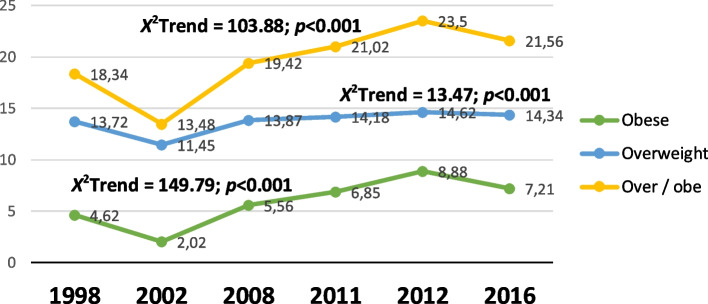
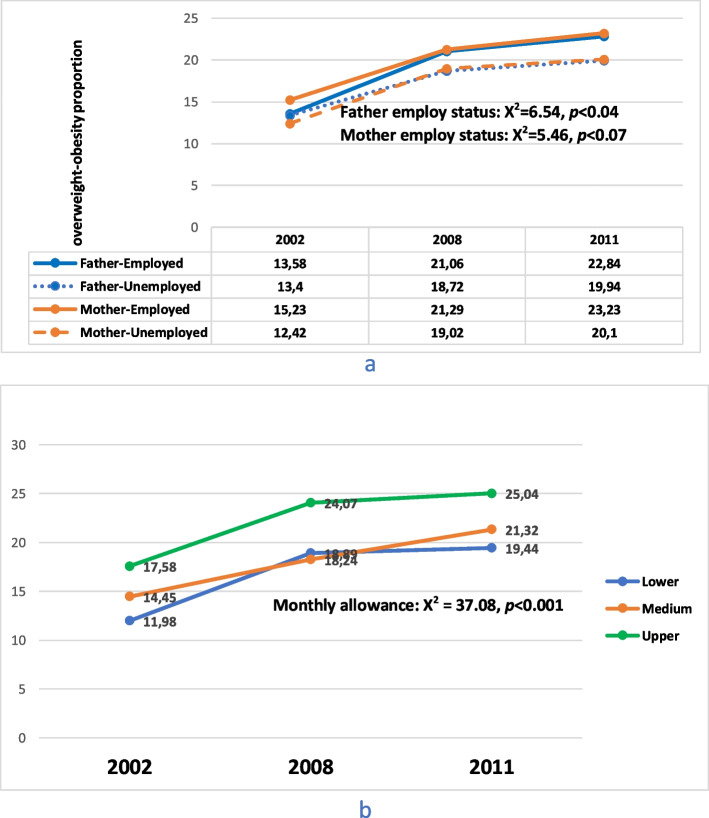
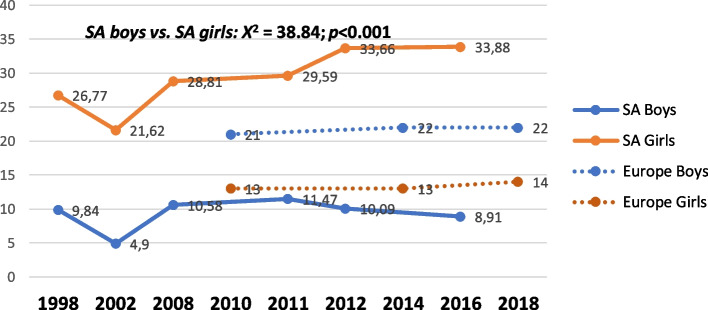
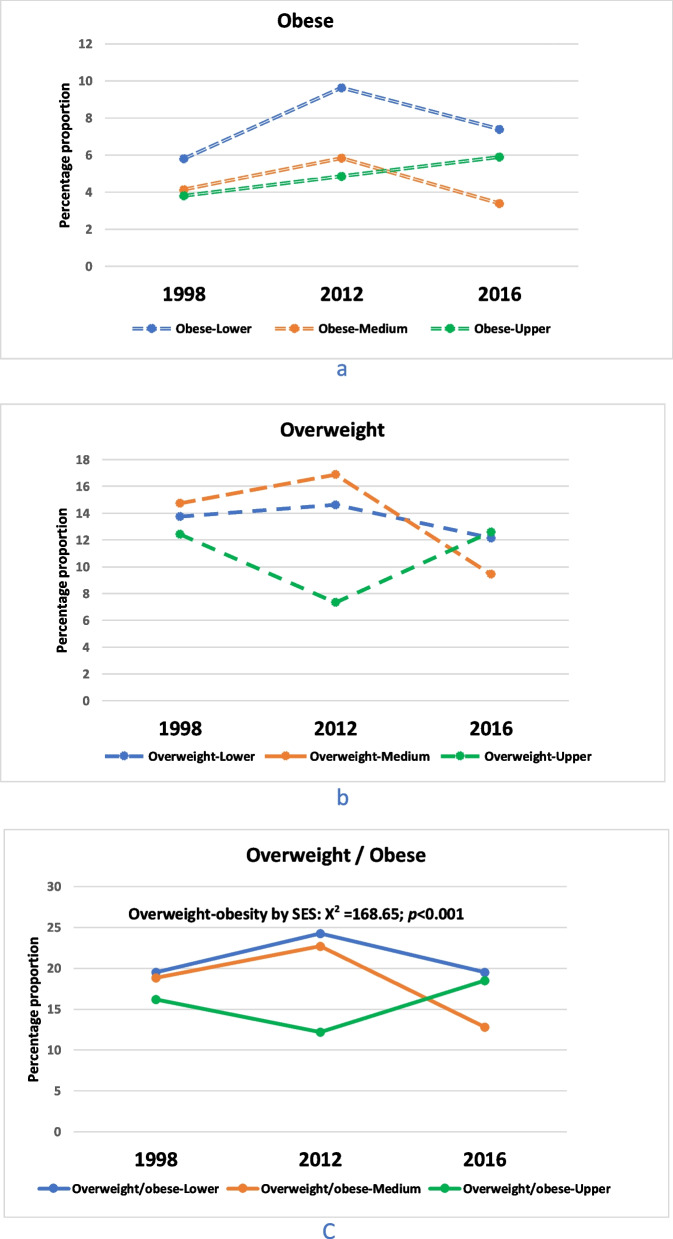
By 2016, 21.56% of South African adolescents were either obese or overweight, similar to the 21% prevalence reported in 2018 among European adolescents. Girls in South Africa showed higher trends for obesity and overweight compared to boys, different from Europe where, higher trends were reported among boys. South African Adolescents from upper socioeconomic families showed greater trends in prevalence of overweight and obesity than adolescents from medium and lower socioeconomic families. Mothers' employment status was significantly associated with adolescents' overweight and obesity.
Our study shows that by 2016, the prevalence of adolescent obesity was high in South Africa - more than 1 in 5 adolescents - which is nearly similar to that in Europe, yet South African girls may be at a greater odd for overweight and obesity in contrast to Europe, as well as adolescents from high earning families. South African local and contextual factors may be driving higher prevalence in specific sub-population. Our study also shows the need for frequent health-related data collection and tracking of adolescents' health in South Africa.
南非有几项与体重相关的数据全国性调查,但这些调查并非定期进行。因此,目前还无法获得有关青少年肥胖的纵向趋势和近期流行率的国家和国际报告数据。本研究综合分析了近 20 年来具有代表性的全国性调查,以调查南非青少年肥胖的流行趋势。此外,本研究还将这些数据与欧洲和北美 45 个国家的类似大陆报告进行了比较,包括英国、挪威、荷兰、瑞典、阿塞拜疆等,以确定青少年超重和肥胖的高危亚人群。
该研究纳入了南非全国性调查(1998 年至 2016 年)中 15-19 岁青少年的原始数据(n=27884 人;女孩占 51.42%)。提取青少年的数据包括测量体重、身高、性别、父母就业状况、每月津贴收入以及家庭社会经济相关变量。使用趋势卡方检验、沃尔德统计、优势比和趋势图对数据进行统计学分析和可视化,并与欧洲调查报告(n=71942 人;女孩占 51.23%)的结果进行比较。根据世界卫生组织(WHO)的生长图表,对南非青少年的肥胖和超重数据进行分类,并按性别与欧洲队列进行比较,按家庭社会经济状况进行比较。
到 2016 年,21.56%的南非青少年肥胖或超重,与 2018 年欧洲青少年 21%的报告患病率相似。与欧洲的情况不同,南非女孩的肥胖和超重趋势高于男孩,而欧洲的情况则是男孩的肥胖和超重趋势更高。来自高社会经济家庭的南非青少年超重和肥胖的流行率高于中低收入家庭的青少年。母亲的就业状况与青少年的超重和肥胖显著相关。
本研究表明,到 2016 年,南非青少年肥胖的流行率很高,超过五分之一的青少年肥胖,这一比例与欧洲相似,但南非女孩的超重和肥胖的几率可能比欧洲女孩更大,以及来自高收入家庭的青少年。南非的地方和背景因素可能导致特定亚人群的流行率更高。我们的研究还表明,南非需要经常收集与健康相关的数据,并跟踪青少年的健康状况。