O'Mahoney Lauren L, Routen Ash, Gillies Clare, Ekezie Winifred, Welford Anneka, Zhang Alexa, Karamchandani Urvi, Simms-Williams Nikita, Cassambai Shabana, Ardavani Ashkon, Wilkinson Thomas J, Hawthorne Grace, Curtis Ffion, Kingsnorth Andrew P, Almaqhawi Abdullah, Ward Thomas, Ayoubkhani Daniel, Banerjee Amitava, Calvert Melanie, Shafran Roz, Stephenson Terence, Sterne Jonathan, Ward Helen, Evans Rachael A, Zaccardi Francesco, Wright Shaney, Khunti Kamlesh
Diabetes Research Centre, University of Leicester, Leicester, UK.
Leicester Real World Evidence Unit, Diabetes Research Centre, University of Leicester, Leicester, UK.
EClinicalMedicine. 2022 Dec 1;55:101762. doi: 10.1016/j.eclinm.2022.101762. eCollection 2023 Jan.
The aim of this study was to systematically synthesise the global evidence on the prevalence of persistent symptoms in a general post COVID-19 population.
A systematic literature search was conducted using multiple electronic databases (MEDLINE and The Cochrane Library, Scopus, CINAHL, and medRxiv) until January 2022. Studies with at least 100 people with confirmed or self-reported COVID-19 symptoms at ≥28 days following infection onset were included. Patient-reported outcome measures and clinical investigations were both assessed. Results were analysed descriptively, and meta-analyses were conducted to derive prevalence estimates. This study was pre-registered (PROSPERO-ID: CRD42021238247).
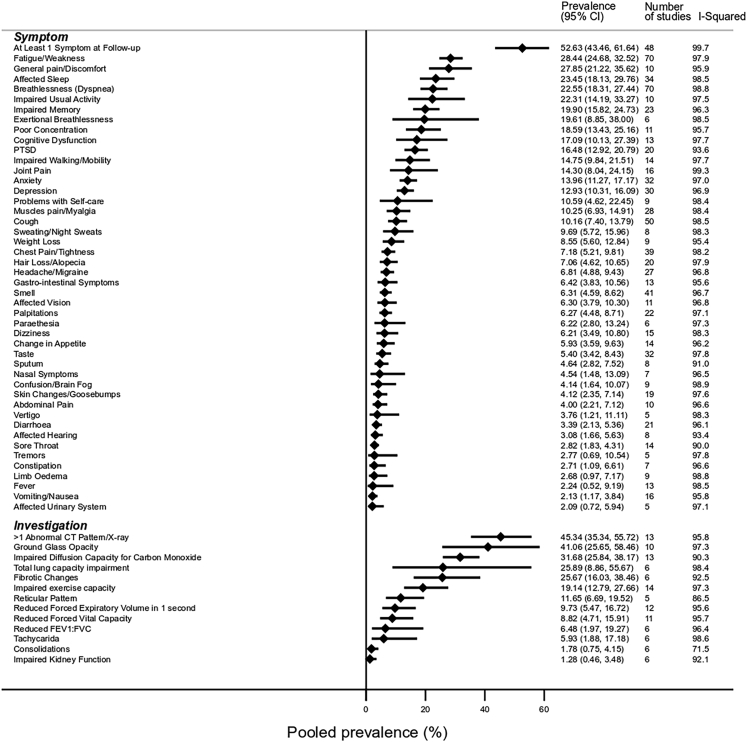
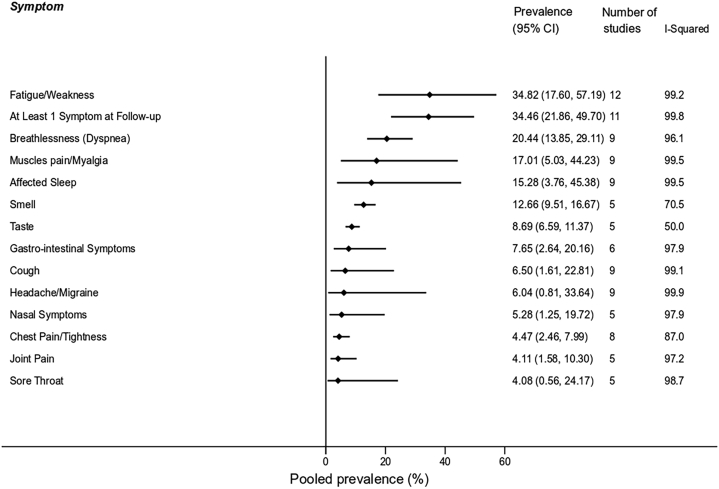
194 studies totalling 735,006 participants were included, with five studies conducted in those <18 years of age. Most studies were conducted in Europe (n = 106) or Asia (n = 49), and the time to follow-up ranged from ≥28 days to 387 days. 122 studies reported data on hospitalised patients, 18 on non-hospitalised, and 54 on hospitalised and non-hospitalised combined (mixed). On average, at least 45% of COVID-19 survivors, regardless of hospitalisation status, went on to experience at least one unresolved symptom (mean follow-up 126 days). Fatigue was frequently reported across hospitalised (28.4%; 95% CI 24.7%-32.5%), non-hospitalised (34.8%; 95% CI 17.6%-57.2%), and mixed (25.2%; 95% CI 17.7%-34.6%) cohorts. Amongst the hospitalised cohort, abnormal CT patterns/x-rays were frequently reported (45.3%; 95% CI 35.3%-55.7%), alongside ground glass opacification (41.1%; 95% CI 25.7%-58.5%), and impaired diffusion capacity for carbon monoxide (31.7%; 95% CI 25.8%-3.2%).
Our work shows that 45% of COVID-19 survivors, regardless of hospitalisation status, were experiencing a range of unresolved symptoms at ∼ 4 months. Current understanding is limited by heterogeneous study design, follow-up durations, and measurement methods. Definition of subtypes of Long Covid is unclear, subsequently hampering effective treatment/management strategies.
No funding.
本研究旨在系统综合全球范围内关于新冠病毒感染康复后普通人群中持续症状患病率的证据。
截至2022年1月,使用多个电子数据库(MEDLINE、Cochrane图书馆、Scopus、CINAHL和medRxiv)进行了系统的文献检索。纳入了在感染发病后至少28天有至少100名确诊或自述新冠病毒感染症状患者的研究。对患者报告的结局指标和临床检查均进行了评估。对结果进行描述性分析,并进行荟萃分析以得出患病率估计值。本研究已预先注册(PROSPERO编号:CRD42021238247)。
共纳入194项研究,涉及735,006名参与者,其中5项研究针对18岁以下人群。大多数研究在欧洲(n = 106)或亚洲(n = 49)进行,随访时间从≥28天到387天不等。122项研究报告了住院患者的数据,18项报告了非住院患者的数据,54项报告了住院和非住院患者合并(混合)的数据。平均而言,无论住院状态如何,至少45%的新冠病毒感染康复者会出现至少一种未解决的症状(平均随访126天)。在住院患者(28.4%;95%置信区间24.7%-32.5%)、非住院患者(34.8%;95%置信区间17.6%-57.2%)和混合队列(25.2%;95%置信区间17.7%-34.6%)中,疲劳是经常被报告的症状。在住院队列中,经常报告异常CT影像/ X光(45.3%;95%置信区间35.3%-55.7%),以及磨玻璃影(41.1%;95%置信区间25.7%-58.5%)和一氧化碳弥散能力受损(31.7%;95%置信区间2%5.8%-38.2%)。
我们的研究表明,无论住院状态如何,45%的新冠病毒感染康复者在约4个月时仍有一系列未解决的症状。目前的认识受到研究设计、随访时间和测量方法的异质性限制。长期新冠病毒感染亚型的定义尚不清楚,这随后阻碍了有效的治疗/管理策略。
无资金支持。