Centre for Patient Reported Outcome Research, Institute of Applied Health Research, University of Birmingham, Birmingham, B15 2TT, UK
National Institute for Health Research (NIHR) Applied Research Collaboration (ARC) West Midlands, Birmingham, UK.
BMJ. 2022 Apr 27;377:e070230. doi: 10.1136/bmj-2022-070230.
To describe the development and validation of a novel patient reported outcome measure for symptom burden from long covid, the symptom burden questionnaire for long covid (SBQ-LC).
Multiphase, prospective mixed methods study.
Remote data collection and social media channels in the United Kingdom, 14 April to 1 August 2021.
13 adults (aged ≥18 years) with self-reported long covid and 10 clinicians evaluated content validity. 274 adults with long covid field tested the draft questionnaire.
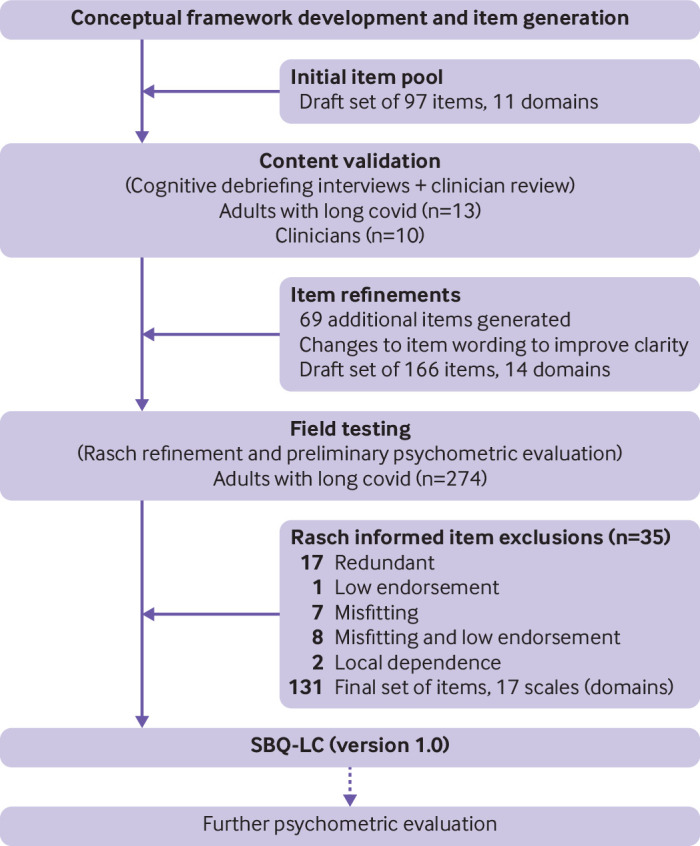
Published systematic reviews informed development of SBQ-LC's conceptual framework and initial item pool. Thematic analysis of transcripts from cognitive debriefing interviews and online clinician surveys established content validity. Consensus discussions with the patient and public involvement group of the Therapies for Long COVID in non-hospitalised individuals: From symptoms, patient reported outcomes and immunology to targeted therapies (TLC Study) confirmed face validity. Rasch analysis of field test data guided item and scale refinement and provided initial evidence of the SBQ-LC's measurement properties.
SBQ-LC (version 1.0) is a modular instrument measuring patient reported outcomes and is composed of 17 independent scales with promising psychometric properties. Respondents rate their symptom burden during the past seven days using a dichotomous response or 4 point rating scale. Each scale provides coverage of a different symptom domain and returns a summed raw score that can be transformed to a linear (0-100) score. Higher scores represent higher symptom burden. After rating scale refinement and item reduction, all scales satisfied the Rasch model requirements for unidimensionality (principal component analysis of residuals: first residual contrast values <2.00 eigenvalue units) and item fit (outfit mean square values within 0.5 -1.5 logits). Rating scale categories were ordered with acceptable category fit statistics (outfit mean square values <2.0 logits). 14 item pairs had evidence of local dependency (residual correlation values >0.4). Across the 17 scales, person reliability ranged from 0.34 to 0.87, person separation ranged from 0.71 to 2.56, item separation ranged from 1.34 to 13.86, and internal consistency reliability (Cronbach's alpha) ranged from 0.56 to 0.91.
SBQ-LC (version 1.0) is a comprehensive patient reported outcome instrument developed using modern psychometric methods. It measures symptoms of long covid important to people with lived experience of the condition and may be used to evaluate the impact of interventions and inform best practice in clinical management.
描述一种新的长新冠症状负担患者报告结局测量工具的开发和验证,即长新冠症状负担问卷(SBQ-LC)。
多阶段、前瞻性混合方法研究。
2021 年 4 月 14 日至 8 月 1 日,英国远程数据收集和社交媒体渠道。
13 名(年龄≥18 岁)自我报告患有长新冠的成年人和 10 名临床医生评估了内容效度。274 名长新冠患者对草案问卷进行了现场测试。
发表的系统评价为 SBQ-LC 的概念框架和初始项目池提供了信息。从认知偏差访谈和在线临床医生调查的转录本中进行的主题分析确定了内容效度。与 Therapies for Long COVID in non-hospitalised individuals: From symptoms, patient reported outcomes and immunology to targeted therapies(TLC 研究)中的患者和公众参与小组的共识讨论证实了表面效度。现场测试数据的 Rasch 分析指导了项目和量表的细化,并初步证明了 SBQ-LC 的测量特性。
SBQ-LC(版本 1.0)是一种模块化仪器,用于测量患者报告的结果,由 17 个独立的量表组成,具有有前途的心理测量特性。受访者使用二项式反应或 4 点评分量表来评估他们过去七天的症状负担。每个量表都涵盖了不同的症状领域,并提供了一个总和的原始分数,可以转换为线性(0-100)分数。分数越高表示症状负担越高。经过评分量表的细化和项目的删减,所有量表都满足了 Rasch 模型对维度性的要求(残差的主成分分析:第一残差对比值<2.00 特征值单位)和项目拟合(适中的均方值在 0.5-1.5 对数之间)。评分量表类别具有可接受的类别拟合统计数据(适中的均方值<2.0 对数)。14 对项目具有局部依赖性的证据(残差相关值>0.4)。在 17 个量表中,个体可靠性范围为 0.34 至 0.87,个体分离范围为 0.71 至 2.56,项目分离范围为 1.34 至 13.86,内部一致性可靠性(克朗巴赫的α)范围为 0.56 至 0.91。
SBQ-LC(版本 1.0)是一种使用现代心理测量方法开发的综合患者报告结局测量工具。它测量了对有长新冠经历的人来说重要的症状,可用于评估干预措施的效果,并为临床管理提供最佳实践信息。