Healthy Aging Research Laboratory, Physical Therapy Department, Federal University of São Carlos, Washington Luis Highway, Km 235, São Paulo, São Carlos, Brazil.
Clinical and Occupational Kinesiology Laboratory, Physical Therapy Department, Federal University of São Carlos, São Carlos, Brazil.
BMC Geriatr. 2022 Dec 7;22(1):940. doi: 10.1186/s12877-022-03648-6.
To interpret changes of muscle strength in older adults with Alzheimer's disease (AD), determining the reliability of outcome measures is necessary. Therefore, the purpose of the present study was to investigate the relative and absolute intra-rater reliability of concentric isokinetic measures of the knee and ankle muscle strength in community-dwelling older adults without and with AD in the mild and moderate stages.
A methodological study was conducted. The participants were submitted to two isokinetic evaluations with an interval of three to seven days. The evaluations consisted of knee extension and flexion at 60°/s (five repetitions) and 180°/s (15 repetitions) and plantar flexion and dorsiflexion of the ankle at 30°/s (five repetitions). The measures of interest were peak torque, average peak torque and total work. The intraclass correlation coefficient two-way mixed model of a single-measure (ICC), standard error of measurement (SEM) and minimal detectable change at the 95% confidence interval (MDC) were calculated. The ICC was interpreted based on Munro's classification. Standard error of measurement and MDC were analyzed in absolute and relative values (percentage of error [SEM%] and change [MDC%]).
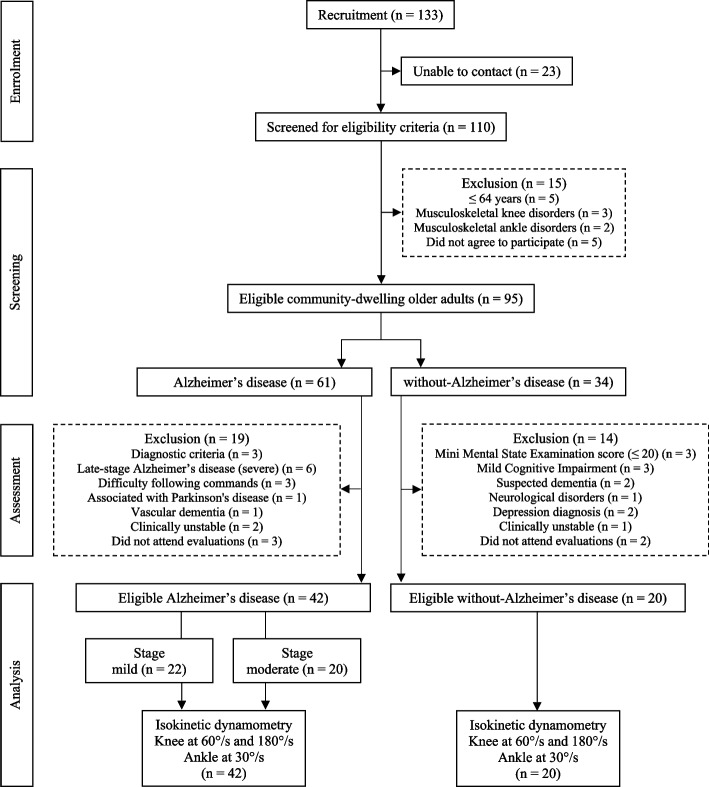
A total of 62 older adults were included and allocated to the three groups: mild-AD (n = 22, 79.9 years, 15 female and seven male), moderate-AD (n = 20, 81.6 years, 15 female and five male) and without-AD (n = 20, 74.3 years, 10 female and seven male). The ICCs of the measures of knee were high/very high in the three groups (0.71-0.98). The ICCs of the measures of ankle were high/very high in the mild-AD group (0.78-0.92), moderate/high/very high in the moderate-AD group (0.63-0.93) and high/very high in the group without-AD (0.84-0.97). The measurements of knee extensors at 60°/s, knee extensors (peak torque and total work), with the exception of peak torque in the mild-AD group, and flexors (average peak torque) at 180°/s, and ankle dorsiflexors at 30°/s had the lowest of SEM% and MDC95% in the three groups.
Concentric isokinetic measures are reliable for the assessment of knee and ankle muscle strength in community-dwelling older adults without and with AD in the mild and moderate stages.
为了评估阿尔茨海默病(AD)老年患者肌肉力量的变化,确定结果测量的可靠性是必要的。因此,本研究的目的是调查社区居住的无 AD 和轻度及中度 AD 老年人在进行膝关节和踝关节等速向心力量测量时的相对和绝对内部测试者可靠性。
本研究采用了一种方法学研究。参与者接受了两次等速评估,间隔三到七天。评估包括膝关节伸肌和屈肌在 60°/s(5 次重复)和 180°/s(15 次重复),以及踝关节跖屈和背屈在 30°/s(5 次重复)。感兴趣的测量指标包括峰值扭矩、平均峰值扭矩和总功。采用单测量双向混合模型的组内相关系数(ICC)、测量误差的标准误差(SEM)和 95%置信区间的最小可检测变化(MDC)进行计算。ICC 根据 Munro 分类进行解释。绝对和相对值(SEM%和 MDC%)分析了测量误差和 MDC。
共纳入 62 名老年人,分为三组:轻度 AD(n=22,79.9 岁,女性 15 名,男性 7 名)、中度 AD(n=20,81.6 岁,女性 15 名,男性 5 名)和无 AD(n=20,74.3 岁,女性 10 名,男性 7 名)。三组膝关节测量的 ICC 值均较高/非常高(0.71-0.98)。轻度 AD 组踝关节测量的 ICC 值较高/非常高(0.78-0.92),中度 AD 组中、高/非常高(0.63-0.93),无 AD 组高/非常高(0.84-0.97)。三组中,60°/s 时膝关节伸肌、膝关节伸肌(峰值扭矩和总功)、除轻度 AD 组外的峰值扭矩和 180°/s 时膝关节屈肌、30°/s 时踝关节背屈肌的 SEM%和 MDC95%最低。
等速向心力量测量对评估社区居住的无 AD 和轻度及中度 AD 老年人的膝关节和踝关节肌肉力量是可靠的。