
原发性同步性乳腺浸润性导管癌和肺腺癌的二代测序分析:一例报告
Analysis of primary synchronous breast invasive ductal carcinoma and lung adenocarcinoma with next-generation sequencing: A case report.
作者信息
Wu Di, Yu Jinyu, Guo Liang, Wei Xiaofei, Tian Zhuang, Duan Xiumei
机构信息
Department of Pathology, The First Hospital of Jilin University, Changchun, Jilin 130021, P.R. China.
Department of Urology, The First Hospital of Jilin University, Changchun, Jilin 130021, P.R. China.
出版信息
Oncol Lett. 2022 Nov 21;25(1):18. doi: 10.3892/ol.2022.13604. eCollection 2023 Jan.
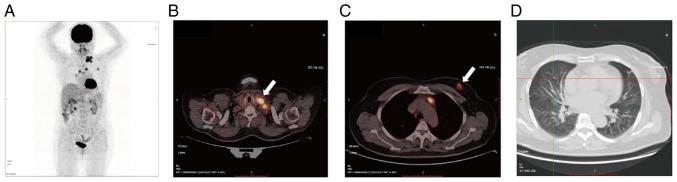
Multiple primary cancers (MPCs) have an increasing incidence rate due to the detection of early stages of cancer and the development of effective therapeutic strategies. MPCs are less common compared with metachronous cancers. Therefore, distinguishing synchronous primary tumors from metastasis and developing an individualized treatment strategy can be challenging. In the present study, the case of a 70-year-old female who was referred to The First Hospital of Jilin University (Changchun, China) with an enlarged left cervical lymph node and no other clinical manifestations is reported. Radiography revealed distinct lesions in the left breast, left cervical lymph node and bilateral lungs. Subsequently, a biopsy was performed in all three lesions and then each specimen was subjected to immunohistochemistry, fluorescence hybridization, amplification refractory mutation system-PCR and next-generation sequencing (NGS). Disease-related enrichment of lymph node mutant genes and Gene Ontology Biological Process enrichment of breast, as well as lung, mutant genes were performed using the Database for Annotation, Visualization and Integrated Discovery. Based on the molecular assessment, the patient was finally diagnosed with breast invasive ductal carcinoma, primary lung adenocarcinoma and cervical lymph node metastatic lung adenocarcinoma. Since primary synchronous breast and lung cancer (SBLC) is rare, a molecular assessment, particularly using NGS, could provide important information for both the diagnosis and treatment of SBLC.
由于癌症早期检测技术的发展以及有效治疗策略的出现,多原发性癌(MPCs)的发病率呈上升趋势。与异时性癌相比,MPCs较为少见。因此,区分同步原发性肿瘤与转移瘤并制定个体化治疗策略具有挑战性。在本研究中,报告了一名70岁女性的病例,该患者因左颈部淋巴结肿大被转诊至吉林大学第一医院(中国长春),无其他临床表现。影像学检查显示左乳、左颈部淋巴结及双肺有明显病变。随后,对所有三个病变进行了活检,然后对每个标本进行了免疫组织化学、荧光杂交、扩增阻滞突变系统聚合酶链反应(ARMS-PCR)和二代测序(NGS)。使用注释、可视化和综合发现数据库(DAVID)对淋巴结突变基因的疾病相关富集以及乳腺和肺突变基因的基因本体生物学过程富集进行了分析。基于分子评估,该患者最终被诊断为乳腺浸润性导管癌、原发性肺腺癌和颈部淋巴结转移性肺腺癌。由于原发性同步性乳腺癌和肺癌(SBLC)较为罕见,分子评估,特别是使用NGS,可为SBLC的诊断和治疗提供重要信息。


 Zotero 插件