Deparatment of Genetic Counseling, University of Minnesota, Minneapolis, Minnesota, USA.
Masonic Cancer Center, University of Minnesota, Minneapolis, Minnesota, USA.
Cancer Med. 2023 Mar;12(6):7234-7245. doi: 10.1002/cam4.5443. Epub 2022 Dec 8.
The KMT2 family of genes is essential epigenetic regulators promoting gene expression. The gene family contains three subgroups, each with two paralogues: KMT2A and KMT2B; KMT2C and KMT2D; KMT2F and KMT2G. KMT2A-D are among the most frequent somatically altered genes in several different cancer types. Somatic KMT2A rearrangements are well-characterized in infant leukemia (IL), and growing evidence supports the role of additional family members (KMT2B, KMT2C, and KMT2D) in leukemogenesis. Enrichment of rare heterozygous frameshift variants in KMT2A and C has been reported in acute myeloid leukemia (AML), IL, and solid tumors. Currently, the non-synonymous variation, prevalence, and penetrance of these four genes are unknown.
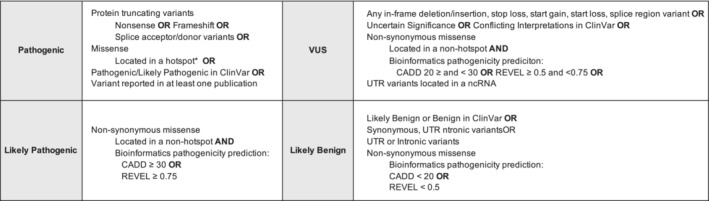
This study determined the prevalence of pathogenic/likely pathogenic (P/LP) germline KMT2A-D variants in a cancer-free adult population from the Genome Aggregation Database (gnomAD). Two methods of variant interpretation were utilized: a manual genomic variant interpretation and an automated ACMG pipeline.
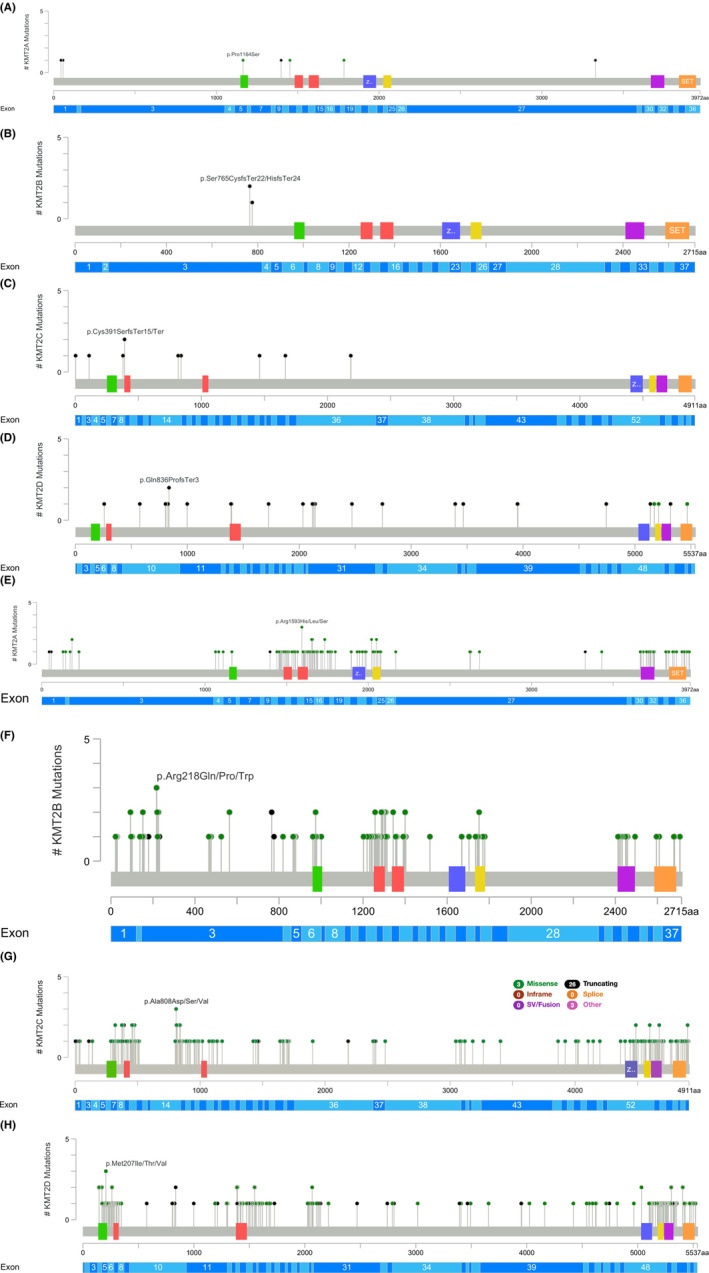
The ACMG pipeline identified considerably fewer P/LP variants (n = 89) compared to the manual method (n = 660) in all 4 genes. Consequently, the total P/LP prevalence and allele frequency (AF) were higher in the manual method (1:112, AF = 4.46E-03) than in ACMG (1:832, AF = 6.01E-04). Multiple ancestry-exclusive P/LP variants were identified along with an increased frequency in males compared to females. Many of these variants identified in this population database are also associated with severe juvenile conditions.
These data demonstrate that putatively functional germline variation in these developmentally important genes is more common than previously appreciated and identification in cancer-free adults may indicate incomplete penetrance for many of these variants. Future research should examine a genetic predisposing role in IL and other pediatric cancers.
KMT2 家族基因是促进基因表达的重要表观遗传调控因子。该基因家族包含三个亚组,每个亚组包含两个旁系同源基因:KMT2A 和 KMT2B;KMT2C 和 KMT2D;KMT2F 和 KMT2G。KMT2A-D 是几种不同癌症类型中最常发生体细胞改变的基因之一。体细胞 KMT2A 重排在婴儿白血病 (IL) 中得到了很好的描述,越来越多的证据支持其他家族成员(KMT2B、KMT2C 和 KMT2D)在白血病发生中的作用。在急性髓细胞白血病 (AML)、IL 和实体瘤中,已报道 KMT2A 和 C 中罕见的杂合框移变异构体的富集。目前,这些四个基因的非同义变异、普遍性和外显率尚不清楚。
本研究通过使用两种变异解释方法(手动基因组变异解释和自动 ACMG 分析),在来自基因组聚集数据库(gnomAD)的无癌症成年人群中确定了无致病性/可能致病性 (P/LP) 种系 KMT2A-D 变异的普遍性。
与手动方法(n = 660)相比,ACMG 分析方法鉴定出的 P/LP 变异(n = 89)明显较少。因此,在手动方法中,总 P/LP 发生率和等位基因频率(AF)更高(1:112,AF = 4.46E-03),而在 ACMG 中则较低(1:832,AF = 6.01E-04)。除了男性中比女性中更频繁发生外,还发现了多种独特于特定祖先的 P/LP 变异,这些变异与严重的青少年疾病有关。
这些数据表明,这些发育关键基因中的潜在功能性种系变异比以前认为的更为常见,在无癌症的成年人中发现这些变异可能表明许多这些变异的不完全外显率。未来的研究应检查这些变异在 IL 和其他儿科癌症中的遗传易感性作用。