
小麦叶枯病菌敏感性的变化影响了欧洲主要杀菌剂的田间防治效果和产量。
Shifting sensitivity of septoria tritici blotch compromises field performance and yield of main fungicides in Europe.
作者信息
Jørgensen Lise Nistrup, Matzen Niels, Heick Thies Marten, O'Driscoll Aoife, Clark Bill, Waite Katherine, Blake Jonathan, Glazek Mariola, Maumene Claude, Couleaud Gilles, Rodemann Bernd, Weigand Stephan, Bataille Charlotte, R Bán, Hellin Pierre, Kildea Steven, Stammler Gerd
机构信息
Department of Agroecology, Aarhus University, Slagelse, Denmark.
NIAB, Cambridge, United Kingdom.
出版信息
Front Plant Sci. 2022 Nov 22;13:1060428. doi: 10.3389/fpls.2022.1060428. eCollection 2022.
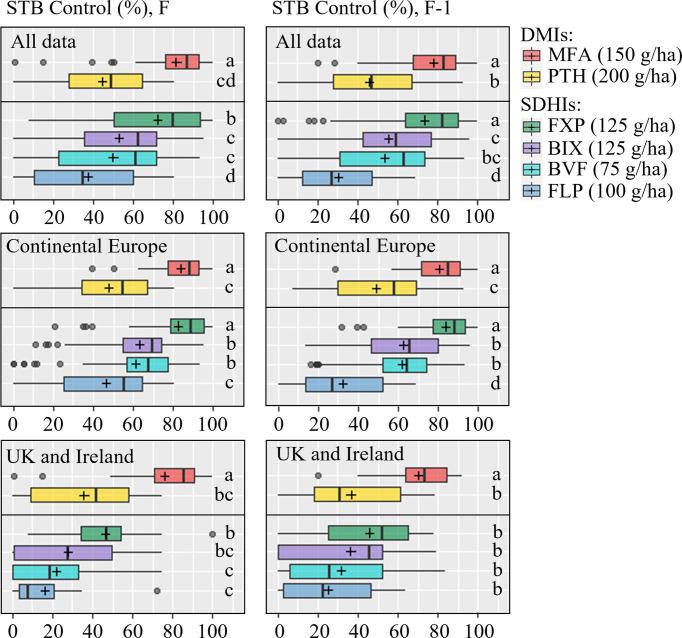
Septoria tritici blotch (STB; ) is a severe leaf disease on wheat in Northern Europe. Fungicide resistance in the populations of is increasingly challenging future control options. Twenty-five field trials were carried out in nine countries across Europe from 2019 to 2021 to investigate the efficacy of specific DMI and SDHI fungicides against STB. During the test period, two single DMIs (prothioconazole and mefentrifluconazole) and four different SDHIs (fluxapyroxad, bixafen, benzovindiflupyr and fluopyram) along with different co-formulations of DMIs and SDHIs applied at flag leaf emergence were tested. Across all countries, significant differences in azole performances against STB were seen; prothioconazole was outperformed in all countries by mefentrifluconazole. The effects also varied substantially between the SDHIs, with fluxapyroxad providing the best efficacy overall, while the performance of fluopyram was inferior to other SDHIs. In Ireland and the UK, the efficacy of SDHIs was significantly lower compared with results from continental Europe. This reduction in performances from both DMIs and SDHIs was reflected in yield responses and also linked to decreased sensitivity of isolates measured as EC values. A clear and significant gradient in EC values was seen across Europe. The lower sensitivity to SDHIs in Ireland and the UK was coincident with the prevalence of SDH-C-alterations T79N, N86S, and sporadically of H152R. The isolates' sensitivity to SDHIs showed a clear cross-resistance between fluxapyroxad, bixafen, benzovindiflupyr and fluopyram, although the links with the latter were less apparent. Co-formulations of DMIs + SDHIs performed well in all trials conducted in 2021. Only minor differences were seen between fluxapyroxad + mefentrifluconazole and bixafen + fluopyram + prothioconazole; the combination of benzovindiflupyr + prothioconazole gave an inferior performance at some sites. Fenpicoxamid performed in line with the most effective co-formulations. This investigation shows a clear link between reduced field efficacy by solo SDHIs as a result of increasing problems with sensitivity shifting and the selection of several SDH-C mutations. The presented data stress the need to practice anti-resistance strategies to delay further erosion of fungicide efficacy.
小麦黄斑叶枯病(STB)是北欧小麦上的一种严重叶部病害。该病原菌群体中的抗药性对未来的防治选择构成了越来越大的挑战。2019年至2021年期间,在欧洲九个国家进行了25项田间试验,以研究特定的脱甲基抑制剂(DMI)和琥珀酸脱氢酶抑制剂(SDHI)类杀菌剂对小麦黄斑叶枯病的防治效果。在试验期间,测试了两种单一的DMI(丙硫菌唑和联苯三唑醇)和四种不同的SDHI(氟唑菌酰胺、吡唑萘菌胺、苯并烯氟菌唑和氟吡菌酰胺),以及在旗叶抽出时施用的不同DMI和SDHI复配制剂。在所有国家中,唑类杀菌剂对小麦黄斑叶枯病的防治效果存在显著差异;在所有国家中,丙硫菌唑的表现均不如联苯三唑醇。SDHI类杀菌剂的效果也有很大差异,总体上氟唑菌酰胺的防治效果最佳,而氟吡菌酰胺的表现不如其他SDHI。在爱尔兰和英国,SDHI的防治效果明显低于欧洲大陆的结果。DMI和SDHI防治效果的下降反映在产量反应上,也与以EC值衡量的病原菌分离株敏感性降低有关。在欧洲各地可以看到EC值存在明显且显著的梯度。爱尔兰和英国对SDHI的敏感性较低与SDH-C改变T79N、N86S以及偶尔出现的H152R的流行情况一致。病原菌分离株对SDHI的敏感性在氟唑菌酰胺、吡唑萘菌胺、苯并烯氟菌唑和氟吡菌酰胺之间表现出明显的交叉抗性,尽管与后者的联系不太明显。DMI + SDHI复配制剂在2021年进行的所有试验中表现良好。氟唑菌酰胺 + 联苯三唑醇与吡唑萘菌胺 + 氟吡菌酰胺 + 丙硫菌唑之间仅存在微小差异;苯并烯氟菌唑 + 丙硫菌唑的组合在某些地点表现较差。氟唑菌苯胺的表现与最有效的复配制剂相当。这项调查表明,由于敏感性转移问题增加,单独使用SDHI导致田间防治效果降低与几种SDH-C突变的选择之间存在明显联系。所提供的数据强调了实施抗药性策略以延缓杀菌剂防治效果进一步下降的必要性。




 Zotero 插件